Production Goods & Services

24hits

Narrow by category

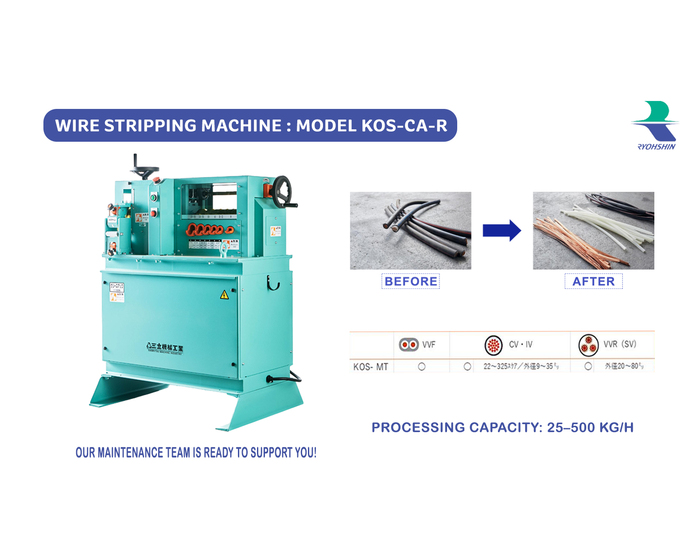
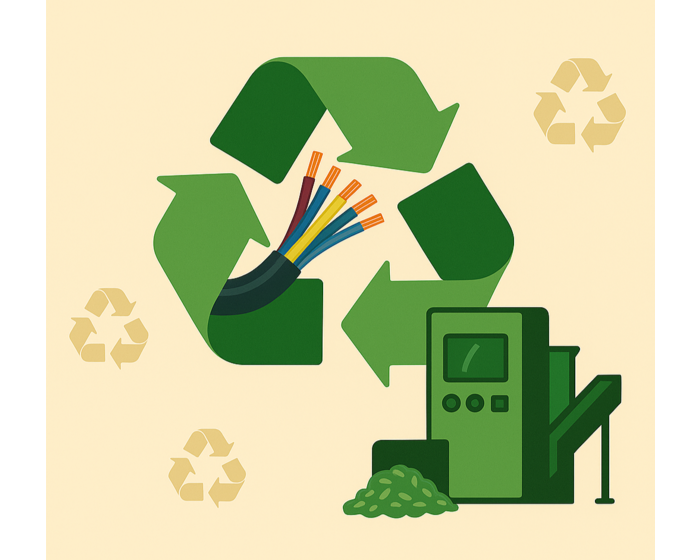
Cable & Wire Recycling Solution | Stripping, Granulating, and Cutting for Pure Copper Recovery

The Wire Stripping Machine is a recycling solution that transforms old or discarded cables into valuable resources by efficiently separating copper from insulation. This not only reduces waste disposal costs but also creates new profit opportunities for businesses, especially as copper prices remain at a high level. ■ Key Features - Durable and Reliable: High-quality Japanese-made machine with a robust design for continuous long-term use. - High Efficiency: Strips cables quickly and accurately, separating copper from insulation with ease, and supports various cable sizes. - User-Friendly and Safe: Designed with operator convenience and safety in mind, complying with Japanese safety standards. - Easy Maintenance: Local technical support in Thailand with after-sales service and spare parts available. ■ Specifications - Standard Model: KOS-CA-R - Applicable Cable Types: VVF, CV・IV (8–325 sq), VVR(SV) - Processing Capacity: 25 – 500 kg/h ■ Applications - Recycling waste cables from industrial plants, demolition, or construction sites - Copper recovery for resale in the scrap metal market - Reducing e-waste disposal costs while improving profitability - Scrap buyers, recycling companies, and waste management firms Looking for a cost-effective, safe, and profitable solution for your cable recycling needs? RYOHSHIN also provides a wide range of wire stripping machines, including cable shredders for copper separation. We are ready to offer full consultation and after-sales service. 📩 Download catalog PDF → https://prime.nc-net.com/105803/en/catalog/request/7305 📞 Contact our specialists → https://prime.nc-net.com/105803/en#contact #WireStripping #CopperRecycling #RyohshinThailand #RecyclingSolution #JapaneseTechnology #CircularEconomy

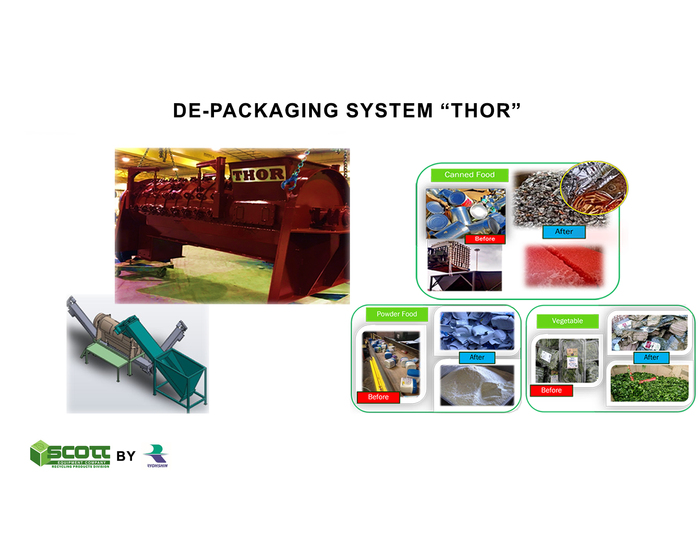
Turbo Separator|Food & Consumer Goods Waste Separation Solution

The Turbo Separator is a Depackaging System that precisely separates organic waste from packaging materials. It can process expired or deteriorated products by separating their contents from various types of packaging such as cans, bags, cartons, and multi-packs. The recovered contents can then be used for biogas, renewable energy, compost, or animal feed, while ensuring proper and hygienic waste management that reduces landfill dependency. At the same time, the separated packaging can be recycled to lower costs or sold to create new revenue streams—supporting the Sustainable Development Goals (SDGs). This machine is ideal for food manufacturers, shopping malls, airports, and public facilities that generate large volumes of food waste, as well as landfills, incineration facilities, waste management companies, or biogas plants. The separation system works by impact-based release, allowing food contents to be separated from packaging without shredding or tearing it into small pieces. It does not require water in the process (though water can be used if necessary). This achieves the following: - Organic material (food waste) → utilized for biogas, animal feed, or compost - Packaging (cans, bags, trays, etc.) → recycled or reused ■ Key Features - Impact-based separation: food contents are released without shredding or tearing the packaging - Separation accuracy up to 99%, producing organic material free from packaging contamination - Packaging remains intact enough to be recycled - Efficient and sustainable waste treatment ■ Specifications - Processing Capacity: 1–20 tons/hour - Main Structure: SUS316 stainless steel (1-inch thick) - Motor: 25–125HP, TEFC, 1800RPM (depending on model) - Operation Modes: Supports both Wet Kit and Dry systems ■ Industry Applications - Consumer goods and food manufacturing plants - Large-scale shopping malls - Airports, train stations, exhibition and event facilities - Public facilities and municipal waste management for large-scale food waste treatment - Gypsum and plasterboard factories (enables recycling of gypsum into pure gypsum powder) - Landfills, incineration facilities, waste management companies, and biogas production plants ■ Why Choose Turbo Separator? Turbo Separator helps eliminate the hidden costs of food waste management by turning waste into valuable resources. It increases recycling rates and supports the development of a Circular Economy and the achievement of the SDGs. 📞 Contact / Download Materials If you need to efficiently separate waste contents from packaging, Turbo Separator is the solution for effective and sustainable waste treatment. - 📩 Download the Turbo Separator catalog PDF→https://prime.nc-net.com/105803/en/catalog/request/8520 - 📞 Request free consultation or quotation→https://prime.nc-net.com/105803/en#contact #FoodWasteSeparation #Depackaging #FoodWasteManagement #Recycling #FoodCourt #CircularEconomy #SDGs #RyohshinThailand

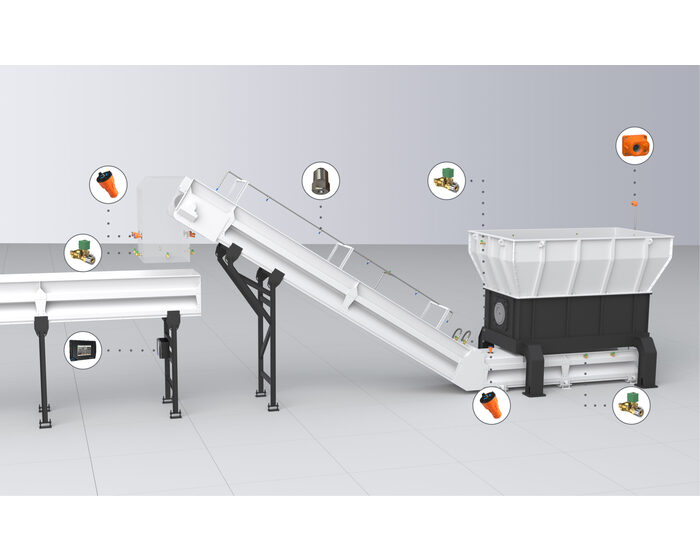
Firefly|Fire Prevention and Suppression System for Industrial Machines and Production Lines

Firefly is an intelligent fire protection system that detects sparks and flames within milliseconds and activates suppression instantly — minimizing damage to machines and production lines. Trusted by industries worldwide, it provides proactive protection against fire risks in manufacturing and recycling environments. Firefly is a Preventive Fire Protection System designed for industrial machinery, production lines, and recycling plants — especially those handling waste containing lithium batteries that pose explosion or fire risks. With advanced heat, spark, and flame detection technology, the system responds rapidly by automatically discharging water mist or spray to protect: - Machines and production lines - Employee safety - Production continuity ■ Key Features - Fast detection: Flame & spark detection within 0.3 seconds - Automatic suppression: Fire extinguishing begins within 3 seconds (maximum 5 seconds) - Full-cone water nozzles: Cover the entire material flow area - Water mist system: Designed for open areas and conveyor belt fire control - Durable design: Resistant to dust, light, and harsh industrial conditions - Low maintenance: Lens cleaning rarely required - User-friendly control: IntuVision™ touch-screen control system ■ Technical Specifications - Flame detector response time: 0.3 sec - Fire suppression activation: Within 3 sec (max 5 sec) - Spark detection: True IR Spark Detector (FM Approved) - Suppression method: Full-Cone Water Spray, Water Mist System - Control System: IntuVision™ Unified Control Interface - Certifications: FM, VdS, CSA, DNV, Bureau Veritas ■ Applications - Industrial production facilities with fire or spark risks - Waste and recycling plants handling combustible materials ✅ Summary Firefly is a total fire safety solution that effectively reduces fire risks in factories and machinery. With its ultra-fast detection, certified safety standards, and comprehensive suppression coverage, you can ensure the safety of your equipment, personnel, and production flow — minimizing costly downtime and damage. 📞 Contact & Download Ensure your production line runs continuously and safely with Firefly ShredderGuard™, the system that protects machinery and personnel from fire hazards and unplanned stoppages. - 📄 Download the Firefly Brochure (PDF)→https://prime.nc-net.com/105803/en/catalog/request/8519 - 📌 Request a Quotation or Free ROI Analysis→https://prime.nc-net.com/105803/en#contact #FireProtection #ShredderGuard #AutomaticFireSuppression #RecyclingPlant #FactorySafety #IndustrialSafety #Firefly

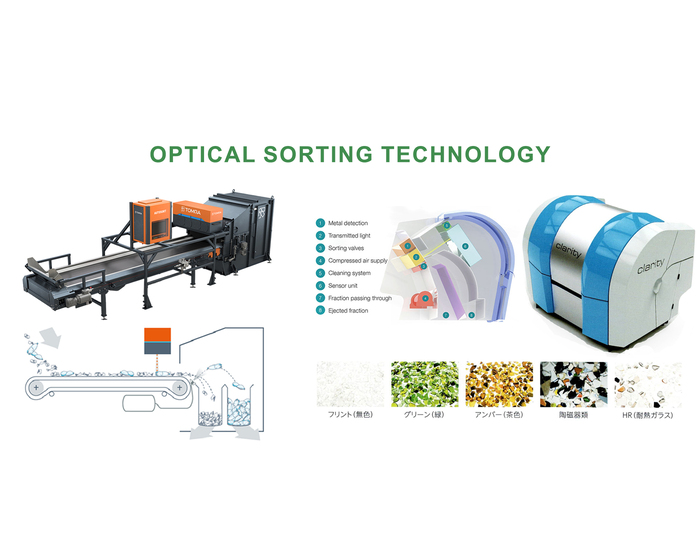
Optical Sorting Technology|Clarity & AUTOSORT for Enhanced Recycling Quality

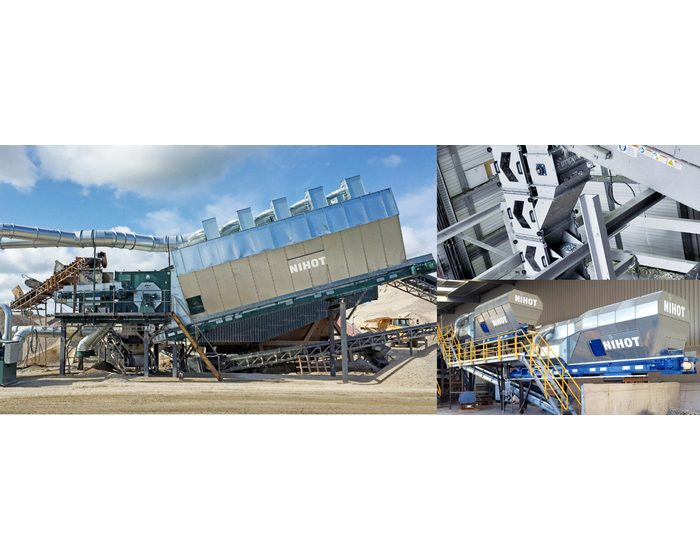
Clarity and AUTOSORT apply advanced Optical Sorting Technology to detect and separate materials with high precision. By distinguishing colors and materials in detail, they significantly improve recycling quality and RDF/RPF fuel value. Manual sorting is costly, error-prone, and unsuitable for industrial-scale operations. Optical Sorting Technology provides an efficient solution, and RYOHSHIN offers Clarity and AUTOSORT systems for accurate, high-speed material separation. ■ Clarity – Material Color Sorting Clarity combines a high-resolution color camera with multiple sensors (Color Camera, UV, NIR, Metal Sensor) to detect materials as small as 1 mm and classify up to 2,000,000 colors. It removes small impurities such as stones, ceramics, metals, and heat-resistant glass. The high-speed Air Valve (0.003 sec response) minimizes material loss. Clarity is ideal for sorting glass, ceramics, stones, sand, and similar materials. ■ AUTOSORT & AUTOSORT SPEEDAIR AUTOSORT uses Optical Sorting Technology to analyze materials, colors, and shapes in real-time, enabling efficient recycling across multiple material types. AUTOSORT SPEEDAIR is designed for lightweight and high-volume materials such as films and thin plastics, using an air-based system to maintain continuous sorting in production lines. ■ Key Features 1. Clarity – Optical Color Sorter - Supported Materials: Glass, ceramics, stones, sand, and similar materials - Precision: Detects down to 1 mm, sorts up to 2,000,000 colors - Benefits: Improves recycling quality; recovered materials may have higher resale value 📩 More Information: Download the Clarity brochure →https://prime.nc-net.com/105803/en/catalog/request/8518 2. AUTOSORT SPEEDAIR – Optical Sorter - Supported Materials: Plastics, paper, light metals, films - Precision: High-speed optical sorting for lightweight materials - Benefits: Designed for films and thin plastics in continuous production lines 📩 Benefits: Designed for films and thin plastics in continuous production lines →https://www.ryohshin.co.jp/products/products4659/ ■ Applications 1. Clarity – Optical Color Sorter - Glass color sorting (clear, green, amber, etc.) - Removal of impurities during separation 2. AUTOSORT SPEEDAIR – Optical Sorter - Sorting plastics (PET, PE, PP, etc.) - Sorting paper, light metals, and other lightweight materials ✅ Conclusion If you aim to reduce contamination and improve recycling quality, RYOHSHIN provides consultation, design, and installation of cost-effective, high-precision Optical Sorting systems. - 📩 Download Catalog (PDF)→https://prime.nc-net.com/105803/en/catalog/request/8518 - 📞 Request a Consultation with Our Specialists→https://prime.nc-net.com/105803/en#contact #OpticalSorting #Clarity #AUTOSORT #GlassSorting #PlasticRecycling #RDF #RPF #RyohshinThailand
Air Separator with Dust Collector|Material Separation Solution for Recycling Plants

The Air Separator accurately separates light and heavy materials, and comes equipped with a Dust Collector to minimize dust emissions. It is ideal for recycling plants and RDF production lines that require improved fuel quality and a cleaner working environment, with a maximum processing capacity of 200㎥/hour. ■ Key Features 1. Accurate Light-Heavy Material Separation Efficiently separates plastics, films, foils, and paper from glass and metals. 2. Reduced Dependence on Manual Sorting Cuts labor costs and minimizes human error in waste sorting. 3. High Processing Capacity – up to 200㎥/hour Suitable for large-scale RDF/RPF production and recycling operations. 4. Integrated Dust Collector Captures dust and reduces environmental impact within the plant. 5. Multiple Models Available - SDS: Two-stage separation system with high capacity for continuous operation - SDI: Compact model for space-limited facilities - ZIGZAG: Multi-stage separation system ideal for fine and lightweight materials ■ Specifications - Processing capacity: Up to 200㎥/hour - Applicable materials: MSW, C&I Waste, plastics, paper, foils, wood scraps - Available models: SDS, SDI, ZIGZAG ■ Applications - RDF/RPF production lines - MSW and C&I waste recycling plants - Recycling of plastics, foils, and paper If you need to separate waste materials with different densities while maintaining a clean plant environment, the Air Separator from RYOHSHIN is the solution. It enhances RDF/RPF fuel quality while minimizing dust impact on your facility. - 📩 Download Catalog (PDF)→https://prime.nc-net.com/105803/en/catalog/request/7312 - 📞 Request Consultation with Our Specialists→https://prime.nc-net.com/105803/en#contact #AirSeparator #RDF #RPF #RecyclingTechnology #DustCollector #CircularEconomy #RyohshinThailand

RDF Fuel Production System | Transforming Waste into Energy with Japanese Technology

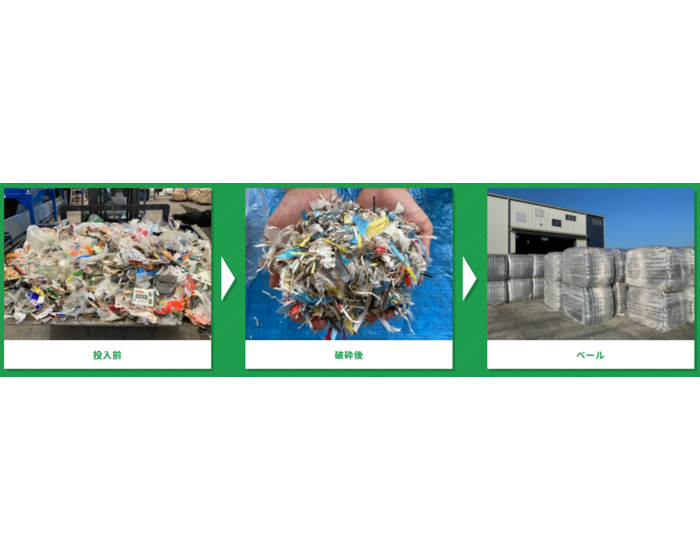
The RDF fuel production system utilises advanced Japanese recycling technology to convert municipal and industrial waste into high-quality solid fuel. This solution reduces CO₂ emissions and energy costs while supporting Thailand's move toward sustainable industrial practices. ■ What Is RDF Fuel? Refuse-Derived Fuel (RDF) is a high-calorie alternative fuel made from non-recyclable waste. It can replace coal in energy-intensive industries such as cement plants, steel mills, and paper factories. RDF fuel production offers a circular solution by turning waste into energy, reducing landfill usage, and supporting ESG targets. ■ Features of RDF Fuel Production Technology ✅ CO₂ Emission Reduction – Switching from fossil fuels to RDF fuel helps reduce greenhouse gas emissions. ✅ Lower Energy Costs – Using waste as fuel lowers operating costs for factories. ✅ High-Efficiency Waste Treatment – Shredding and sorting processes are optimised for fuel purity. ✅ Versatile Waste Handling – Processes various waste types, including industrial waste, for stable RDF output. ✅ Efficient Logistics – Hexagonal bale compression ensures space-saving storage and transport. ■ Step-by-Step RDF Fuel Production Process 1️⃣ Dual-Shaft Shredder – Handles hard-to-shred items such as fishing nets and ropes. 2️⃣ Primary Shredder – Reduces waste to 150–250mm for improved downstream processing. 3️⃣ Vibrating Separator – Removes sand and debris, reducing processing load. 4️⃣ Air Separator – Isolates lightweight combustible materials for fuel use. 5️⃣ Magnetic & Aluminium Separator / Manual Sorting – Extracts metals and recyclables. 6️⃣ Optical Separator – Removes chlorine and metallic content for cleaner RDF fuel. 7️⃣ Secondary Shredder – Achieves capacities of up to 12 tons/hour (<20mm) or 20 tons/hour (<40mm). 8️⃣ Hexagonal Bale Compression & Packaging – Enhances transportation and storage efficiency. ■ Why Invest in RDF Fuel Production? 🌱 Achieve carbon neutrality targets (Net Zero 2050) 💰 Reduce fuel procurement costs 🔄 Support circular economy initiatives ♻ Improve waste management efficiency 🔧 Increase operational sustainability in Thai industry Advanced RDF technology supports Thailand’s shift toward a sustainable, low-carbon economy, while delivering cost-effective waste-to-energy solutions for industrial users. If you are looking for an advanced RDF fuel production system to reduce energy costs and improve waste management efficiency, RYOHSHIN is ready to provide technical consultation and tailored solutions for your industry. 📩 Download the PDF Catalog → https://prime.nc-net.com/105803/en/catalog/request/7309 📞 Contact Our Specialists → https://prime.nc-net.com/105803/en/product_others/detail_goods/24957#contact #RDFFuel #WasteToEnergy #RecyclingTechnology #JapaneseMachines #SustainableIndustry #ESG #NetZero2050 #IndustrialWaste #AlternativeFuel #CircularEconomy

Glass Recycling System | Turning Used Glass into High-Quality Recyclable Cullet

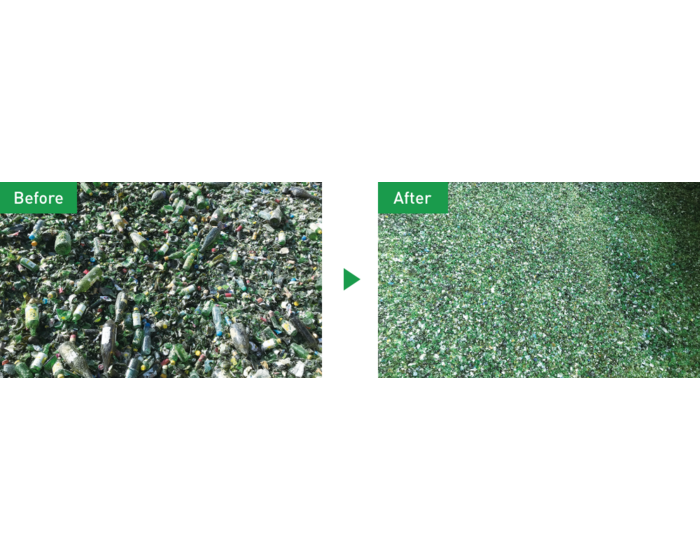
Glass recycling systems developed with Japanese technology enable the transformation of used glass into high-purity cullet, reducing manufacturing costs, CO₂ emissions, and natural resource use. This closed-loop system supports Thailand’s sustainable industrial development and circular economy goals. ■ Why Glass Recycling Is Essential Glass is one of the few materials that can be recycled endlessly without degradation in quality. By turning used glass into cullet (recycled glass granules), industries can significantly lower energy use in production, reduce raw material costs, and decrease environmental impact. ■ Key Features ✅ Lower Raw Material & Energy Costs – Cullet melts faster than virgin raw materials, saving ~25% energy ✅ Lower CO₂ Emissions – Melting cullet emits ~28% less CO₂ compared to traditional processes ✅ Advanced Sorting System – Automatically classifies glass by colour/type and removes impurities ✅ Conserves Natural Resources – Reduces use of silica sand, limestone, and soda ash ✅ Supports Closed-Loop Recycling – Glass can be recycled endlessly within the same production loop ■ How Cullet Benefits Production 1️⃣ Cost Reduction - Reduces melting temperature → saves energy - 100% cullet = only 75% of the energy needed vs traditional raw materials - Results in lower fuel and material costs in glass production 2️⃣ Environmental Impact - Shorter melting time → ~28% CO₂ emission reduction - Supports corporate ESG goals and carbon neutrality initiatives ■ Ideal Applications - Glass bottle manufacturers - Construction material producers (glass-blended bricks, tiles) - Waste management and recycling centres - Beverage and food manufacturers using glass packaging This system enhances recycling efficiency, promotes cleaner production practices, and enables high-purity cullet recovery for reuse in industrial applications. If your business is seeking a reliable glass recycling system to cut costs, reduce CO₂ emissions, and achieve high-purity cullet recovery, RYOHSHIN can provide tailored solutions and technical expertise. 📩 Download the PDF Catalog → https://prime.nc-net.com/105803/en/catalog/request/7311 📞 Contact Our Specialists → https://prime.nc-net.com/105803/en/product_others/detail_goods/24961#contact #GlassRecycling #CulletRecovery #RecyclingTechnology #CO2Reduction #CircularEconomy #SustainableManufacturing #JapaneseMachinery #GlassProcessing #IndustrialRecycling #GreenFactory

Shredder Series for Industrial Waste | Enhancing Productivity with Japanese Shredding Technology

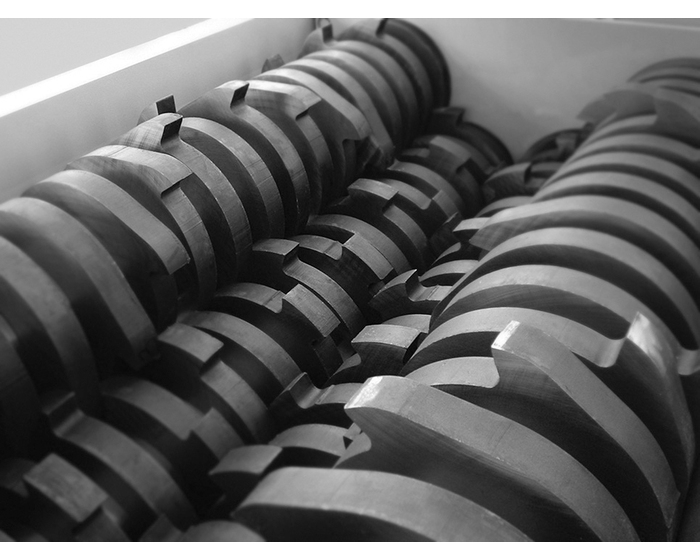
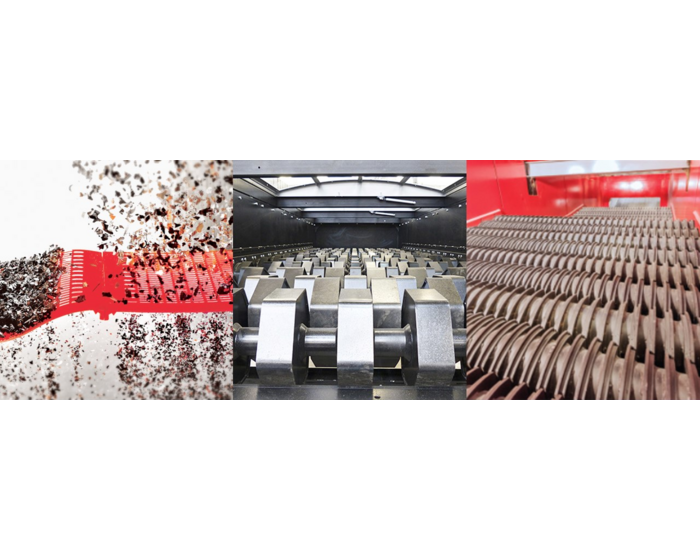
The Shredder Series offers a full range of industrial shredders—from single-shaft to mobile models—engineered to meet diverse material types and processing needs. Powered by Japanese technology, these shredders ensure efficient waste management, cost savings, and increased system productivity. ■ Why Use Industrial Shredders? Industrial shredders are vital for crushing and processing metals, plastics, textiles, paper, and general waste. They help streamline recycling, reduce waste volume, and enhance material recovery for reuse. Selecting the right shredder improves operational efficiency and supports sustainable waste handling. ■ Key Features of the Shredder Series ✅ Wide Model Selection – Choose from single, dual, four-shaft, primary, or mobile types ✅ High Throughput – Efficient shearing design for large-volume processing ✅ Energy-Saving Design – Uses high-efficiency motors to reduce power consumption ✅ Foreign Object Protection – Built-in clutch and torque control minimise equipment damage ✅ Easy Blade Replacement – Maximises uptime and maintenance efficiency ■ Types of Shredders & Applications 1️⃣ Single-Shaft Shredder - Precise shredding with high-speed rotor and built-in screen - Ideal for fine, consistent particle output 🔧 Recommended Models: Jupiter, Polaris, Comet, Micromat, Universo 2️⃣ Dual-Shaft Shredder - High torque and strong shearing force - Suitable for ropes, FIBC bags, fishing nets, and hard-to-shred waste 3️⃣ Four-Shaft Shredder - Excellent control of output size with dual screens - Used for complex materials requiring high precision 4️⃣ Primary Shredder - Produces coarse shredded material (~200–250mm) - Ideal for initial waste size reduction in RDF and recycling systems 5️⃣ Mobile Shredder - Fully portable unit with 770 HP engine - Handles up to 50 tons/hour - Perfect for disaster waste, landfills, or on-site operations ■ Optimise Your Waste Processing Line The right shredder improves productivity, reduces energy usage, and enhances overall system performance. Our shredders are tailored for Thai industry needs, supporting circular economy goals and environmental compliance. If your facility is seeking a high-efficiency shredding solution to boost recycling capacity, reduce costs, and handle diverse waste streams, RYOHSHIN offers customised industrial shredders designed to match your operation. 📩 Download the PDF Catalog → https://prime.nc-net.com/105803/en/catalog/request/7308 📞 Contact Our Specialists → https://prime.nc-net.com/105803/en/product_others/detail_goods/24976#contact #IndustrialShredder #WasteProcessing #JapaneseTechnology #RDFSystem #ShredderThailand #RecyclingMachinery #DualShaftShredder #PrimaryShredder #MobileShredder #CircularEconomy

High-Precision Metal Separator | For Pure Iron Recovery and Efficient Recycling

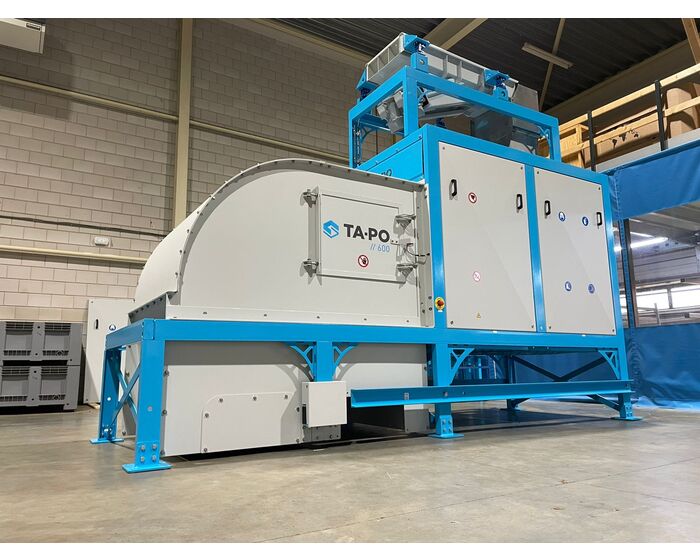
Our Japanese-engineered high-precision metal separator enables the extraction of Clean FE (pure iron) with less than 0.3% copper content, streamlining recycling operations while reducing labour needs. This technology supports efficient resource recovery and contributes to cleaner industrial processes in Thailand. ■ What Is a High-Precision Metal Separator? It is an advanced sorting machine that separates magnetic materials into two groups: - Clean FE – 100% magnetic, reusable, high-purity iron - FE+MIX – Partially magnetic materials containing contaminants This system improves sorting precision, increases throughput, and reduces the manual labour typically required to extract pure iron from mixed scrap. ■ Key Features ✅ High-Purity Iron Output – Clean FE contains less than 0.3% copper ✅ Reduced Manual Labour – Automatically separates cables, motors, and batteries ✅ Low Maintenance Design – Minimal consumables, with belt replacement in just 30 minutes ✅ Compact and Scalable Models – From 5 to 40 tons/hour processing capacity ✅ Ideal for Various Metal Recycling Lines – Appliance, automotive, or motor scrap ■ Product Models 1️⃣ TA-P 600 (Compact Model) - Size: W1,820 × L4,775 × H3,630 mm - Capacity: ~5 tons/hour - Input Size: Max. 150 mm 2️⃣ TA-P 1000 (High-Capacity Model) - Size: W1,660 × L10,790 × H3,400 mm - Capacity: ~40 tons/hour - Input Size: Max. 150 mm ■ Applications - Sorting magnetic scrap from magnetic separators - Home appliance recycling lines - Automotive and motor scrap recovery - Enhancing resource purity in heavy industries ■ Why Choose This Solution? 🧲 Improve iron recovery with <0.3% copper contamination 🔧 Minimise downtime and maintenance costs 💼 Reduce sorting labour and increase operational efficiency 🌱 Support ESG and sustainable resource recovery goals Our high-precision magnetic separator is designed to improve profitability, purity, and productivity in industrial recycling. Looking to recover high-purity Clean FE iron with minimal labour and maximum efficiency? RYOHSHIN provides advanced high-precision metal separators tailored to your recycling operations. 📩 Download the Product PDF → https://prime.nc-net.com/105803/en/catalog/request/7303 📞 Contact Our Specialists → https://prime.nc-net.com/105803/en/product_others/detail_goods/24987#contact #MetalSeparator #MagneticSorting #CleanFE #CopperFreeIron #HighPrecisionSeparator #RecyclingTechnology #JapaneseMachines #ResourceRecovery #IndustrialRecycling #CircularEconomy

Screening Technology for Industrial Waste | Prevents Clogging and Maximizes Sorting Accuracy

Advanced screening systems with urethane screens are engineered to prevent clogging, especially when handling high-moisture materials. These high-precision solutions enhance sorting performance, boost material recovery, and support more efficient recycling operations in Thailand’s industrial sector. ■ Why Screening Matters in Waste Processing Efficient separation of materials by particle size is essential for downstream processing and recycling. Conventional screens often clog when processing moist or fibrous waste. Our Japanese-engineered urethane screening systems maintain high throughput and stable operation, even with challenging materials. ■ Key Features ✅ Anti-Clogging Design – Urethane screens eliminate clogging, even in moist conditions ✅ High-Precision Separation – Consistent particle sizing improves downstream material quality ✅ High-Volume Throughput – Built to handle large-scale industrial and municipal waste ✅ Air Separator Integration – Enhances efficiency and recovery rates when combined with air separation systems ✅ Flexible Configurations – Available in multiple screen types to suit diverse waste streams ■ Types of Screening Machines 1️⃣ Vibrating Screen - Uses vibratory motion to classify materials by size - Excellent for the precise separation of fine particles - Common in RDF fuel systems and resource recovery plants 2️⃣ Disc Screen DS - Anti-wrapping design prevents films, ropes, and flexible materials from jamming the system - Ensures consistent performance during continuous operation 3️⃣ Disc Screen DRS - Special design minimises material buildup and clogging - Provides highly accurate separation, ideal for high-efficiency sorting lines ■ Why Choose Our Screening Technology? 🛠 Reduce downtime from clogging-related disruptions 🔍 Improve material recovery rates through precision screening 🌿 Support ESG and circular economy goals through efficient resource separation 🔧 Integrate easily into existing sorting and recycling systems Our urethane-based screening systems deliver long-term reliability, operational stability, and optimised performance, making them ideal for industrial waste processing in Thailand. If your facility needs a screening solution that prevents clogging, handles moist waste, and ensures high sorting accuracy, RYOHSHIN can help configure the ideal urethane-based system for your recycling operations. 📩 Download the PDF Catalog → https://prime.nc-net.com/105803/en/catalog/request/7306 📞 Contact Our Specialists → https://prime.nc-net.com/105803/en/product_others/detail_goods/24985#contact #ScreeningTechnology #WasteSorting #IndustrialRecycling #AntiCloggingScreen #UrethaneScreen #DiscScreen #RecyclingPlant #JapaneseMachinery #CircularEconomy #SortingEfficiency

TKK-TBR-120 Waste Compactor | CO₂ Reduction & Transport Optimization for Industrial Waste

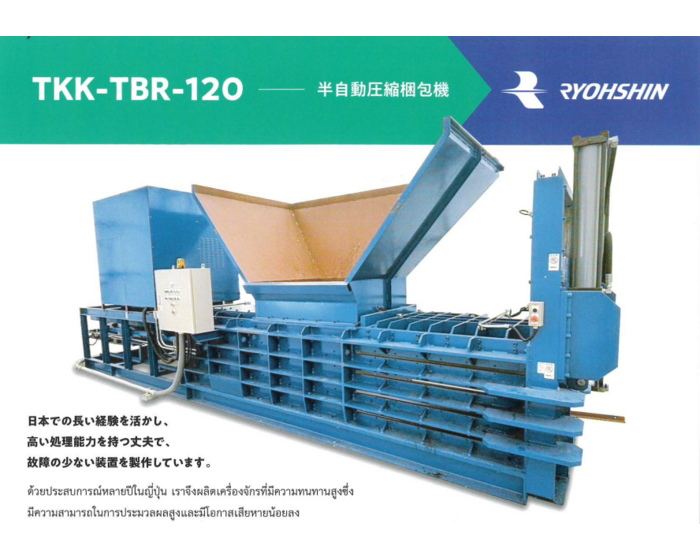
The TKK-TBR-120 is a high-performance, semi-automatic industrial waste compactor designed in Japan. It compresses bulky waste into dense bales, reducing transport volume, lowering CO₂ emissions, and cutting logistics costs, making it an ideal eco-friendly solution for industrial waste management in Thailand. ■ Why Industrial Waste Compression Matters Managing bulky industrial waste is costly and inefficient. By compressing materials like metal scraps, plastics, and paper into compact bales, this machine minimises transport trips, improves logistics efficiency, and reduces carbon emissions, while delivering long-term savings. ■ Key Features of the TKK-TBR-120 ✅ High-Efficiency Compression – Large-capacity hopper handles high-volume waste with fast cycle times ✅ Cost & CO₂ Reduction – Less volume = fewer truckloads = lower transport costs and emissions ✅ Heavy-Duty Construction – Built with high-strength steel for maximum durability and longevity ✅ Semi-Automatic Operation – User-friendly design improves safety and reduces manual labour ✅ Ready for Thailand – Plans for local manufacturing and support hubs underway ■ Technical Specifications - Model: TKK-TBR-120 - Compression Force: 120 tons - Processing Capacity: 350–400 kg/hour (material-dependent) - Compression Chamber: 1200W × 750H × 1400L mm - Bale Size: 1000W × 750H × up to 1400L mm - Power: AC 200V, 3-phase - Machine Weight: ~6,200 kg ■ Ideal for ♻ Recycling plants & scrap yards 🏭 Industrial manufacturers (automotive, electronics, FMCG) 🗑 Waste management companies 🚛 Logistics & warehouse operators ■ Benefits 🔧 Long service life and low maintenance 🌿 Supports carbon neutrality and ESG goals 📦 Maximises storage and transport space efficiency TKK-TBR-120 is more than just a compactor—it’s an investment in clean, cost-effective waste handling. If your facility is seeking a high-performance compaction solution to cut transport costs, reduce CO₂ emissions, and improve industrial waste handling efficiency, RYOHSHIN can provide full technical support and tailored integration. 📩 Download the PDF Catalog → https://prime.nc-net.com/105803/en/catalog/request/7304 📞 Contact Our Specialists → https://prime.nc-net.com/105803/en/product_others/detail_goods/24974#contact #WasteCompactor #TKKTBR120 #IndustrialRecycling #CO2Reduction #LogisticsOptimization #JapaneseMachinery #RecyclingTech #WasteManagementThailand #SustainableManufacturing #EcoFriendlyIndustry

Gypsum Board Recycling System | Turning Construction Waste into Reusable Gypsum Powder

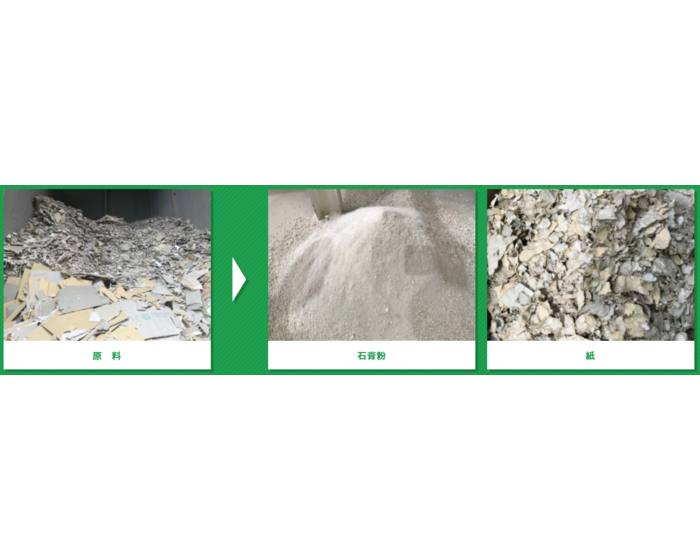
Our gypsum board recycling system transforms construction waste into high-quality gypsum powder through efficient separation, crushing, and impurity removal. This solution reduces landfill use, preserves natural gypsum resources, and supports low-carbon manufacturing in the building materials industry. ■ Why Recycle Gypsum Boards? Demolition waste from gypsum boards poses a major environmental challenge. Instead of landfilling, recycling these materials into reusable gypsum powder reduces CO₂ emissions and lowers raw material costs, while contributing to a sustainable supply chain in construction and cement production. ■ Key Features ✅ Raw Material Savings – Recycled gypsum replaces virgin material, lowering production costs ✅ CO₂ Emissions Reduction – Avoids emissions from landfill and new mining operations ✅ Natural Resource Conservation – Limits the need for gypsum mining and resource depletion ✅ High-Precision Metal Separation – Magnetic system removes nails and metals for cleaner powder ✅ Consistent Output Quality – Final sieving ensures stable particle size and product purity ■ Gypsum Board Recycling Process 1️⃣ Waste Conveyor System - Transports and performs rough crushing of used boards - Prepares materials for precise downstream processing 2️⃣ Gypsum Separator - Separates paper from gypsum - Enhances sorting accuracy and processing capacity 3️⃣ Magnetic Metal Separator - Extracts nails and metallic contaminants - Improves recycled gypsum quality 4️⃣ Vibrating Sieving Machine - Final particle size adjustment - Ensures high-purity and consistent gypsum powder for reuse ■ Suitable for: 🏢 Gypsum board manufacturers 🧱 Building materials producers 🏗 Construction firms with high waste output 🏭 Cement factories using gypsum as an additive ♻ Industrial recycling companies ■ Why Adopt This System? ♻ Improve resource circularity in the construction industry 🌿 Reduce waste and environmental burden 🧱 Lower raw material and transportation costs 📦 Deliver a cleaner, more sustainable gypsum supply chain Interested in adopting gypsum board recycling technology in Thailand? Let us help you configure the ideal system. If your business is looking for an advanced gypsum board recycling solution to reduce waste and produce high-purity gypsum powder, RYOHSHIN is ready to support you with tailored systems and technical expertise. 📩 Download the PDF Catalog → https://prime.nc-net.com/105803/en/catalog/request/7307 📞 Contact Our Specialists → https://prime.nc-net.com/105803/en/product_others/detail_goods/24959#contact #GypsumRecycling #ConstructionWaste #RecycledGypsum #BuildingMaterials #CementAdditive #JapaneseTechnology #CO2Reduction #SustainableConstruction #CircularEconomy #WasteProcessingTech

AI Sorting Robots | Automating Waste Separation with Precision AI for a Circular Economy

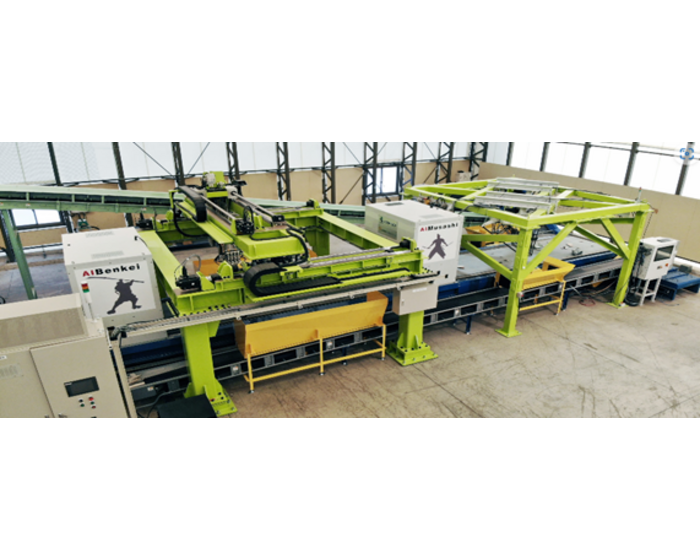
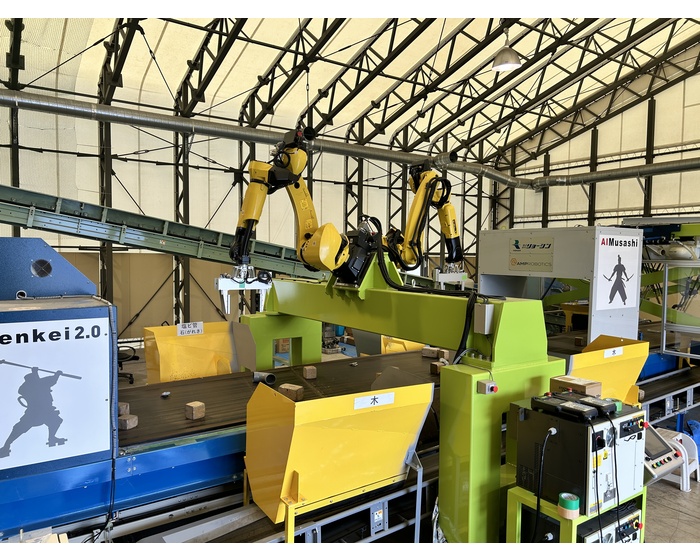
AI-powered sorting robots developed with Japanese technology replace manual waste sorting with advanced AI and robotic arms. These systems operate continuously, recognise over 50 types of materials, and deliver 98% accuracy, boosting recycling efficiency and addressing labour shortages in Thailand’s waste management sector. ■ Why Use AI Sorting Robots? Manual sorting is labour-intensive, inconsistent, and increasingly impractical. AI robots deliver reliable and precise identification of recyclables 24/7, helping reduce costs, improve throughput, and optimise material recovery, especially in high-volume industrial recycling lines. ■ Key Features ✅ AI-Based Vision Recognition – High-resolution cameras and algorithms ensure ultra-precise classification ✅ Unmanned 24/7 Operation – Minimises labour costs and supports stable production ✅ Vacuum Suction Arm – Lifts items up to 4.5 kg and supports six material streams ✅ AI Learning Engine – Continuously improves through real-time recognition data ✅ Customizable by Material Type – Trains AI to identify plastic cups, colored bottles, containers with residue, and more ■ Robot Models 1️⃣ AI Benkei – For Heavy Items - Single gripper with up to 20 picks/min - Handles weights of 5–15 kg - Best for construction waste, beverage containers - Accuracy: 98% - Installed globally: 100+ units - Setup time: 3 days - Runs 24 hours/day, all year 2️⃣ AI Musashi – For Lightweight Items - Dual grippers with combined 200 picks/min - Target weight: 0–0.45 kg - Supports 50+ material types - Ideal for mixed recyclables in sorting centres - Accuracy: 98% - Setup time: 3 days - Continuous operation: 365 days/year ■ Industrial Benefits 🤖 Reduce labour and risk in sorting environments ♻ Increase material recovery accuracy 📈 Maximise ROI through automation 🌱 Advance ESG and sustainability goals with AI-driven systems AI sorting robots are transforming the recycling industry—delivering automation, accuracy, and adaptability to Thailand’s evolving resource recovery needs. If your recycling facility is ready to boost efficiency, reduce labour costs, and achieve 98% sorting accuracy with AI Benkei and AI Musashi, RYOHSHIN provides tailored solutions and technical support to help you automate your waste sorting lines. 📩 Download the PDF Catalog → https://prime.nc-net.com/105803/en/catalog/request/7310 📞 Contact Our Specialists → https://prime.nc-net.com/105803/en/product_others/detail_goods/24978#contact #AISortingRobot #RecyclingAutomation #WasteSortingTech #SmartRecycling #JapaneseAI #SustainableTechnology #CircularEconomy #BenkeiMusashi #WasteManagementThailand #ESGRecycling

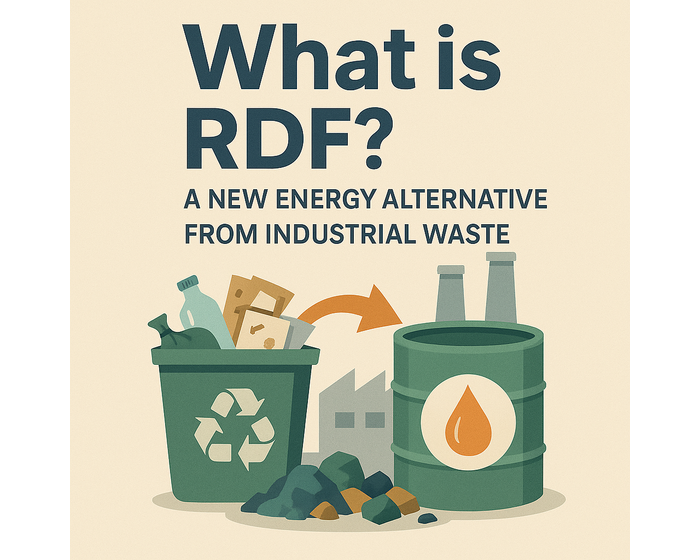
What is RDF? A New Energy Alternative from Industrial Waste

RDF, or Refuse Derived Fuel, is an alternative fuel produced from industrial waste through appropriate sorting and processing. It helps reduce waste volume and serves as a substitute for fossil fuels in production processes. _ _ _ ■ What is RDF? RDF (Refuse Derived Fuel) is a type of solid fuel derived from non-recyclable waste, especially industrial waste such as leftover plastic, packaging films, contaminated cardboard boxes, or composite materials that cannot be reused. The RDF production process involves sorting and size reduction of these materials, followed by processing them into ready-to-use fuel. The final product may appear as shredded pieces or compacted fuel briquettes, depending on the application. RDF can be used as a substitute for coal in industries that require high thermal energy, such as cement kilns, medium-sized power plants, or industrial boilers. _ _ _ ■ RDF Production Process and Raw Materials RDF is typically made from non-biodegradable industrial waste, including: - Used plastic films such as PE, PP, and PVC - Paper contaminated with oil or chemicals - Textiles or fabric scraps from production lines - Multi-material packaging waste that cannot be recycled The RDF production process includes: - Sorting: Removing unsuitable materials such as metals, glass, or hazardous substances - Size Reduction: Shredding materials into smaller pieces for easier combustion - Moisture Reduction: Drying to reduce moisture content for better calorific performance - Packing or Briquetting: Enhancing convenience in storage, transport, and usage The resulting RDF fuel typically has a calorific value between 4,000–6,000 kcal/kg, which is sufficient for most industrial combustion systems. _ _ _ ■ Benefits of RDF Compared to Other Fuel Types Using RDF as a replacement for fossil fuels offers several advantages, particularly in terms of environmental impact and operational cost: - Landfill Waste Reduction: Converts non-recyclable waste into usable energy - Energy Cost Savings: RDF is generally more cost-effective than coal or liquid fuels over time - Reduced Dependence on Fossil Fuels: Enhances energy security for industrial facilities - Supports ESG and Carbon Neutral Goals: Lowers CO₂ emissions and improves corporate environmental image However, it is important to note that RDF quality can vary depending on the raw materials and production control. Therefore, partnering with a high-standard and experienced RDF supplier is crucial. _ _ _ ■ The Growth of RDF Usage in Thailand Thailand has increasingly emphasised alternative energy derived from waste, particularly in industrial sectors, aiming to reduce energy costs and comply with stricter environmental regulations. RDF is now widely accepted in cement plants, waste-to-energy facilities, and heavy manufacturing industries that require continuous high-temperature energy. It has become a key enabler in transitioning toward a Circular Economy at the factory level. For more information, please contact us directly.

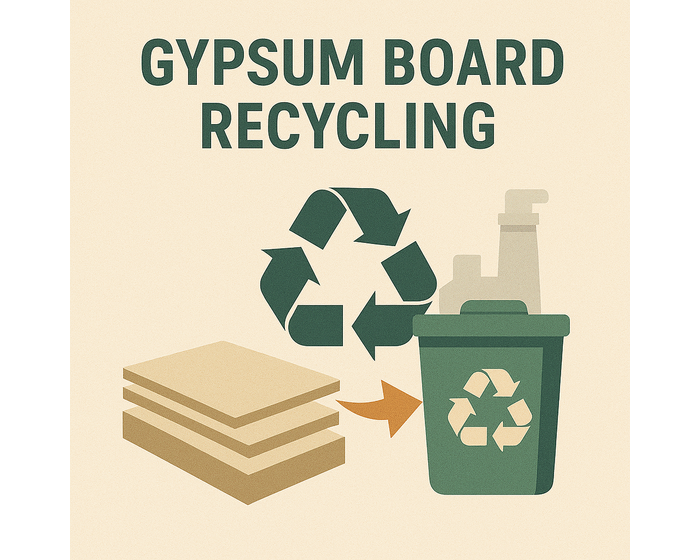
Gypsum Board Recycling: A New Industrial Solution for Construction Waste

Gypsum boards, once considered waste after demolition, can now be transformed into high-quality raw materials and reintegrated into the industrial cycle. Thanks to advanced recycling technology, businesses can reduce costs and environmental impact in a sustainable way. _ _ _ 1. The Growing Problem of Gypsum Waste in the Construction Industry With the rapid expansion of the construction sector, gypsum boards have become a widely used material for lightweight walls and ceilings due to their lightweight, ease of installation, and sound insulation properties. However, during renovation or demolition, large volumes of used gypsum boards are generated. In many cases, these materials are disposed of via landfill without proper separation or processing. This causes several problems: - Overloaded landfills - Methane gas emissions from paper layers in anaerobic conditions - Wasted gypsum mineral resources that could otherwise be reused _ _ _ 2. Why Gypsum Board Recycling Is a Smart and Sustainable Solution Gypsum board recycling involves separating paper, nails, and other contaminants from used boards to produce high-purity gypsum powder. This powder can then be reused in the production of new gypsum boards or in cement manufacturing processes. Key Benefits of Recycling Gypsum Boards: - ✅ Reduces the cost of acquiring new raw materials - ✅ Decreases the volume of landfill waste - ✅ Cuts CO₂ emissions from mining and waste disposal - ✅ Lowers reliance on natural gypsum resources - ✅ Supports the transition to a true circular economy _ _ _ 3. The Industrial Gypsum Recycling Process Modern recycling systems use automated, continuous technologies to efficiently process used gypsum boards in industrial settings. The standard process includes the following steps: 3.1 Conveying and Coarse Crushing Demolished gypsum boards are fed onto a conveyor and crushed using a screw-based system to reduce size and prepare for separation. 3.2 Separation of Paper and Gypsum Powder A specialised machine separates the paper layer from the gypsum content, with real-time control of powder output and purity. 3.3 Magnetic Metal Separation Nails, screws, and other metal debris are removed using a high-powered magnet, ensuring clean, contaminant-free recycled material. 3.4 Vibration Sieving for Particle Size Control The resulting gypsum powder is passed through a vibrating sieve to ensure it meets size and quality standards for industrial reuse. _ _ _ 4. Who Should Consider a Gypsum Recycling System? This recycling technology is ideal for various sectors within the construction and waste management industries, including: - Gypsum board manufacturers - Large-scale construction companies generate gypsum waste - Cement factories are looking for alternative raw materials - Waste management and recycling centres - Real estate developers focusing on ESG and sustainable practices Installing this system doesn’t just reduce operational costs—it also enhances environmental responsibility and long-term competitiveness. _ _ _ 5. Building a Sustainable Construction Industry with Japanese Technology Japan’s advanced gypsum recycling technology offers a highly accurate and efficient solution that is now available in Thailand. This system helps industrial users to: - Dramatically reduce landfill waste - Decrease dependency on imported raw materials - Enhance corporate sustainability image - Stay ahead of tightening environmental regulations In today’s competitive industrial landscape, it’s no longer just about production efficiency. Environmental accountability is now a key factor in business value. Recycling gypsum boards is one of the most practical first steps toward that goal. _ _ _ ■ Interested in Installing a Gypsum Recycling System? If you’re a manufacturer looking to reduce raw material costs or a construction firm seeking efficient waste management, we offer tailored gypsum board recycling solutions specifically designed for industrial applications in Thailand. For more information, please contact us directly.

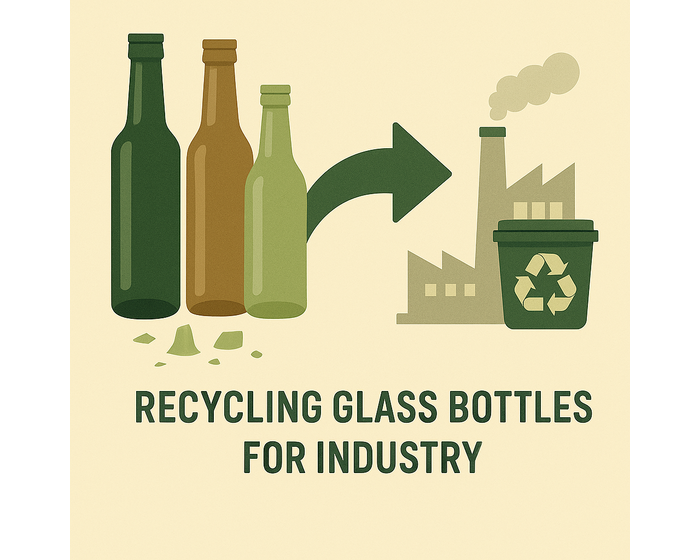
Glass Recycling A Sustainable Option for the Manufacturing Industry

Used glass is not waste—it is a valuable, renewable resource. With modern recycling technology, discarded glass can be transformed into high-quality raw materials, helping to reduce production costs, cut CO₂ emissions, and support the circular economy in Thailand’s industrial sector. _ _ _ 1. What is Glass Recycling? Glass recycling is the process of collecting used glass materials—such as bottles, packaging, and manufacturing scraps—and reusing them in the production of new glass products. Recycled glass is known as cullet, a clean and contaminant-free form of crushed glass. Cullet can be re-melted and reused as raw material for new bottles or in construction materials. Glass can be recycled infinitely without losing quality, making it one of the most sustainable materials available. _ _ _ 2. Industrial Glass Recycling Process With cutting-edge Japanese technology, modern glass recycling systems are equipped with automated processes designed for efficiency and consistency: - Automatic Sorting Systems Accurately sort glass by color and type using cameras and optical sensors. - Contaminant Removal Removes labels, caps, metal, plastic, and other impurities. - Crushing and Sizing Crushes the glass into appropriately sized cullet ready for melting. - Quality Inspection and Packaging Ensures high-purity cullet meets industry standards and is ready for reuse. _ _ _ 3. Why is Cullet So Valuable? Cullet is more than just recycled glass—it is a cost-saving, energy-efficient, and eco-friendly alternative to raw materials. ✅ Reduces Raw Material Costs - Cullet melts at lower temperatures than natural raw materials. - Up to 25% energy savings in glass production processes. ✅ Lowers CO₂ Emissions - Cullet melts faster, reducing energy consumption and CO₂ emissions by approximately 28%. - Contributes to carbon neutrality goals. ✅ Preserves Natural Resources - Decreases dependence on natural materials such as silica sand, limestone, and soda ash. - Supports sustainable resource management. _ _ _ 4. Industries That Benefit from Glass Recycling Glass recycling systems are ideal for a wide range of businesses and industries, including: - Glass bottle manufacturing plants - Beverage and food producers that rely on glass packaging - Construction material manufacturers using glass in products like lightweight bricks or tiles - Waste management and recycling companies - Hotels, restaurants, and retail chains that generate large volumes of used glass _ _ _ 5. Driving Sustainable Industry in Thailand with Japanese Technology RYOHSHIN is introducing high-precision Japanese glass recycling technology to Thailand, offering benefits such as: - Efficient processing of post-consumer and post-industrial glass waste - Reduced energy costs and lower CO₂ emissions - Enhanced corporate image and compliance with ESG and environmental standards - A closed-loop, sustainable raw material supply chain within Thailand With highly accurate sorting and cleaning systems, our solution ensures a stable supply of high-purity cullet for industrial reuse. _ _ _ Conclusion: Glass is a Resource, Not Waste Glass recycling is more than waste management—it is a forward-thinking solution that unlocks the full value of materials, reduces environmental impact, and strengthens industrial competitiveness. For more information, please download the PDF or contact us directly.

How to Recycle Waste Cables Effectively? | Solutions from Ryohshin (Thailand)

In the industrial world, waste electrical cables are generated in large volumes, whether from manufacturing lines, electrical system upgrades, or demolition work. While often discarded as trash, copper wires inside these cables still hold considerable value and can be recovered through proper cable recycling. But how do you recycle cables efficiently, safely, and sustainably? In this article, we introduce a highly effective solution from RYOHSHIN — an expert in cable recycling machines and industrial waste management. 🔍 What is Cable Recycling? Cable recycling is the process of separating insulation materials (e.g., PVC, PE) from internal copper wires, allowing the copper to be reused in various industries such as electronics, automotive, or metallurgy. Traditional recycling methods often rely on burning or chemical separation, both of which pose serious environmental and health risks. Ryohshin’s dry-type solution offers a safer and more efficient alternative, enabling copper recovery without the use of chemicals. ⚙️ Ryohshin’s Solution – Dry-Type Copper Separator Ryohshin’s cable recycling machine is designed to separate copper and insulation through a dry, mechanical process — no chemical treatment required. ✅ Key Advantages: - No chemicals used – safe for workers and the environment - Accurate separation of copper from insulation - Produces high-purity copper suitable for resale or reuse - No smoke or toxic fumes, unlike burning - Reduces labor time and waste disposal costs This system is ideal for manufacturers, recyclers, and contractors looking to recycle copper wires efficiently and responsibly. 🏭 Who Can Benefit? - Cable manufacturers or repair shops - Scrap dealers and recyclers - Demolition contractors - Automotive & machinery factories - Any facility with large volumes of electrical cables 💡 Why Invest in a Cable Recycling Machine? 1. Generate additional revenue from recycled copper 2. Lower disposal costs by processing cables in-house 3. Environmentally friendly – no burning or chemical emissions 4. Quick ROI through labour and material savings 5. Enhance the sustainability image of your business 📞 Interested in Cable Recycling Solutions? RYOHSHIN offers professional support for companies looking to turn waste into value. Whether you're handling production scraps or electrical demolition waste, we can help you implement an eco-friendly copper recycling system.

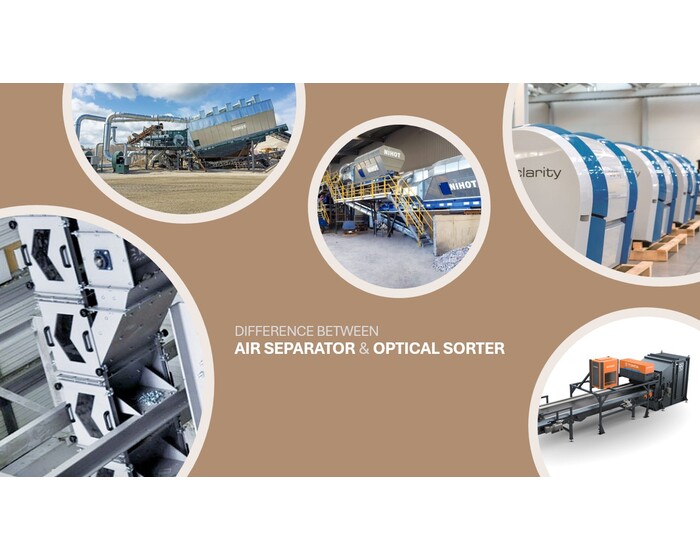
Waste Sorting: Air Separator vs Optical Sorter|How They Work and When to Use Each

Understand how Air Separators and Optical Sorters work, their benefits and limits, and how to choose the right one for your factory. This article covers all the practical basics for industrial waste sorting. 1. Why Sorting Matters in Recycling As industrial and municipal waste volumes rise, efficient sorting has become a crucial part of modern recycling. Proper separation at the source improves material purity, reduces labor costs, and increases the value of recovered materials. Waste sorting systems play a central role in this process. Two widely used technologies — air separation and optical sorting — each offer distinct advantages. This article explains how both systems work and when they are best used. 2. What is an Air Separator? An Air Separator uses airflow and gravity to separate light materials from heavier ones. It’s often used for initial sorting in recycling facilities. How it works: - Waste enters a chamber with controlled air pressure - Lightweight items (like film, paper) are blown upwards - Heavier items (like metal, glass) fall and are collected separately Advantages: - Simple design, low maintenance - Cost-effective for high volumes - Ideal for pre-sorting mixed waste Limitations: - Not suitable for materials with similar weights - Cannot sort by material type (e.g., PET vs. HDPE) 3. What is an Optical Sorter? An Optical Sorter identifies materials by scanning them with cameras and sensors. It can detect properties such as color or chemical composition and uses air jets to sort them precisely. How it works: - Materials move on a fast conveyor - Sensors scan each item in real time - Air jets sort materials into separate bins Advantages: - High precision — great for sorting plastics and packaging - Reduces contamination - Customizable for different materials Limitations: - Higher cost to install - Needs regular maintenance of cameras and sensors - Performance may drop if materials are dirty 4. Which System is Right for You? Air Separators are excellent for basic separation tasks — such as light vs. heavy waste — and are budget-friendly. Optical Sorters are better for advanced sorting needs like separating plastic types or improving purity for high-value recycling. Your choice should depend on your materials, accuracy goals, budget, and available space. 5. Why Choose RYOHSHIN for Sorting Systems RYOHSHIN Co., Ltd. specializes in advanced waste sorting systems for industrial use. Backed by Japanese technology, Ryohshin offers air separators, optical sorters, shredders, and full recycling system integration. Their one-stop service includes consultation, design, installation, and local maintenance support. Whether your factory needs basic separation or high-end automation, RYOHSHIN provides tailored solutions to boost recycling efficiency and quality. Download our product PDF or contact us for expert advice. #WasteSorting #AirSeparator #OpticalSorter #IndustrialRecycling #RecyclingTechnology #FactoryAutomation #PlasticSorting #RecyclingSystem #RyohshinThailand

AI Sorting Robots|Smart Automation That Transforms Recycling Efficiency

Discover how AI-powered sorting robots are reshaping recycling operations by improving accuracy, reducing labor costs, and advancing sustainability goals. Learn the technology behind intelligent material classification. 1. Why Automation Is Essential for Modern Recycling Challenges in the recycling industry—labor shortages, inconsistency in sorting, and rising costs—make automation a necessity. AI sorting robots provide scalable, efficient, and 24/7 solutions for waste management systems worldwide. 2. What Is an AI Sorting Robot? Using high-resolution cameras and artificial intelligence, these robots analyze material properties in real-time and automatically sort items using vacuum suction heads. Key Features: - Identifies 6+ types of recyclable materials - Up to 98% accuracy - Continuous operation (24/7/365) - Real-time learning and adaptability 3. Advantages Over Manual Sorting Compared to human labor, AI sorting robots offer greater speed (up to 200 pieces/min), accuracy (98%), safety, and operational uptime—resulting in lower costs and higher recycling rates. 4. Models for Industrial Needs AIBenkei – Ideal for heavy materials (5–15 kg), handles 20 items/min, installed in 100+ sites. AIMusashi – Ideal for lightweight materials, dual-heads sorting up to 200 items/min, recognizes 50+ types. Rapid setup within 3 days. 5. Supporting Environmental Sustainability AI sorting robots reduce landfill waste, boost recycling rates, and align with ESG and green factory initiatives. They help factories transition toward a circular economy. Looking for high-precision, scalable recycling solutions? AIBenkei and AIMusashi are the answer—AI-driven robots that handle light or heavy materials, operate 24/7, and seamlessly integrate into your facility. Transform your recycling process today. #AISortingRobot #RecyclingTechnology #SmartFactory #WasteManagement #SustainableAutomation #CircularEconomy #IndustrialAI #MaterialSorting #AIBenkei #AIMusashi

Clog-Free Vibrating Screens for Wet Waste|Ryohshin (Thailand)'s Efficient Sorting Solution

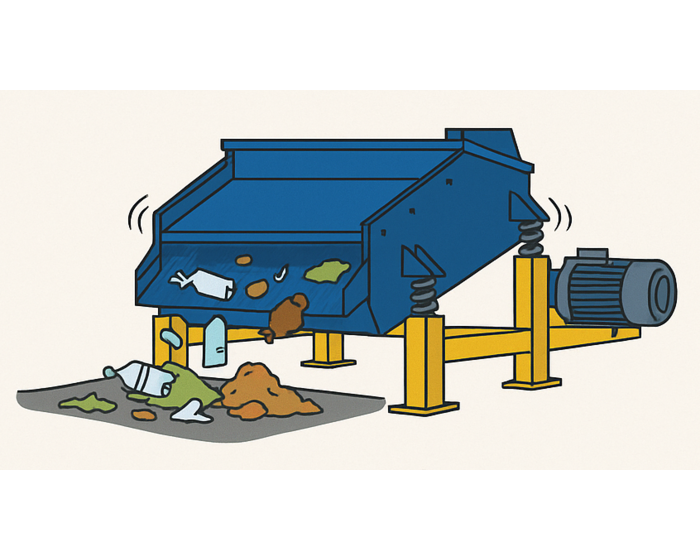
Vibrating screens from RYOHSHIN enable accurate, clog-free separation of wet and sticky materials — boosting recycling efficiency and reducing downtime in industrial plants. Accurate size separation is critical in modern recycling operations. Whether processing plastics, food waste, or films, materials often arrive wet or in mixed conditions. RYOHSHIN offers a reliable vibrating screen solution designed for continuous operation and superior separation, especially when dealing with high-moisture or sticky waste streams. 1. Importance of Vibrating Screens in Recycling Plants In recycling lines handling various materials like PET flakes, organic waste, or flexible films, vibrating screens help separate by size while preventing material buildup. The multidirectional vibration ensures a stable material flow, minimizing stoppages due to clogging — even with moist or tangled inputs. 2. Key Features of Ryohshin’s Vibrating Screening Technology ✅ Minimizes clogging with wet or sticky materials Perfect for post-wash plastics, food scraps, and flexible materials like film or wrap. ✅ Handles continuous, high-volume processing Built for medium to large recycling plants that need non-stop operation with minimal downtime. ✅ Adjustable vibration settings for various materials Customizable vibration frequency and amplitude accommodate different material types (e.g., PET, PP, film, ropes). ✅ Works with air separators for higher precision Pairs effectively with air separation systems to sort by weight and shape. 3. Real-World Applications Ryohshin’s vibrating screens are in use across industries: - Plastic recycling: Separating washed flakes, film, and pellets - Municipal waste: Sorting wet and dry components in a single line - Flexible material processing: Handling long, soft, or entangled waste like ropes and stretch wrap These screens help prevent clogging, which improves throughput and lowers maintenance time. 4. Why Choose RYOHSHIN RYOHSHIN is a leading expert in recycling machinery, known for its high-performance vibrating screening systems. Their use of polyurethane screen decks and adjustable vibration ensures long life, minimal clogging, and high sorting accuracy. Each unit is customized to suit the specific materials in your production line — reducing downtime and improving operational efficiency. If your factory processes wet waste, sticky materials, or requires continuous high-volume separation, Ryohshin’s Vibrating Screen is a solution worth considering. Download our product brochure or contact us for a free consultation. #VibratingScreen #RecyclingTechnology #WasteManagement #IndustrialScreening #RyohshinThailand #PlasticRecycling #WetMaterialSeparation #ContinuousOperation #RecyclingMachinery #OEM

1〜20件 / 24件

CONTACT

Inquiry

This is the inquiry form for RYOHSHIN Co., Ltd.. Please enter your inquiry.

This service is intended to provide consultation and opinion requests for processing projects.
Please do not use this information for self-promotion or sales activities.
If we receive a complaint from a recipient about the contents of the transmission, we may take measures such as forcibly stopping the use of the service.

Inquiry Type*Required
Message*Required
Attach file

Only image (jpeg, jpg, gif, png, pdf) and compressed file (zip, lzh) extensions are valid. Maximum file size 10MB