
MORIKAWA Co., Ltd. / T.I.T. ELECTRONICS CO., LTD.
SERVICE
Production Goods & Services
VOC Management in Manufacturing | Paint Booths vs Cleaning Lines
Product Info
🌟 Key Takeaways
• VOC behavior differs significantly between Paint Booths and Cleaning Lines, so one system should not be applied to both
• Paint Booths require emission and odor control due to very large airflow volumes
• Cleaning Lines generate high-concentration VOC suitable for recovery to reduce solvent costs
• Process-specific strategies help ensure regulatory compliance while remaining economically efficient
ーーーーーーーーーーーーーーーーーーーーーーーーーーーーーーー
In many industrial plants, VOC management is often simplified by applying a single system across the entire factory. In practice, this approach rarely works. Some processes meet regulations at high cost, while others reduce cost but fail to control VOC emissions.
The root cause is simple: VOC characteristics differ by process.
🔷 Process Differences: The Root of the Issue
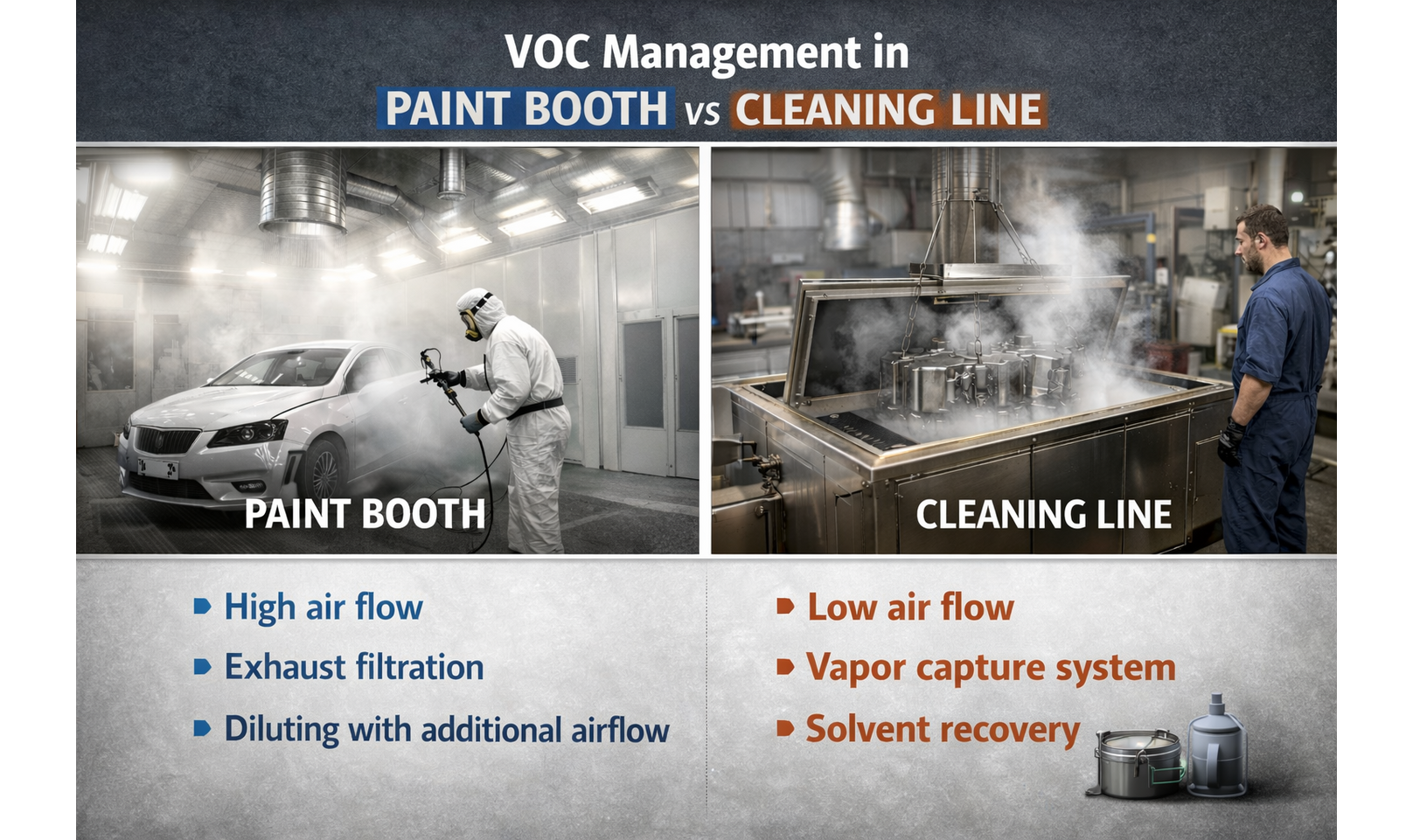
In Paint Booth operations, large airflow volumes are essential for safety, odor control, and surface quality. As a result, VOC is diluted in massive air volumes and generated continuously throughout production.
In contrast, Cleaning Line processes use solvents directly. VOC is generated from solvent evaporation in cleaning tanks, during system opening and closing, or during heated phases. Emissions occur intermittently and at significantly higher concentrations.
🔷 VOC Management Concept for Paint Booths
The primary objective in Paint Booths is to control VOC emissions, reduce odors, and comply with environmental regulations.
Because the airflow volume is extremely high, solvent recovery is not economically viable. Therefore, exhaust-based emission control systems are the most appropriate approach.
Key performance indicators include stack VOC concentration, odor levels, and airflow stability inside the booth.
🔷 VOC Management Concept for Cleaning Lines
For Cleaning Lines, the main objective is to reduce solvent loss and recover usable solvents.
Since VOC concentrations are high and solvent quality is often preserved, recovery and recycling systems are the preferred approach.
Key indicators include recovery rate, reduction in new solvent purchases, and cost per production unit.
🔷 Decision-Oriented Comparison (Conceptual)
• VOC characteristics: Diluted vs Concentrated
• Air volume: Very high vs Lower
• Emission pattern: Continuous vs Batch-based
• Primary objective: Emission control vs Recovery and cost reduction
• Key KPIs: Emission / Odor vs Recovery / Cost saving
From industrial experience, plants that separate VOC management strategies by process typically achieve better overall cost control. This approach avoids overinvestment where recovery is impractical and creates added value where solvent recovery is feasible.
🔷 Implications & Next Step: Hybrid Strategy
For factories operating both Paint Booths and Cleaning Lines, a hybrid strategy is recommended:
• High-airflow processes → focus on emission control
• High-concentration VOC sources → focus on recovery and recycling
This approach allows VOC management to go beyond mere regulatory compliance, supporting cost control and long-term sustainability.
📘 Summary
VOC management in Paint Booths and Cleaning Lines requires fundamentally different approaches. Process-based strategies enable factories to comply with regulations, control costs, and use resources efficiently.
📥 CTA
To translate these concepts into real-world applications, MORIKAWA Co., Ltd., with experience in industrial VOC management,
recommends reviewing the related Core Content and Advanced Knowledge topics below to support appropriate system design.
🔗 Cluster Internal Link
• Core Content: https://prime.nc-net.com/104303/en/product/detail/224959
• Basic Knowledge: https://prime.nc-net.com/104303/en/product_others/detail_goods/27704
ーーーーーーーーーーーーーーーーーーーーーーーーーーーーーーー
❓ FAQ
Q: Why is VOC recovery unsuitable for Paint Booths?
A: Because extremely large airflow volumes dilute VOC, making recovery economically impractical.
Q: How does VOC recovery benefit Cleaning Lines?
A: It reduces solvent loss, lowers new chemical purchases, and decreases cost per production unit.
Q: Where should factories start VOC planning?
A: By separating processes and understanding VOC characteristics at each stage.
📚 Glossary (Key Terms)
• VOC (Volatile Organic Compounds): Organic vapors generated from solvents in industrial processes
• Paint Booth: A spray coating system with controlled airflow
• Cleaning Line: A process that cleans parts using solvents
• Hybrid Strategy: A combined approach using different management methods for different processes
📖 Reference
• https://prime.nc-net.com/104303/en/product/detail/224959
🔒 Trust
This content has been technically reviewed by Tsuyoshi Morikawa
of MORIKAWA Co., Ltd. to ensure academic and industrial accuracy.
#VOC #VOCManagement #PaintBooth #CleaningLine #IndustrialVOC #ManufacturingProcess #AirEmission #SolventRecovery #EnvironmentalControl #IndustrialEngineering
📆 Updated: 2025-12-23
CATALOG
Related Catalogs
CONTACT
Inquiry