
MORIKAWA Co., Ltd. / T.I.T. ELECTRONICS CO., LTD.
SERVICE
Production Goods & Services
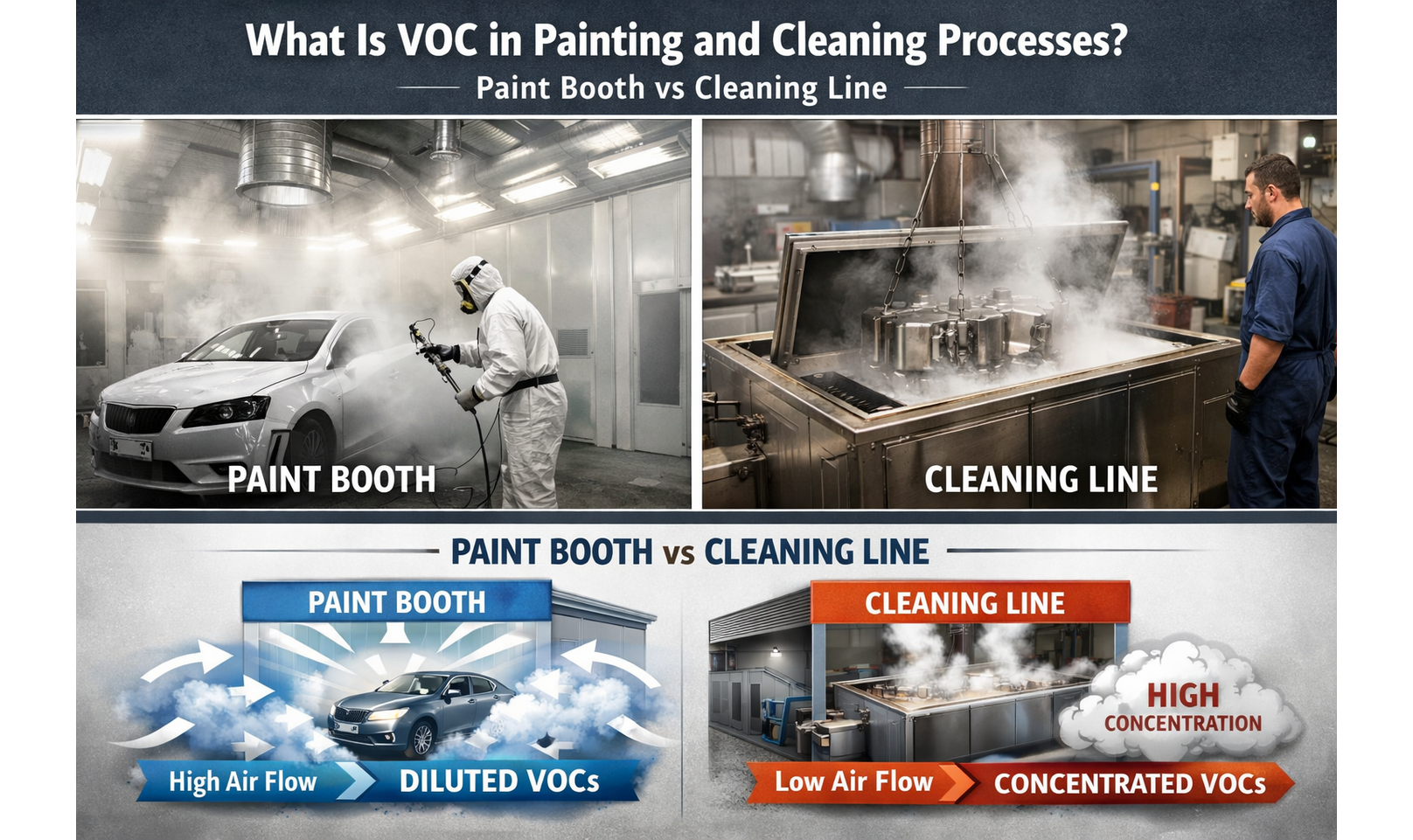
What Is VOC in Painting and Cleaning Processes? | Paint Booth vs Cleaning Line
Product Info
🌟 Key Takeaways
• VOC from painting and parts cleaning processes originate from different sources
• Paint Booths use large airflow, resulting in diluted but continuous VOC emissions
• Cleaning Lines generate higher VOC concentrations, suitable for recovery concepts
• Clear VOC classification helps select the correct management strategy
ーーーーーーーーーーーーーーーーーーーーーーーーーーーーーーー
In industrial manufacturing plants, many processes release Volatile Organic Compounds (VOC) into the atmosphere. Although they are commonly grouped under the term “VOC,” emissions from different processes behave very differently.
This is especially true when comparing Paint Booth operations and Cleaning Line processes. Understanding the origin and behavior of VOC in each process is the essential first step toward effective VOC management.
🔷 VOC Sources in the Paint Booth Process
VOC in Paint Booths mainly originates from solvents contained in paints and thinners. During spraying, part of the paint becomes overspray and evaporates immediately upon contact with air.
Paint Booth operations typically run continuously with production cycles and require very high airflow rates to control odor, safety, and coating quality.
🔷 Characteristics of VOC from Paint Booths
VOC from Paint Booths generally has low to medium concentration due to dilution by large volumes of air. However, emissions occur continuously throughout operation.
Because of these characteristics, VOC management for Paint Booths focuses primarily on emission control rather than solvent recovery.
🔷 VOC Sources in the Cleaning Line Process
VOC in Cleaning Lines is generated from solvent evaporation inside cleaning tanks, as well as from process activities such as opening and closing tank lids, parts transfer, and applied heat.
Evaporation does not occur continuously but rather in batches depending on the operation cycle.
🔷 Characteristics of VOC from Cleaning Lines
Although the airflow volume is lower than in Paint Booths, VOC concentrations in Cleaning Lines are significantly higher. In addition, many solvents still retain usable properties.
This makes VOC from Cleaning Lines highly suitable for recovery and recycling when an appropriate system is implemented.
🔷 VOC Comparison: Paint Booth vs Cleaning Line (Conceptual Overview)
• Source: Paint and thinner vs Cleaning solvents
• VOC concentration: Low–medium vs High
• Air volume: Very high vs Lower
• Emission pattern: Continuous vs Batch-based
• Management concept: Emission control vs Recovery and reuse
These differences clearly show that a single VOC treatment approach cannot be applied to all processes. System design should always reflect the actual VOC characteristics of each production stage.
📘 Summary
VOC emissions from Paint Booths and Cleaning Lines differ significantly in origin and behavior. Process-based understanding enables factories to select effective, compliant, and cost-efficient VOC management strategies.
📥 CTA
To deepen your understanding, MORIKAWA Co., Ltd., with extensive experience in industrial VOC management,
recommends exploring the related advanced articles below for practical application.
🔗 Cluster Internal Link
• Core Content: https://prime.nc-net.com/104303/en/product/detail/224959
• Advance Knowledge: https://prime.nc-net.com/104303/en/product_others/detail_goods/27705
ーーーーーーーーーーーーーーーーーーーーーーーーーーーーーーー
❓ FAQ
Q: How does VOC from Paint Booths differ from Cleaning Lines?
A: Paint Booth VOC is diluted by large airflow and occurs continuously, while Cleaning Line VOC is concentrated and batch-based.
Q: Which process has higher VOC recovery potential?
A: Cleaning Lines, due to higher VOC concentration and reusable solvent properties.
Q: Why shouldn’t one VOC system be used for all processes?
A: Because VOC sources and behaviors differ, affecting system efficiency and operating cost.
📚 Glossary (Key Terms)
• VOC (Volatile Organic Compounds): Organic vapors generated from solvents in industrial processes
• Paint Booth: A controlled area or system for spray coating operations
• Cleaning Line: A process that uses solvents to clean industrial parts
• Overspray: Paint particles dispersed into the air during spraying
📖 Reference
• https://prime.nc-net.com/104303/en/product/detail/224959
🔒 Trust
This content has been technically reviewed by Tsuyoshi Morikawa
of MORIKAWA Co., Ltd. to ensure academic and industrial accuracy.
#VOC #IndustrialVOC #PaintBooth #CleaningLine #VOCManagement #ManufacturingProcess #IndustrialEnvironment #AirEmission #SolventRecovery #EnvironmentalCompliance
📆 Updated: 2025-12-23
CATALOG
Related Catalogs
CONTACT
Inquiry