SERVICE
Production Goods & Services
8hits
Narrow by category
What Are VOCs? | Risks, Regulations, and REARTH® Recovery System for Industrial Emissions
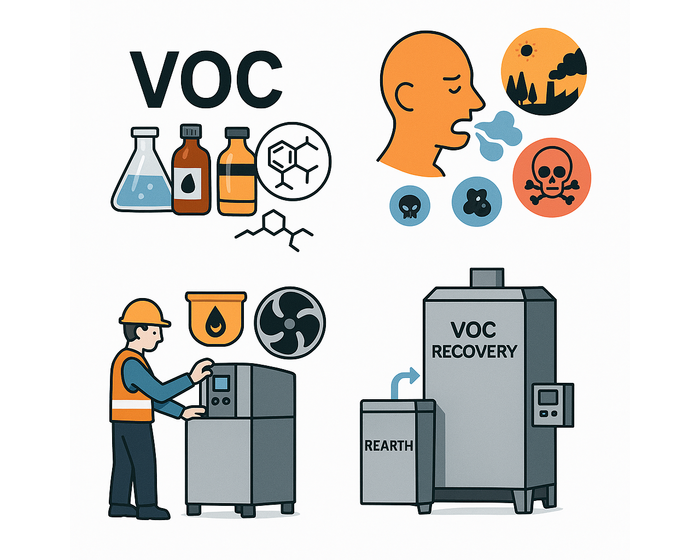
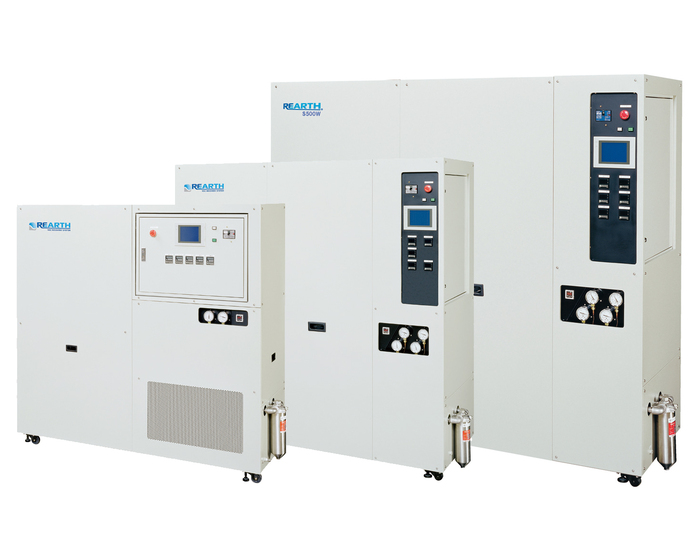
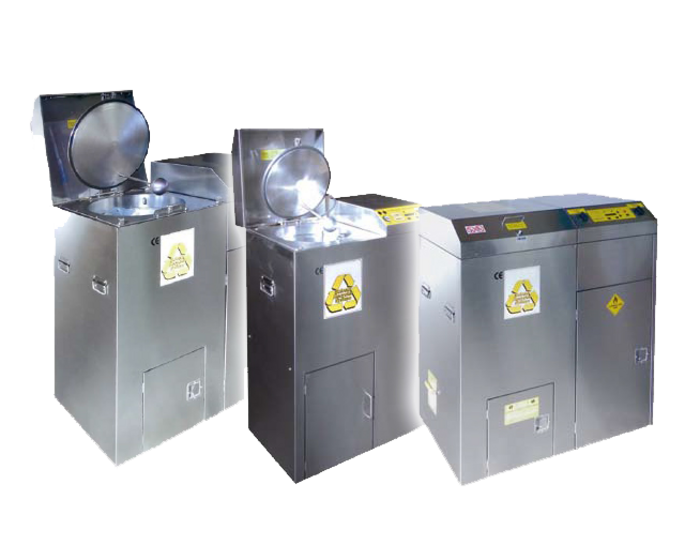
1. What Are VOCs? Volatile Organic Compounds (VOCs) are organic chemicals that easily vaporize at room temperature. They are commonly found in industrial solvents, coatings, adhesives, and cleaning agents, contributing to indoor and outdoor air pollution. Typical VOCs: - Toluene - Xylene - Acetone - Methanol - Isopropanol (IPA) - Formaldehyde Industries where VOCs are emitted: - Printing and electronics manufacturing - Paint and coating processes - Industrial cleaning - Adhesive use ======================== 2. Why VOCs Are a Serious Problem ● Health Hazards - Eye, skin, and respiratory irritation - Fatigue, headaches, and dizziness - Risk of chronic diseases and cancer ● Environmental Impact - Ground-level ozone formation - Photochemical smog and PM2.5 pollution - Contribution to global warming ● Legal and CSR Risks - Stricter emission standards (e.g., ISO 14001) - Fines and community backlash - Sustainability and ESG compliance concerns ======================== 3. How to Manage VOCs in Industry A comprehensive strategy includes: - Prevention: Use low-VOC or water-based materials - Control: Enhance ventilation and isolate VOC sources - Recovery: Use a VOC Recovery System like REARTH® - Monitoring: Track VOC levels with sensors Benefits: Cost savings, lower emissions, improved workplace safety. ======================== 4. VOC Recovery Systems – Why They're Essential VOC recovery systems capture harmful vapors and convert them into reusable solvents using adsorption or condensation. Benefits: - Reduced solvent costs - Regulatory compliance - Better air quality - Greener brand image ======================== 5. Solution: REARTH® by MORIKAWA Co., Ltd. MORIKAWA Co., Ltd. offers REARTH®, an advanced VOC recovery system for industrial use. REARTH® Highlights: - Handles IPA, acetone, toluene, and more - High efficiency with continuous operation - Compact and easy to install - Built-in safety and auto controls - Available in Thailand via T.I.T. ELECTRONICS CO., LTD. REARTH® supports factories in meeting environmental goals, reducing waste, and enhancing operational sustainability. 📩 Download the PDF for details or contact us today. ======================== #VOC #EmissionControl #IndustrialSafety #REARTH #EnvironmentalCompliance #FactorySolutions #SolventRecovery #Sustainability #AirPollutionControl
Solvent Recovery Unit REARTH®|Installation Tips for Maximum Efficiency and Safety
1. What is REARTH® and Why Is Proper Installation Important? REARTH® is a solvent vapor recovery unit developed by MORIKAWA Co., Ltd. that captures volatile organic compounds (VOCs) using an adsorption–condensation method. It is widely used in industries such as: - Painting and coating - Metal degreasing - Electronic components manufacturing Correct installation is crucial because it: - Maximizes recovery efficiency (up to 30%) - Enhances equipment stability and durability - Reduces fire/explosion risks - Improves ROI and supports environmental compliance ======================== 2. Key Factors Affecting Solvent Recovery Efficiency To ensure your REARTH® unit operates at peak performance, consider the following: ● Machine Placement - Close to the VOC source: Minimize loss through ducting. - Well-ventilated location: Prevent vapor buildup and reduce explosion risk. - Stable room temperature: Enhances condensation efficiency. ● Ducting and Airflow Control - Use chemical-resistant hoses with proper inner diameter. - Minimize duct bends and keep routing short. - Install exhaust fans with suitable CFM (airflow) rating. ● Temperature & Humidity Management - Inlet air temperature below 30°C improves solvent condensation. - Keep relative humidity below 60% to extend adsorbent life and efficiency. ======================== 3. Recommended Installation Steps 1. Site survey: Check available space, electrical load, and ventilation. 2. Connect ductwork from the production process using VOC-resistant piping. 3. Install cooling & condensation system and verify operation. 4. Connect power panel via a licensed electrician. 5. Perform test run with support from MORIKAWA or its official distributor (e.g., T.I.T. ELECTRONICS CO., LTD. in Thailand). ======================== 4. Common Installation Mistakes to Avoid - Installing in high-temperature or high-humidity areas - Using non-VOC-resistant ducts or materials - Skipping pre-filters, leading to early adsorbent degradation - No monitoring system for airflow or internal pressure - Lack of staff training or standard operating procedures (SOPs) ======================== 5. Why Choose MORIKAWA and REARTH®? MORIKAWA’s REARTH® series is engineered for real-world factory environments. It offers: - High-performance adsorption systems for various solvent types - Compact, space-saving design for tight industrial areas - Smart automation features including safety sensors and error alerts - Reliable local support via partners like T.I.T. ELECTRONICS CO., LTD. When installed correctly, REARTH® helps turn waste solvent into reusable resources—cutting costs and improving sustainability in your manufacturing process. 👉For more details, please download the PDF or feel free to contact us directly. ======================== #SolventRecovery #VOCControl #REARTH #MORIKAWA #IndustrialSafety #EnergySaving #ThailandFactories #SustainableManufacturing #OEM
Beginner’s Guide: How to Maintain a Solvent Recycling Machine | Keep It Efficient and Safe
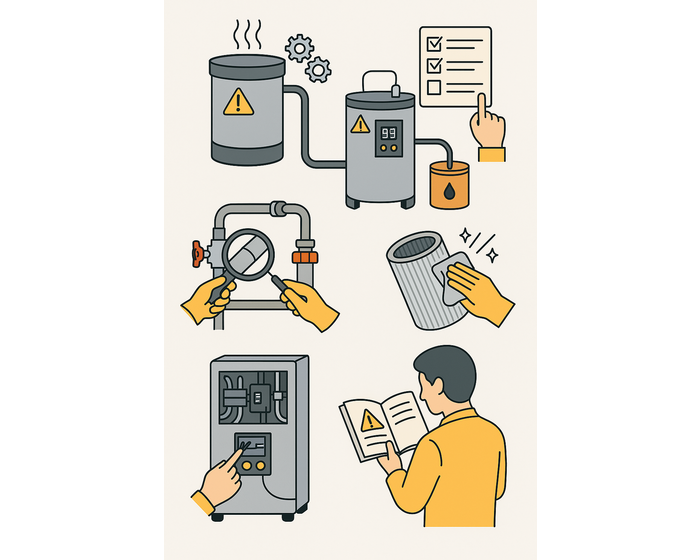
Proper maintenance of a solvent recycler prevents costly failures, improves recovery rates, and ensures long-term factory efficiency—especially important for first-time users. 1. Why Maintenance is Crucial Solvent regenerators deal with heat, pressure, and chemicals. Without routine care, residue builds up, efficiency drops, and parts wear out—leading to unexpected downtime and high repair costs. ================================= 2. Daily Checklist for All Operators ▸ Check hoses and wiring for leaks ▸ Monitor input/output levels ▸ Verify control panel status ▸ Check for abnormal heat or noise ▸ Inspect gaskets and joints ================================= 3. Weekly & Monthly Maintenance ▸ Clean solvent and waste tanks ▸ Replace filters ▸ Tighten mechanical parts ▸ Ensure pressure/temperature are stable (Refer to manual for correct procedures.) ================================= 4. Quarterly or Annual Technician Tasks ▸ Clean heaters and sensor units ▸ Calibrate sensors ▸ Software and automation checks ▸ Change lubricants and seals as needed ▸ Prevent long-term failures and downtime ================================= 5. Tips for First-Time Users ▸ Start with small batches ▸ Keep a logbook ▸ Train all operators ▸ Never modify the machine ▸ Always follow safety protocols ================================= 6. Recommended: MORIKAWA Solvent Regenerators MORIKAWA’s machines are beginner-friendly, with: ▸ Fully automated control ▸ Multi-layer safety (sensor, auto-shutdown) ▸ Chemical-resistant components ▸ Support in Thailand via T.I.T. ELECTRONICS CO., LTD. For more info, download our PDF or contact us directly. ================================= #SolventRecycler #MachineMaintenance #FactorySafety #IndustrialCleaning #MORIKAWA #ESG #SmartFactory #SolventRecovery
How to Start Solvent Recycling in Your Factory | Cut Costs and Meet ISO 14001 Goals
Factories in chemical, printing, electronics, and pharmaceutical sectors use large volumes of solvents daily. Solvent recycling helps reduce both procurement and disposal costs, while supporting ISO 14001 and sustainability goals. ======================== 1. The Problem with Using Large Amounts of Solvents Solvents like IPA, MEK, toluene, and acetone are essential in manufacturing but lead to: ‐ High purchasing and disposal costs ‐ Environmental pollution from VOC emissions ‐ Worker health risks ‐ Pressure to meet ISO14001 and ESG targets Solution: Implement on-site solvent recycling systems to reduce dependency on new solvent purchases and lower waste management costs. ======================== 2. How Solvent Recycling Works Solvent recycling systems use distillation: ‐ Contaminated solvent is heated in a sealed tank ‐ Vapors are condensed into clean liquid solvent ‐ Non-recyclable residues remain in the original tank (e.g., ink, oil, contaminants) These systems are automated, safe, and compatible with common solvents like IPA, acetone, toluene, and MEK. ======================== 3. Steps to Start Solvent Recycling in Your Factory ‐ Analyze Usage: Track monthly solvent use; prioritize costly or high-disposal ones ‐ Calculate ROI: If your factory uses over 300L/month, investment can pay off within 1–2 years ‐ Select Equipment: Consider batch size, temperature control, safety features, and solvent compatibility ‐ Train Operators: Provide training and ensure compliance with fire safety and chemical handling ======================== 4. Common Myths Debunked ‐ "Too expensive" – Modern units recover 90–95%, offering major long-term savings ‐ "Difficult to use" – Most units are fully automatic and user-friendly ‐ "Only for specific solvents" – Advanced systems handle a broad range, including high-boiling solvents ======================== 5. Why Solvent Recycling Makes Business Sense ✅ Cuts chemical and disposal costs ✅ Reduces VOC emissions and environmental impact ✅ Aligns with ISO 14001, ESG, and sustainability targets ✅ Reuses high-value solvents without quality loss ✅ Integrates easily into existing cleaning or coating lines 📎 Download our detailed equipment brochure 📞 Contact T.I.T. ELECTRONICS CO., LTD. anytime for support across Thailand ======================== #SolventRecycling #DistillationUnit #FactorySustainability #ReduceVOC #IPARecovery #ISO14001 #Morikawa #OEM #SolventCostSaving #ThailandIndustry
What Is a Solvent Recycler and How Does It Work? | Simple Guide for Factory Teams
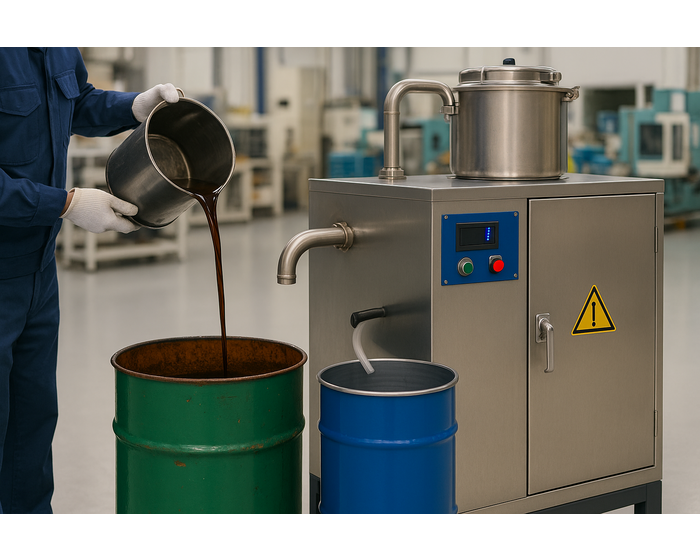
A solvent recycler transforms used solvents into clean, reusable liquid. It’s easy to use, reduces waste, saves costs, and helps factories meet sustainability goals—perfect for printing, chemical, and electronics industries. ======================== 1. Why Recycle Solvents? Solvents like IPA, acetone, and xylene are used daily in printing, electronics, and plating factories. Once contaminated, they become hazardous waste—expensive to dispose of and harmful to the environment. With a solvent recycler, factories can reuse solvents again and again. This cuts: ‐ The cost of buying new chemicals ‐ Waste disposal costs ‐ Environmental impact ======================== 2. How Does a Solvent Recycler Work? It uses a simple distillation process—like boiling water and collecting steam: 1. Pour the used solvent into the tank 2. The system heats it to vaporize clean solvent 3. The vapor passes through a cooling coil and turns back into clean liquid 4. Residue and contaminants stay behind in a special bag or container The result: clean solvent, ready to reuse ======================== 3. Easy to Use, Even for Non-Experts Morikawa’s machines are fully automatic: ‐ Load solvent ‐ Press start ‐ Let the machine do the rest Solid waste stays in a heat-resistant bag (easy to remove). If liquid, it drains from a valve. ======================== 4. Temperature Control Is Key Each solvent boils at a different temperature (e.g., IPA ≈ 82°C, acetone ≈ 56°C). Morikawa’s machines automatically adjust to the correct point—ensuring high-purity recovery without overheating. ======================== 5. Why Choose Morikawa’s Solvent Recycler? ✅ Compact but handles large volumes ✅ Fully automatic and easy to operate ✅ Reduces both chemical and disposal costs ✅ Supports your SDG and ESG goals ✅ Expert support in Thailand from T.I.T. ELECTRONICS CO., LTD. 📎 Download detailed PDF guide 📞 Contact T.I.T. ELECTRONICS CO., LTD. anytime for support across Thailand ======================== #solventrecycler #howitworks #factoryguide #solventreuse #Thailandindustry #chemicalcostsaving #distillationmachine #Morikawa #OEM #sustainablefactory
What Is an Automatic Solvent Recycling System? | Reduce Waste and Save 95% on Solvent Costs
An automatic solvent recycling system allows factories to recover and reuse contaminated solvents—cutting disposal costs, improving safety, and supporting ESG goals across manufacturing industries. ======================== ■ What Is an Automatic Solvent Recycling System? Automatic solvent recycling systems are fully automated devices that use distillation technology to separate contaminants (e.g., oil, dirt, grease) from used solvents like IPA, acetone, and xylene. The purified solvent is then reused in cleaning, coating, or degreasing processes—minimizing hazardous waste generation and lowering chemical procurement costs. ======================== ■ Key Benefits 1. Cut Solvent Purchase Costs - Up to 80–95% of used solvent volume can be recovered and reused 2. Reduce Hazardous Waste Output - Less waste to treat or dispose of = lower handling fees 3. Improve Workplace Safety - Closed system minimizes operator exposure to dangerous vapors 4. Eco-Friendly Manufacturing - Less environmental discharge, better alignment with CSR/ESG goals 5. Ensure Compliance - Supports ISO 14001 and Thai environmental audit requirements ======================== ■ Recommended for Industries Such As: - Electronics: PCB and connector cleaning - Metalworking & Mold: Degreasing of precision parts - Printing: Solvent reuse in ink and plate cleaning - Automotive: Spray booth solvent control and cleaning - Industrial Cleaning: Service companies managing solvent-heavy operations ======================== ■ Why Choose Morikawa? Morikawa Co., Ltd. is a Japanese leader in industrial solvent recovery with systems trusted across Asia. Our automatic solvent recyclers feature: - Fully automated controls for easy operation - Durable, chemical-resistant materials - Multiple system sizes for different factory scales - Expert support in Thailand through T.I.T. ELECTRONICS CO., LTD. 📎 Download detailed product brochure (PDF) 📞 Contact T.I.T. ELECTRONICS CO., LTD. anytime for support across Thailand ======================== #solventrecycling #solventreuse #industrialwaste #distillationsystem #Thailandfactory #chemicalreduction #VOCcontrol #Morikawa #OEM #greenmanufacturing
Why Every Paint & Coating Factory Needs a Solvent Recycler | Cut Costs, Waste, and VOCs Today
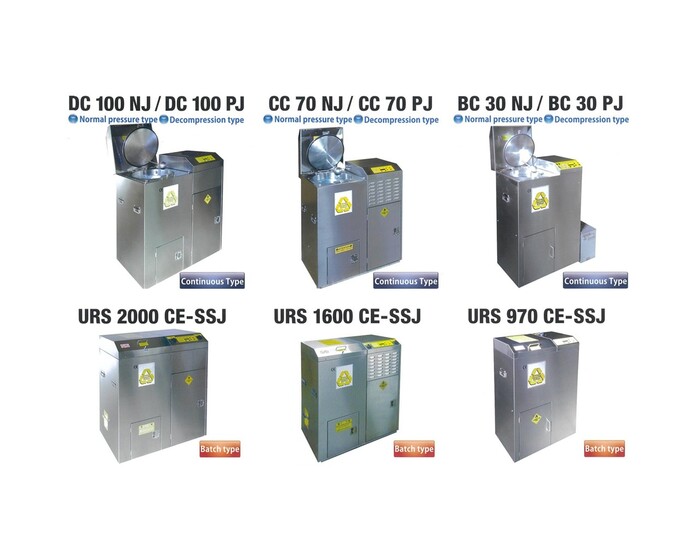
Paint and coating factories use large volumes of solvents like xylene and acetone. A solvent recycler reduces these costs, minimizes hazardous waste, and helps comply with environmental laws—making it an essential tool for sustainable production. ======================== ■ Why Should Paint and Coating Manufacturers Use a Solvent Recycler? 1. Reduce Solvent Costs Paint production uses expensive solvents daily. Disposing of contaminated solvent adds recurring costs. A solvent recycler restores used solvents to reusable quality—cutting both purchase and waste disposal costs. 2. Minimize Waste and Pollution Solvent waste contributes to air, soil, and water pollution. A recycling system significantly lowers the volume of hazardous chemicals released, helping factories align with Thai environmental regulations. 3. Improve Production Efficiency Recycling solvents reduces cleaning time for tools and spray equipment. This minimizes production downtime and prevents cross-contamination during color or formula changes. 4. Maintain Product Quality Properly regenerated solvents can be reused without degrading product performance, ensuring consistent paint and coating quality. 5. Comply with Environmental and Safety Regulations Solvent recyclers support compliance with VOC limits and ISO 14001—reducing chemical emissions and simplifying hazardous waste management. ======================== ■ Recommended Solution: Morikawa Solvent Recycler Morikawa’s solvent recycling system efficiently regenerates solvents used in the painting and coating industry, including xylene, thinner, and acetone. Available in batch and continuous types, it supports factory operations of various scales while enhancing both environmental and cost performance. 📎 Download detailed product brochure (PDF) 📞 Contact T.I.T. ELECTRONICS CO., LTD. anytime for support across Thailand ======================== #paintfactorysolutions #solventrecycler #coatingindustry #xyleneacetone #wastereduction #Thailandindustry #VOCcontrol #Morikawa #OEM #environmentalcompliance
New Purchase vs. Solvent Regeneration | Which Is More Cost-Effective for Factories in Thailand?
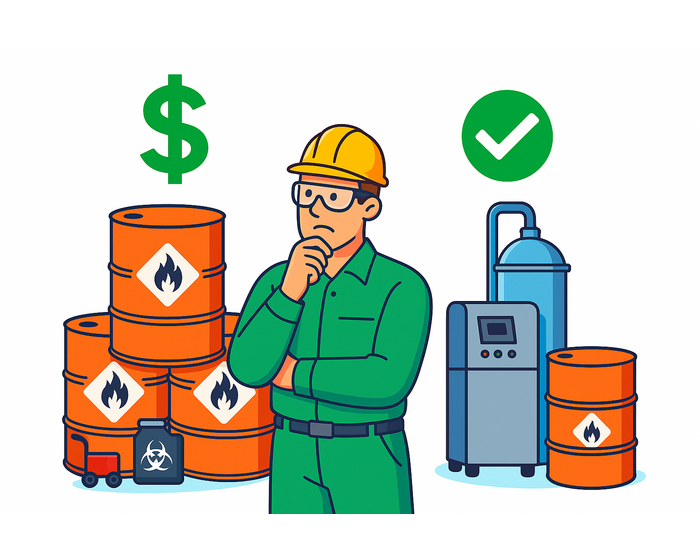
Find out which solvent management approach truly saves you more in your production line. 1. The hidden costs of buying new solvents In industries such as chemicals, electronics, automotive components, and printing, solvents are widely used in large volumes. Many companies simply purchase new solvents every time, assuming it’s the easiest solution. However, the real cost of this practice is often underestimated. Costs associated with purchasing new solvents include: - Cost of new solvents (e.g., IPA, Acetone, Toluene) - Logistics and storage costs - Disposal costs for used solvents, which must comply with strict environmental regulations - Potential fines or penalties for improper waste management When these costs are totaled, factories can easily spend millions of baht per year just on solvent procurement and disposal. =============================== 2. Solvent regeneration: One-time investment, long-term savings Solvent regeneration using an automatic solvent regenerator allows factories to recover and reuse solvents by separating contaminants through distillation. With modern equipment, it’s possible to recover 90–95% purity, significantly reducing the need for new solvent purchases. Benefits of regeneration include: - Substantial reduction in new solvent purchases (up to 70% or more) - Lower waste disposal volumes and costs - Easier compliance with environmental standards like ISO14001 - Reduced chemical storage risks =============================== 3. A simplified cost comparison Let’s assume a factory uses 1,000 liters of solvent per month, at 80 THB per liter. If purchasing new solvents: - Solvent cost = 80 x 1,000 = 80,000 THB/month or 960,000 THB/year - Disposal cost \~15 THB/liter = 15 x 1,000 = 15,000 THB/month or 180,000 THB/year - Total annual cost ≈ 1,140,000 THB If regenerating 80%: - Purchase only 20% new solvent = 200 liters x 80 = 16,000 THB/month or 192,000 THB/year - Disposal cost for 200 liters = 3,000 THB/month or 36,000 THB/year - Total annual cost ≈ 228,000 THB Summary: - Annual savings ≈ 912,000 THB - Typical payback period for a regenerator: 1–2 years, depending on volume and model =============================== 4. Key points to consider - Monthly usage volume: If too low, ROI may not justify the investment. - Solvent types: Confirm that the regenerator supports the specific solvents you use. - Installation space: Includes tanks, control units, and ventilation. - Operator training: Proper operation and maintenance training are essential. For factories with continuous high-volume solvent use, regeneration dramatically cuts costs, increases profits, and improves environmental sustainability. =============================== 5. Why choose MORIKAWA Co., Ltd. MORIKAWA Co., Ltd. provides high-performance solvent regenerators designed for diverse industrial applications. Key advantages include: - Automatic control system that’s easy to use - Advanced safety features such as temperature and pressure sensors with automatic shutdown - Compatibility with various solvents, including high-boiling-point types - Full support and after-sales service, including local partners like T.I.T. ELECTRONICS CO., LTD. in Thailand Choosing MORIKAWA ensures your solvent management is safe, economical, and environmentally friendly, regardless of factory size. For more details, please download the PDF or feel free to contact us directly. #SolventRegeneration #FactoryCostSaving #ThailandIndustry #ReduceSolventWaste #ISO14001 #MORIKAWA #SustainableFactory #ChemicalWasteReduction #IndustrialThailand #FactoryInnovation

CONTACT
Inquiry