
DOWA THERMOTECH (THAILAND) CO., LTD.
PRODUCTS
Technology / Product Information
Carbonitriding Process|Surface Hardening for Low-Carbon Steel
Technology / product information
For low-carbon steels requiring enhanced surface hardness and resistance to wear, the Carbonitriding process (Carburizing–Nitriding) is one of the most effective heat treatment solutions. By simultaneously introducing carbon (C) and nitrogen (N) into the steel surface, this process creates a hard yet tough surface layer with superior fatigue resistance compared to conventional carburizing. It is particularly suitable for components subjected to alternating loads, rotation, or continuous friction such as gears, spindles, and bushings across the machinery and automotive industries.
Process Principle
Carbonitriding involves heating the steel workpiece in a gas atmosphere containing carbon and ammonia (NH₃) at 730–900 °C. During the process, carbon and nitrogen atoms diffuse simultaneously into the steel surface. After heating, the part is quenched to form a martensitic structure a microstructure known for its exceptional strength and hardness. The treated surface contains Fe–C–N compounds, producing a fine-grained structure that combines high hardness, excellent wear resistance, and improved fatigue strength while minimizing the risk of surface cracking compared to standard hardening processes.
Properties After Treatment
Average surface hardness: 600–750 HV
Fine-grained martensitic structure offering both hardness and ductility
Strong adhesion of the carburized–nitrided layer, resistant to flaking or peeling
Improved fatigue strength and corrosion resistance
Core remains tough to prevent internal cracking under stress
Applicable Materials
The Carbonitriding process is best suited for low-carbon and low-alloy steels that require a balance between surface hardness and core toughness, such as S10C, S20C, SCM420, SCR420. These grades are commonly used in parts that endure alternating or rotational stresses, such as gears and shafts.
Applications & Use Cases
Widely used in high-load components across automotive, machinery, and energy industries, including:
Gears and Bushings: Enhanced wear and fatigue resistance
Spindles: Require high surface precision and hardness
Rolls: Need long-lasting durability under repeated stress
Supports large workpieces up to 760 × 1230 × 720 mm, making it suitable for both medium and large-scale production environments.
Advantages of Carbonitriding
Simultaneously improves surface hardness and toughness
Provides better fatigue and wear resistance than standard carburizing
Requires lower treatment temperature, ideal for low-carbon steels
Produces a smooth surface with minimal dimensional change after quenching
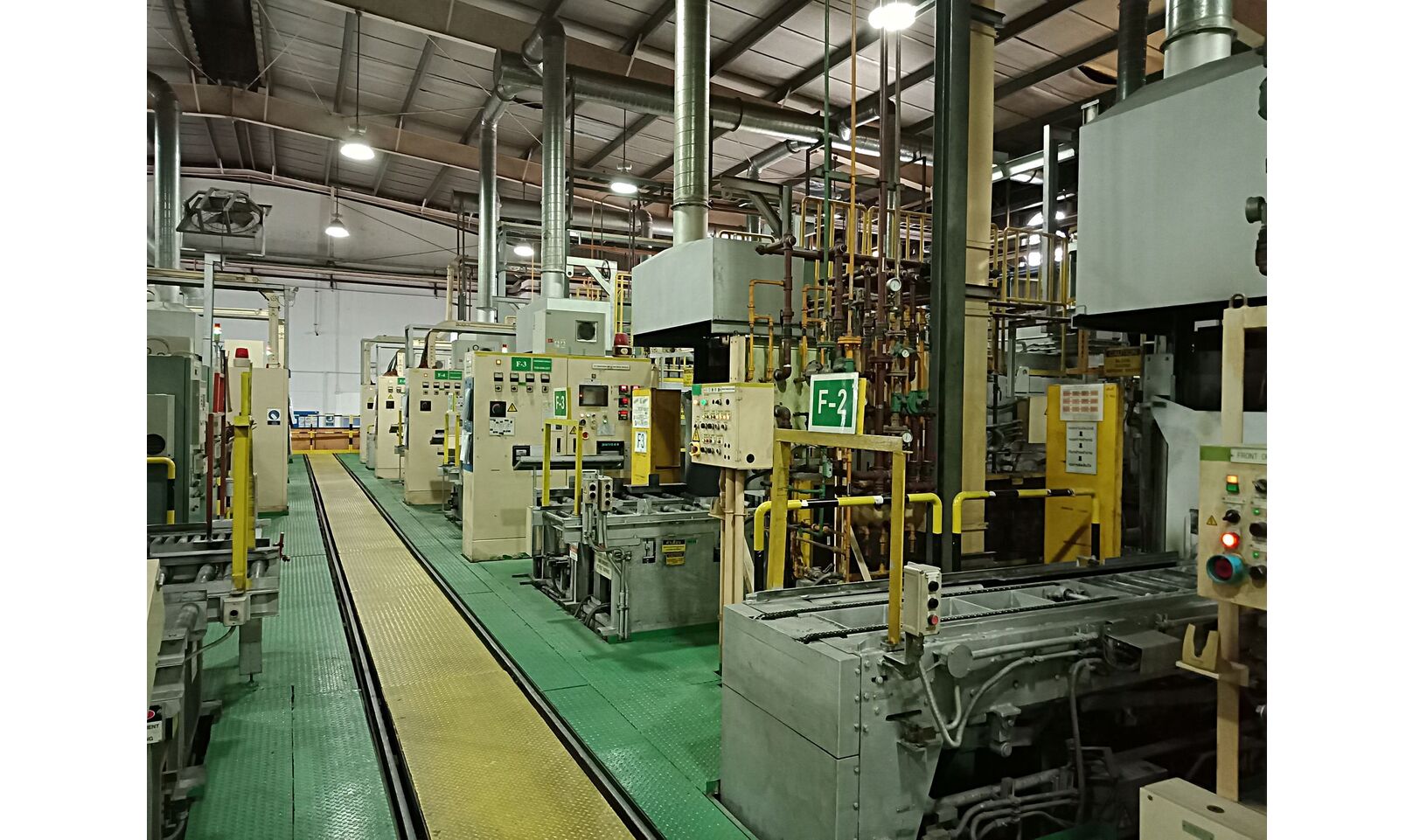
Compatible with continuous production systems using automatic furnaces
Summary
Carbonitriding is a surface hardening process specifically designed for low-carbon steels. Conducted at 730–900 °C under a precisely controlled carbon–nitrogen gas atmosphere, it produces a martensitic surface layer with hardness of 600–750 HV. The process enhances wear and fatigue resistance while maintaining core toughness making it ideal for gears, bushings, rolls, and spindles in high-load industrial applications.
For more information, please download PDF or contact us.
#Carbonitriding #HeatTreatment #DOWAThermotech #Martensite #LowCarbonSteel #SurfaceHardness #Gear #Spindle #IndustrialFurnace #ThermalEngineering
PICKUP
Technology / Product Information
CONTACT
Inquiry