
HAKKAI PRECISION (THAILAND) CO., LTD.
SERVICE
Production Goods & Services
PMMA Injection Molding|Surface Defects, Optical Clarity, and Process Control
Product Info
🌟 Key Takeaways
• Most PMMA quality issues originate from process instability rather than the material itself
• Moisture and shear are the primary enemies of optical clarity
• PMMA must be controlled as a complete system, from raw material to part handling
ーーーーーーーーーーーーーーーーーーーーーーーーーーーーーーー
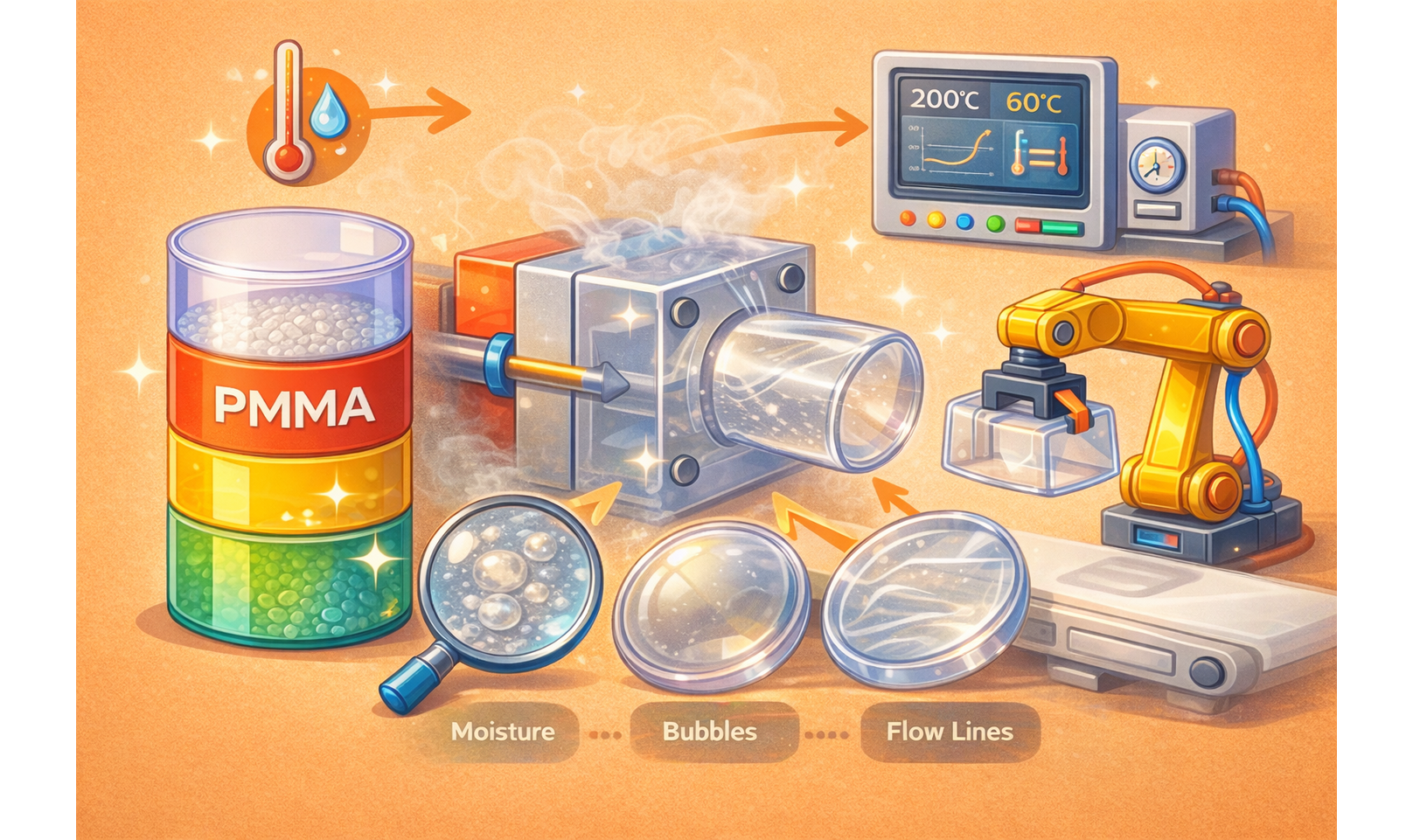
PMMA (Polymethyl Methacrylate) is a transparent plastic that is generally easy to mold from a formability perspective, yet highly challenging in terms of surface quality and optical clarity. Common defects include uneven transparency, silver streaks, flow marks, and surface haze or thermal damage. These issues make PMMA a “high-risk” material for appearance-critical applications when the process lacks stability.
The root of these problems lies in PMMA’s inherent material behavior. PMMA readily absorbs moisture, which can vaporize during injection and appear as silver streaks on the surface. It is also highly shear-sensitive, meaning surface structure can be easily damaged by unstable or aggressive flow conditions. In addition, PMMA operates within a narrow processing temperature window, so even small fluctuations can immediately affect surface quality and transparency.
For advanced PMMA molding, the goal is not to identify a single “optimal setting,” but to maintain overall process consistency. Material preparation is critical pellets must be thoroughly dried before molding to minimize residual moisture. Melt temperature must be carefully controlled to avoid overheating, which can lead to surface haze or discoloration.
Mold temperature plays a more significant role in PMMA than in many other plastics, directly influencing surface smoothness and optical clarity. Maintaining a stable mold temperature throughout production improves surface orientation and visual consistency. Injection profiling should promote continuous, smooth flow while minimizing sudden shear spikes, especially near the gate area where transparency loss often begins.
From an engineering standpoint, every adjustment introduces trade-offs. Increasing injection speed can reduce flow marks but raises shear stress, potentially clouding the surface. Raising melt temperature improves flowability but increases the risk of burn marks or color change. Higher mold temperatures enhance surface clarity and smoothness, but extend cooling time. Advanced process control requires balancing the entire system rather than optimizing individual parameters in isolation.
Practical experience with transparent electrical appliance components shows that PMMA performs best when raw material cleanliness and environmental conditions are tightly controlled. Automated part removal systems help reduce surface contact, while consistent mold temperature control across shifts ensures uniform quality from batch to batch.
In summary, PMMA is not suitable for trial-and-error process tuning. It demands disciplined material handling and stable machine settings. When properly controlled, PMMA delivers superior optical appearance compared with many other transparent plastics and can become a key differentiator in product design.
📘 Summary
PMMA requires high process discipline. Moisture, shear, and temperature stability determine surface quality and transparency more than any single parameter setting.
ーーーーーーーーーーーーーーーーーーーーーーーーーーーーーーー
❓ FAQ
Q: How does PMMA differ from PC in processing behavior?
A: PMMA is more sensitive to moisture and shear, but offers superior optical clarity and surface quality.
Q: Why is mold temperature so critical for PMMA?
A: Because it directly affects surface orientation and transparency of the molded part.
Q: Is PMMA suitable for precision applications?
A: Yes, provided the process is controlled with consistency and discipline.
📚 Glossary (Key Terms)
• Silver streak: Surface streaks caused by moisture vapor during molding
• Flow mark: Surface marks resulting from unstable or discontinuous flow
• Shear sensitivity: The tendency of a material to degrade under high shear stress
• Mold temperature: Mold thermal condition that directly influences surface quality and clarity
🔗 Cluster Internal Link
Core Content: https://prime.nc-net.com/89979/en/product/detail/258021
Basic Knowledge: https://prime.nc-net.com/89979/en/product_others/detail_goods/27744
#PMMA #InjectionMolding #AcrylicPlastic #PlasticProcessing #ProcessControl #SurfaceDefects #ManufacturingEngineering #OpticalPlastics #IndustrialKnowledge #PrecisionMolding
📆 Updated: 2025-01-06
CONTACT
Inquiry