
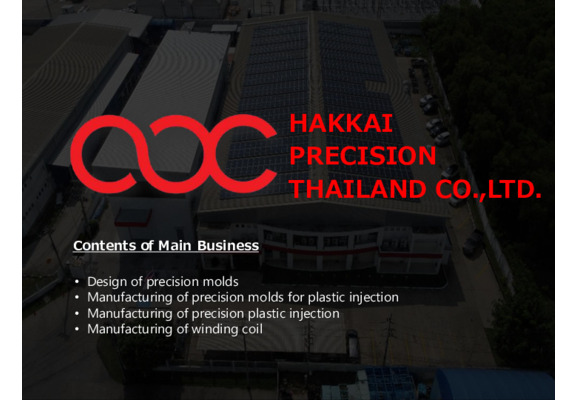
HAKKAI PRECISION (THAILAND) CO., LTD.
SERVICE
Production Goods & Services
PMMA Injection Molding | Understanding Transparent Materials for Industrial-Grade Surface Quality

Product Info
🌟 Key Takeaways
• PMMA (Acrylic) is a plastic material known for high transparency and superior surface appearance
• Moisture and temperature control are critical factors in PMMA injection molding
• Part quality depends more on mold design and process stability than on the material alone
ーーーーーーーーーーーーーーーーーーーーーーーーーーーーーーー
PMMA, commonly known as acrylic, is an engineering plastic widely used for applications requiring glass-like transparency, lightweight structure, and excellent surface finish. It is commonly applied in lenses, transparent covers, appliance windows, and decorative components in the electrical and automotive industries, especially where visual appearance and light transmission are critical.
From a material property perspective, PMMA offers approximately 92% light transmittance, high hardness, and good resistance to UV radiation and weathering. However, it is relatively brittle and highly sensitive to moisture and melt temperature. These characteristics directly affect the injection molding process. If not properly controlled, defects such as air bubbles, silver streaks, or surface haze may occur.
When material properties are mapped to the injection molding process, consistent control of melt temperature and mold temperature becomes essential. PMMA pellets must be properly dried before molding to minimize bubbles and silver streak defects. In addition, gate design and melt flow paths have a direct impact on surface clarity and optical quality. Non-uniform flow can easily result in visible flow lines, which are especially noticeable in transparent parts.
PMMA is suitable when transparent or semi-transparent parts with high surface quality are required and when the parts are not subjected to high impact loads. It is also well-suited for long-term use in light-exposed environments, provided that temperature control, cleanliness, and part handling can be precisely managed throughout the process.
A common misconception is that PMMA is difficult to mold and prone to defects. In practice, high-quality PMMA parts can be consistently produced by controlling three key factors: proper material drying, appropriate mold temperature, and uniform melt flow behavior.
In industrial applications such as transparent covers for electrical devices, maintaining stable mold temperature and using automated part handling systems can significantly reduce surface scratches and preserve optical clarity throughout continuous production.
📘 Summary
PMMA injection molding delivers high-quality results when the relationship between material properties and process control is properly understood. This makes PMMA a strong material choice for applications that demand both functional performance and visual appeal in modern industrial products.
ーーーーーーーーーーーーーーーーーーーーーーーーーーーーーーー
❓ FAQ
Q: How is PMMA different from PC
A: PMMA provides higher transparency and better surface finish, while PC offers superior toughness and impact resistance.
Q: Is drying PMMA pellets before molding necessary
A: Yes, drying is essential to prevent air bubbles and silver streak defects on the part surface.
Q: Can PMMA be used in automotive applications
A: Yes, it is suitable for decorative or transparent components that do not experience high impact loads.
📚 Glossary (Key Terms)
• Light Transmittance: The percentage of light that passes through a material, approximately 92% for PMMA
• Silver Streak: Surface streak defects caused by moisture or trapped gas
• Flow Line: Visible flow marks resulting from non-uniform melt flow
• Mold Temperature: Mold thermal condition that directly influences surface quality and transparency
🔗 Cluster Internal Link
Core Content: https://prime.nc-net.com/89979/en/product/detail/258021
Advance Knowledge: https://prime.nc-net.com/89979/en/product_others/detail_goods/27745
#InjectionMolding #PMMA #Acrylic #TransparentParts #PlasticEngineering #MoldDesign #Manufacturing #IndustrialKnowledge
📆 Updated: 2025-01-06
CONTACT
Inquiry