
HAKKAI PRECISION (THAILAND) CO., LTD.
SERVICE
Production Goods & Services
Engineering Plastics and Precision Injection Molding|Linking Materials, Processes, and Quality KPIs
Product Info
🌟 Key Takeaways
• Injection molding quality issues often arise from misalignment between material and process
• Different engineering plastics directly affect KPIs such as warpage, tolerance, and yield
• Proper control of injection parameters and mold design enables full material performance
• Factories with strong QA systems and high-precision machinery reduce risk in automotive applications
ーーーーーーーーーーーーーーーーーーーーーーーーーーーーーーー
In high-level industrial injection molding, material selection is not only about whether a plastic can be molded. It must be directly linked to process KPIs, such as dimensional tolerance, warpage, scrap rate, and long-term part stability. If material selection is not aligned with the manufacturing process, it becomes a long-term risk to both quality and cost.
In the automotive and electrical industries, common issues include parts failing tolerance after assembly, warpage occurring only in certain lots, and mechanical properties degrading during real-world use. These problems are rarely caused by material or machinery alone. Instead, they result from the combined interaction of material, mold design, and injection conditions.
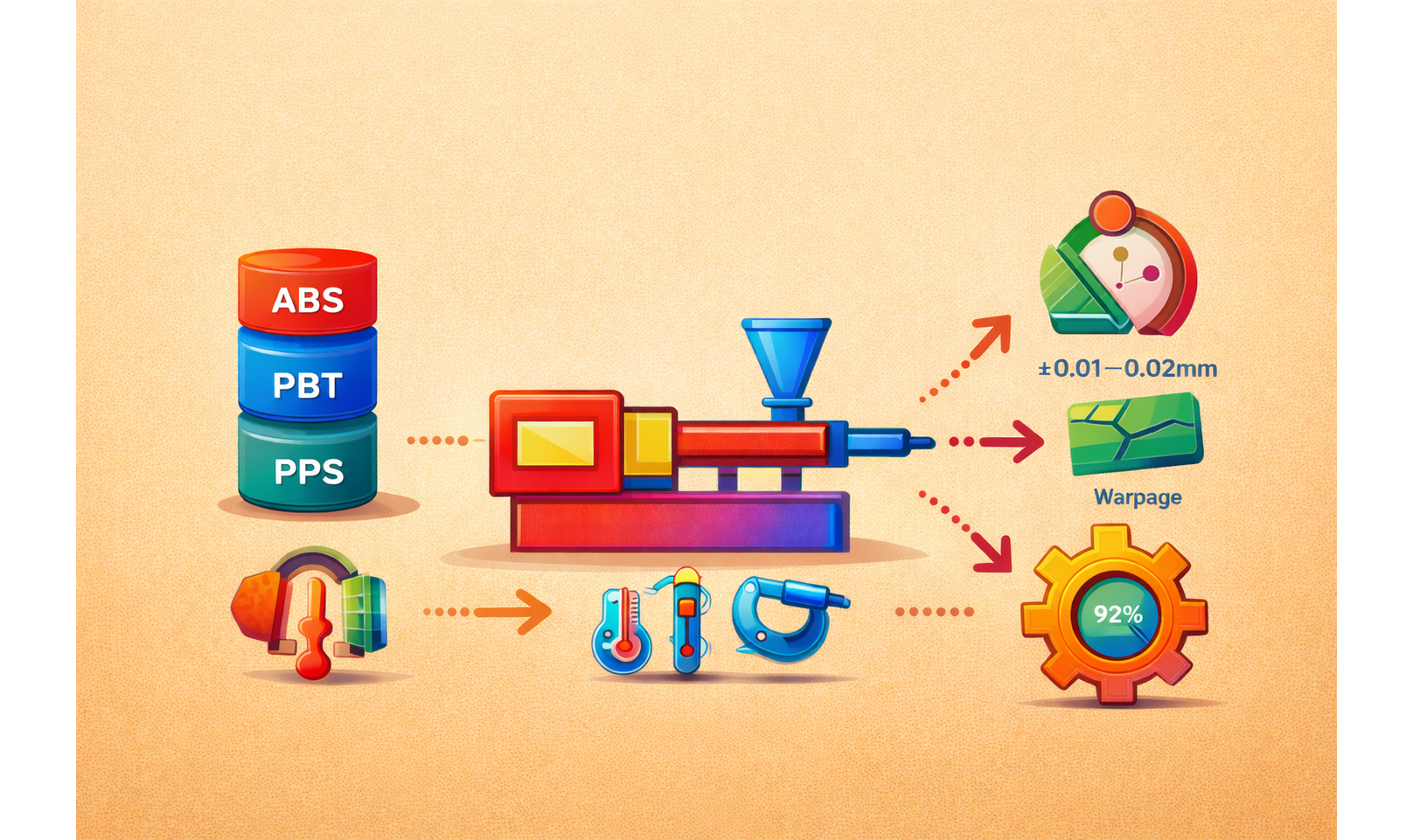
From a root-cause perspective, materials contribute through shrinkage behavior, moisture absorption, and Tg or Tm values. Mold-related factors include gate design, cooling balance, and venting. Process parameters involve melt temperature, injection speed, and holding pressure. For example, PA or PBT materials with poor moisture control lead to unstable flow behavior, resulting in warpage and reduced tensile strength.
Process control must therefore match material characteristics. LCP and PPS require precise mold temperature and flow-rate control to maintain dimensional stability. POM requires balanced holding pressure to reduce sink marks without increasing internal stress. PC and PMMA demand controlled cooling rates to prevent stress cracking and optical haze.
Material selection also involves trade-offs between cost and risk. High-heat-resistance materials such as PPS or PEI have higher material costs but reduce reliability risks. Easy-to-process materials like ABS offer lower cost but have limitations in service temperature. Decision-making should therefore consider Total Cost of Ownership (TCO) rather than material price alone.
From a KPI standpoint, proper process control can support tolerances of ±0.01–0.02 mm, depending on material and mold design. Yield improves significantly with consistent moisture and temperature control, while part stability increases in automated assembly applications.
In an anonymous industrial case, a small LCP component used in electronics manufacturing significantly reduced warpage and assembly-related scrap after optimizing cooling balance and injection speed to match material behavior. This demonstrates the direct impact of aligning material properties with process conditions.
Selecting materials without considering process compatibility increases long-term quality and cost risks. The next practical step is to establish a Material–Process Window in collaboration with the manufacturing plant during the design phase, ensuring production stability aligned with required KPIs.
📘 Summary
Engineering plastics deliver maximum value only when material selection and process control are systematically linked through a Problem → Parameter → KPI framework. This approach reduces risk, improves stability, and supports global-scale industrial manufacturing.
ーーーーーーーーーーーーーーーーーーーーーーーーーーーーーーー
❓ FAQ
Q: Why does the same material produce different injection results?
A: Because injection parameters and mold design directly influence material behavior.
Q: Are high heat-resistant materials always better?
A: Not always. Cost, process complexity, and required KPIs must be evaluated together.
Q: Where should projects requiring tight tolerances begin?
A: Start by selecting materials with high dimensional stability and designing a compatible process.
📚 Glossary
• Engineering Plastics: Plastics used in industrial applications that directly affect process KPIs
• Warpage: Deformation of molded parts after injection
• Tolerance: Allowable dimensional deviation of a component
• Process KPI: Process performance indicators such as yield and part stability
• Material–Process Window: The operating range where material and process conditions are optimally aligned
📖 Reference
Company Profile & Manufacturing Capability – HAKKAI PRECISION (THAILAND) CO., LTD.
🔗 Cluster Internal Link
• Core Content: https://prime.nc-net.com/89979/en/product/detail/245069
• Basic Knowledge: https://prime.nc-net.com/89979/en/product_others/detail_goods/27670
#EngineeringPlastics #InjectionMolding #ProcessKPI #Warpage #Tolerance #QualityControl #AutomotiveIndustry #IndustrialManufacturing #PrecisionMolding #ManufacturingEngineering
📆 Updated: 2025-12-17
CONTACT
Inquiry