
HAKKAI PRECISION (THAILAND) CO., LTD.
SERVICE
Production Goods & Services
Engineering Plastics in Injection Molding|How to Select Materials for Real-World Applications
Product Info
🌟 Key Takeaways
• Engineering plastics provide higher mechanical, thermal, and chemical properties than general-purpose plastics.
• Proper material selection helps reduce warpage, wear, and short service life.
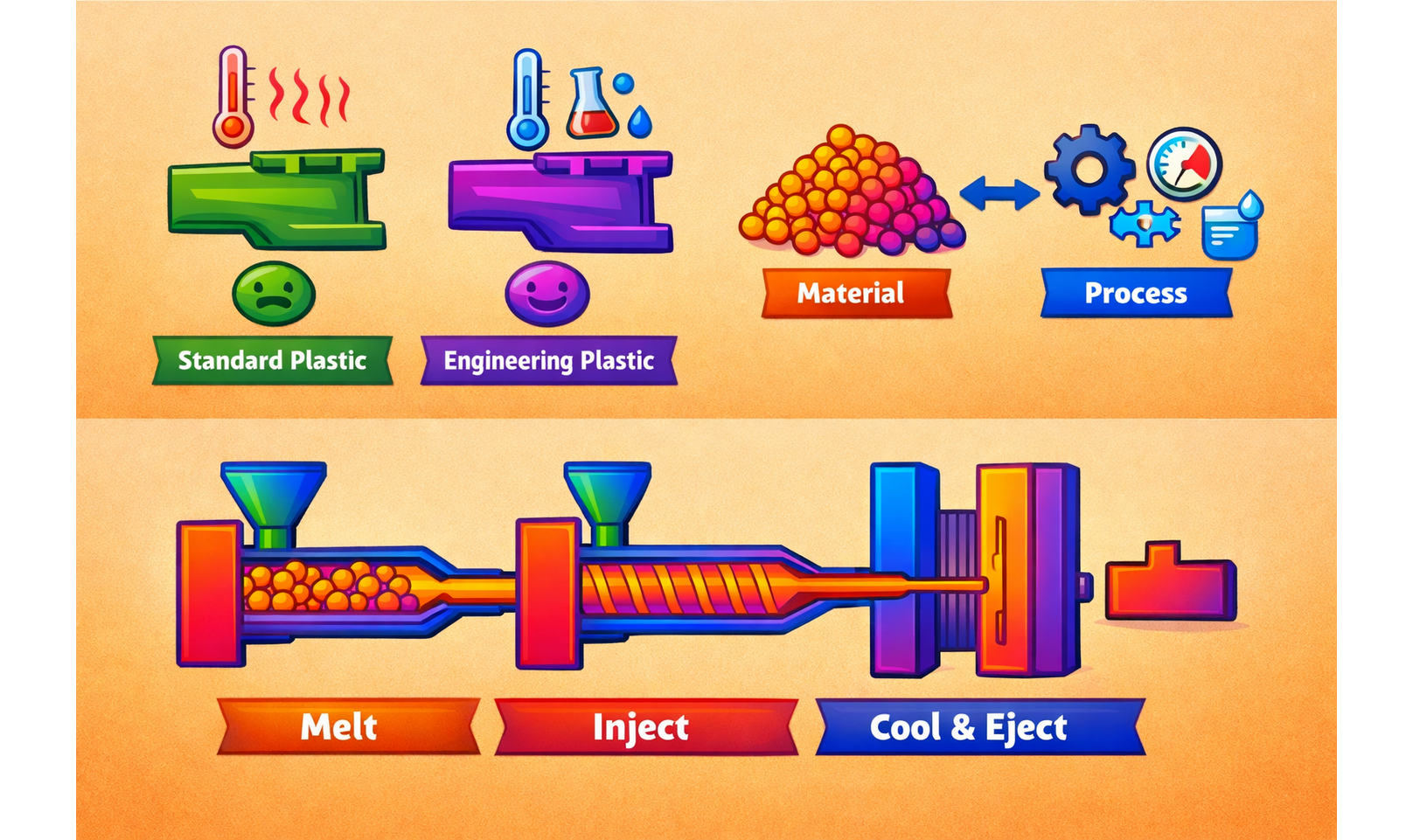
• Injection molding must consider the combination of material, process, and mold design.
• Factories with high-precision machinery and quality control systems can fully realize material performance.
ーーーーーーーーーーーーーーーーーーーーーーーーーーーーーーー
Engineering plastics are a class of materials designed for industrial applications that require higher strength, durability, and dimensional stability than general-purpose plastics. In plastic injection molding, material selection directly affects part quality, service life, and overall reliability.
Engineering plastics offer excellent heat resistance, chemical resistance, mechanical strength, and shape retention. These properties make them suitable for components operating continuously under demanding conditions, such as in automotive, electrical, and electronics industries. Beyond improving part performance, they also reduce the risk of deformation and premature degradation.
In injection molding, the relationship between material and process is critical. Material properties determine molding temperature, injection pressure, and cooling time. Mold design must align with material flow behavior and shrinkage characteristics. Proper process control helps maintain dimensional accuracy and minimize production waste.
Commonly used engineering plastics include:
• PBT / PET: High strength and chemical resistance, suitable for electrical components
• LCP: Excellent dimensional stability, ideal for small and complex parts
• POM: Low friction, used for gears and moving components
• PA / PA66: High impact resistance, widely used in automotive applications
• PC / PMMA: Transparent materials for covers and optical parts
• PPS / PEI / PES / PSU: High heat resistance, used in electrical and medical applications
Before selecting a material, basic factors should be evaluated, including whether the part bears mechanical loads, required heat or chemical resistance, dimensional stability needs, production volume, and target cost. A common misconception is that the highest-grade material is always the best choice. In practice, the most suitable material is the one that best matches the functional requirements and manufacturing process.
A real-world example is automotive connectors, which often use PA or PBT combined with tightly controlled injection molding processes. Strict temperature and moisture control are applied to achieve the required strength and dimensional stability.
📘 Summary
Engineering plastics are not simply “stronger materials” but key elements that must be designed in harmony with injection molding processes. Understanding these fundamentals improves material selection, reduces risk, and enhances long-term part quality.
ーーーーーーーーーーーーーーーーーーーーーーーーーーーーーーー
❓ FAQ
Q: How are engineering plastics different from general-purpose plastics?
A: They offer higher heat resistance, mechanical strength, and dimensional stability, making them suitable for demanding industrial applications.
Q: Is selecting material based only on properties sufficient?
A: No. Material selection must also consider injection molding processes and mold design.
Q: Which engineering plastics are commonly used in the automotive industry?
A: PA, PBT, POM, and LCP are frequently used for structural and electrical components.
📚 Glossary
• Engineering Plastics: Plastics with higher strength, heat resistance, and stability than general-purpose plastics
• Plastic Injection Molding: A process in which molten plastic is injected into a mold to form parts
• Dimensional Stability: The ability of a part to maintain its size and shape
• Warpage: Part deformation caused by shrinkage or improper process control
📖 Reference
[1] Company Profile & Manufacturing Capability – HAKKAI PRECISION (THAILAND) CO., LTD.
🔗 Cluster Internal Link
• Core Content: https://prime.nc-net.com/89979/en/product/detail/245069
• Advance Knowledge: https://prime.nc-net.com/89979/en/product_others/detail_goods/27674
#EngineeringPlastics #PlasticInjectionMolding #AutomotiveIndustry #IndustrialComponents #MaterialSelection #InjectionMolding #QualityControl #ISO #IATF #Manufacturing
📆 Updated: 2025-12-17
CONTACT
Inquiry