
KOBAYASHI CASTING Co.,Ltd
PRODUCTS
Technology / Product Information
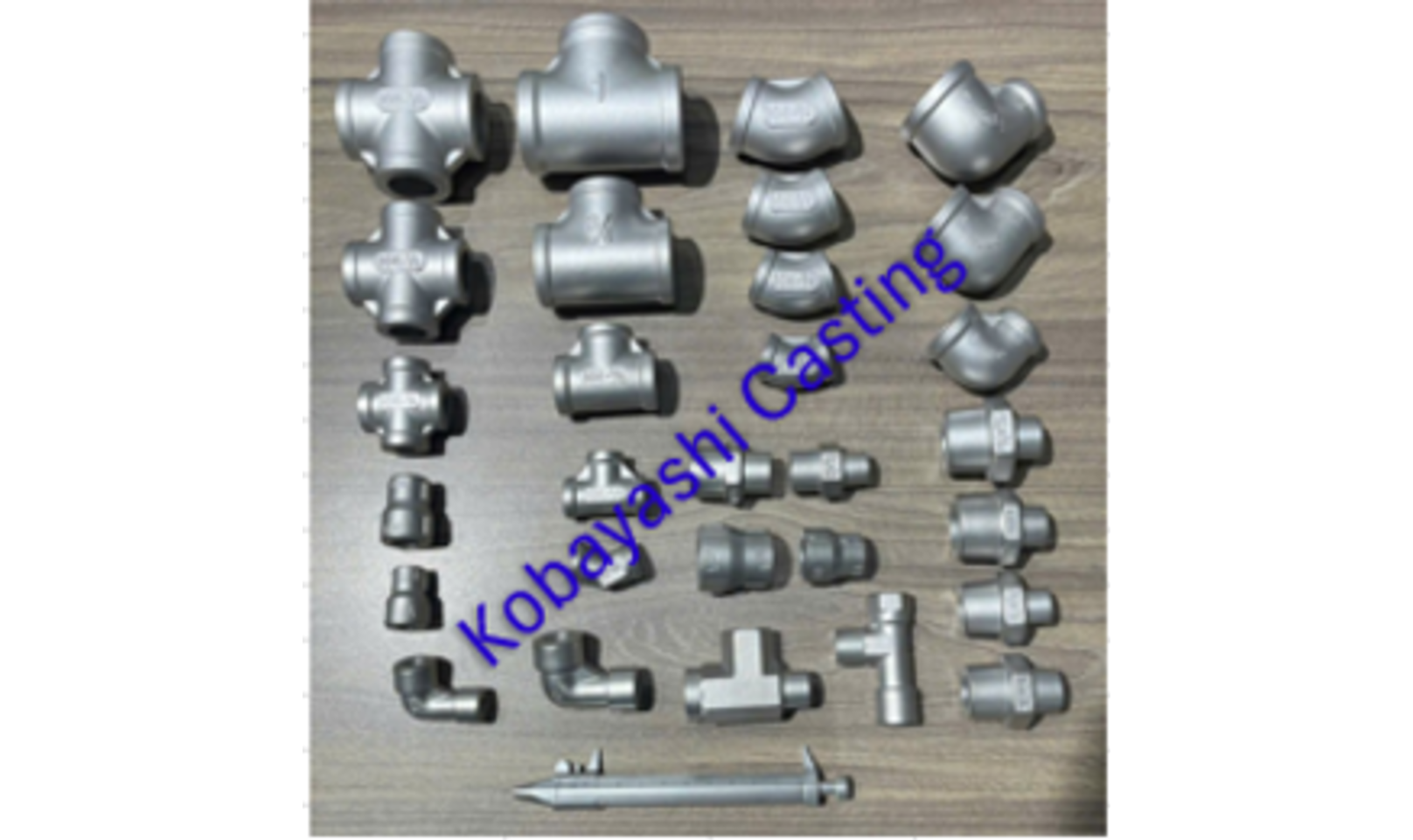
Gas Porosity Control Solutions in Stainless Steel Lost Wax Casting for Elbow Fittings
Technology / product information
In the production of stainless steel elbows and pipe fittings using lost wax casting, one of the most critical challenges is the control of gas porosity. If not properly eliminated, microscopic pores may appear after CNC machining, leading to air or fluid leakage when the parts are assembled into piping systems.
At Kobayashi Casting Vietnam, we have developed a comprehensive gas porosity control process, combining over 20 years of experience in wax pattern and stainless steel casting with advanced precision equipment. This approach ensures tight sealing performance, smooth surfaces, and high dimensional accuracy in every product.
1. Wax Injection and Wax Pattern Quality Control
Wax patterns are formed using dedicated wax injection machines, ensuring high stability, smooth surfaces, and accurate replication of the design dimensions.
After injection, wax patterns are periodically inspected using ZEISS 3D CMM systems and optical measuring equipment to monitor wax shrinkage and dimensional consistency.
➡️ This inspection process helps maintain precise dimensions and prevents nonconforming products caused by dimensional deviations during stainless steel casting.
2. Optimized Cluster Assembly for Complete Wax Removal
During the cluster assembly stage, Kobayashi engineers design optimized gating and venting paths to ensure that:
During dewaxing, all wax is completely removed from the mold, with no residual wax trapped inside
During metal pouring, molten stainless steel flows smoothly and uniformly into the mold, preventing air entrapment and cold shuts
➡️ As a result, the mold remains clean and well-vented, significantly reducing gas porosity in the final casting.
3. Ceramic Shell Building and Controlled Storage
The ceramic shell is built and cured in temperature- and humidity-controlled environments, ensuring high shell strength and preventing cracking during metal pouring.
Without proper environmental control, ceramic shells may crack, absorb moisture, or weaken—leading to gas porosity and casting defects.
4. Stainless Steel Inspection and Melting Control
Before melting and pouring, stainless steel materials are analyzed using optical emission spectrometers (AMETEK SPECTRO) to verify compliance with SUS304, SUS316L, and other specified grades.
The metal is then melted in induction furnaces and poured at controlled temperatures, ensuring stable metal flow and minimizing gas formation within the mold.
5. Machining and Final Inspection
After casting, components are precision-machined using high-accuracy CNC machines to meet required tolerances.
Finally, each part undergoes pressure and leak testing to ensure there is no gas or fluid leakage during actual service conditions.
By implementing a fully integrated control process—from wax injection and cluster assembly to stainless steel casting, CNC machining, and leak testing—Kobayashi Casting achieves a high acceptance rate, particularly for stainless steel elbows and pipe fittings that require excellent sealing performance.
📞 Contact Kobayashi Casting to discuss optimized stainless steel lost wax casting solutions for your products—reducing gas porosity, improving precision, and delivering superior durability.
PICKUP
Technology / Product Information
CONTACT
Inquiry