
MORIKAWA Co., Ltd. / T.I.T. ELECTRONICS CO., LTD.
SERVICE
Production Goods & Services
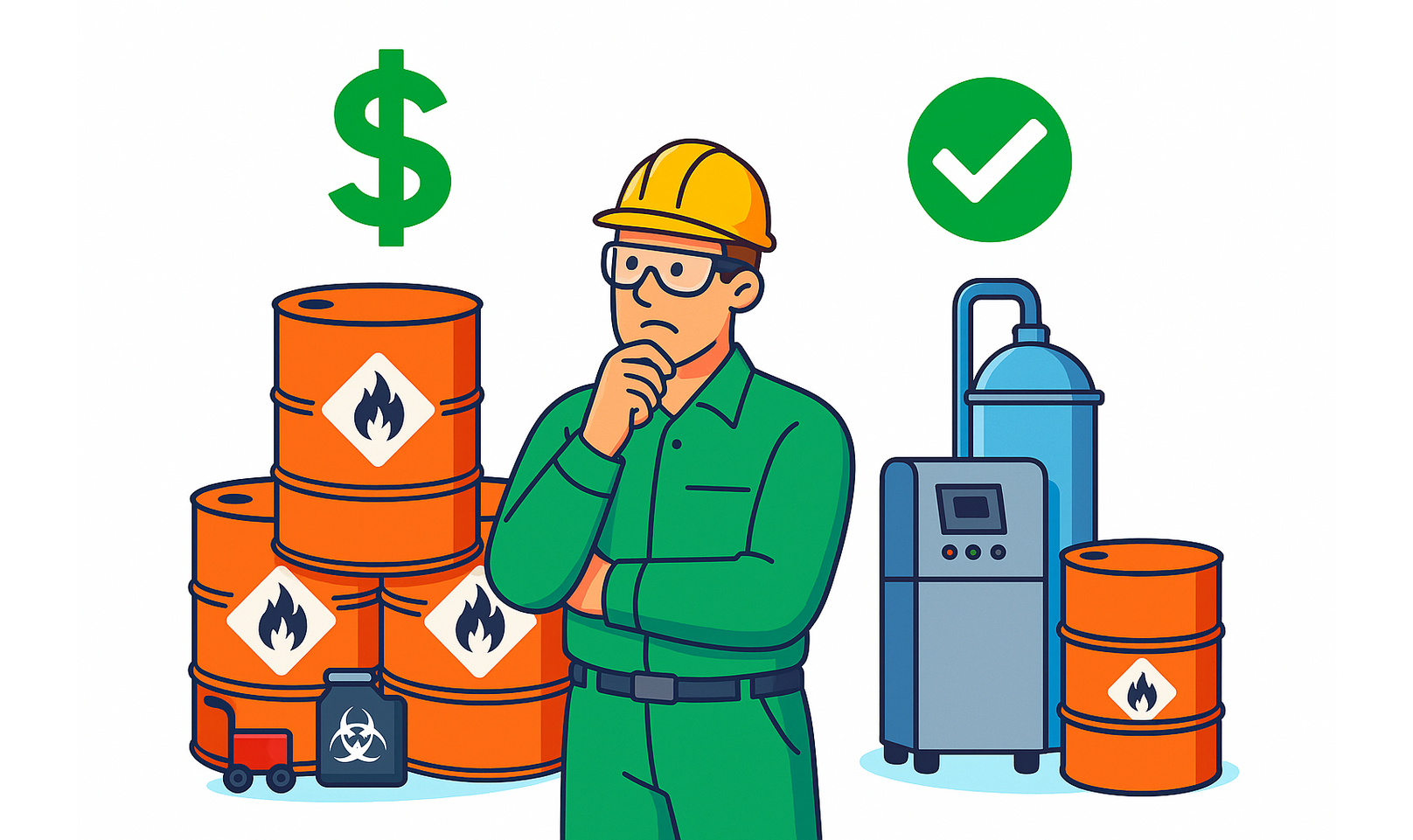
New Purchase vs. Solvent Regeneration | Which Is More Cost-Effective for Factories in Thailand?
Product Info
Find out which solvent management approach truly saves you more in your production line.
1. The hidden costs of buying new solvents
In industries such as chemicals, electronics, automotive components, and printing, solvents are widely used in large volumes. Many companies simply purchase new solvents every time, assuming it’s the easiest solution. However, the real cost of this practice is often underestimated.
Costs associated with purchasing new solvents include:
- Cost of new solvents (e.g., IPA, Acetone, Toluene)
- Logistics and storage costs
- Disposal costs for used solvents, which must comply with strict environmental regulations
- Potential fines or penalties for improper waste management
When these costs are totaled, factories can easily spend millions of baht per year just on solvent procurement and disposal.
===============================
2. Solvent regeneration: One-time investment, long-term savings
Solvent regeneration using an automatic solvent regenerator allows factories to recover and reuse solvents by separating contaminants through distillation. With modern equipment, it’s possible to recover 90–95% purity, significantly reducing the need for new solvent purchases.
Benefits of regeneration include:
- Substantial reduction in new solvent purchases (up to 70% or more)
- Lower waste disposal volumes and costs
- Easier compliance with environmental standards like ISO14001
- Reduced chemical storage risks
===============================
3. A simplified cost comparison
Let’s assume a factory uses 1,000 liters of solvent per month, at 80 THB per liter.
If purchasing new solvents:
- Solvent cost = 80 x 1,000 = 80,000 THB/month or 960,000 THB/year
- Disposal cost \~15 THB/liter = 15 x 1,000 = 15,000 THB/month or 180,000 THB/year
- Total annual cost ≈ 1,140,000 THB
If regenerating 80%:
- Purchase only 20% new solvent = 200 liters x 80 = 16,000 THB/month or 192,000 THB/year
- Disposal cost for 200 liters = 3,000 THB/month or 36,000 THB/year
- Total annual cost ≈ 228,000 THB
Summary:
- Annual savings ≈ 912,000 THB
- Typical payback period for a regenerator: 1–2 years, depending on volume and model
===============================
4. Key points to consider
- Monthly usage volume: If too low, ROI may not justify the investment.
- Solvent types: Confirm that the regenerator supports the specific solvents you use.
- Installation space: Includes tanks, control units, and ventilation.
- Operator training: Proper operation and maintenance training are essential.
For factories with continuous high-volume solvent use, regeneration dramatically cuts costs, increases profits, and improves environmental sustainability.
===============================
5. Why choose MORIKAWA Co., Ltd.
MORIKAWA Co., Ltd. provides high-performance solvent regenerators designed for diverse industrial applications. Key advantages include:
- Automatic control system that’s easy to use
- Advanced safety features such as temperature and pressure sensors with automatic shutdown
- Compatibility with various solvents, including high-boiling-point types
- Full support and after-sales service, including local partners like T.I.T. ELECTRONICS CO., LTD. in Thailand
Choosing MORIKAWA ensures your solvent management is safe, economical, and environmentally friendly, regardless of factory size.
For more details, please download the PDF or feel free to contact us directly.
#SolventRegeneration #FactoryCostSaving #ThailandIndustry #ReduceSolventWaste #ISO14001 #MORIKAWA #SustainableFactory #ChemicalWasteReduction #IndustrialThailand #FactoryInnovation
CATALOG
Related Catalogs
CONTACT
Inquiry