
SIMA TECHNOLOGY CO., LTD
SERVICE
Production Goods & Services
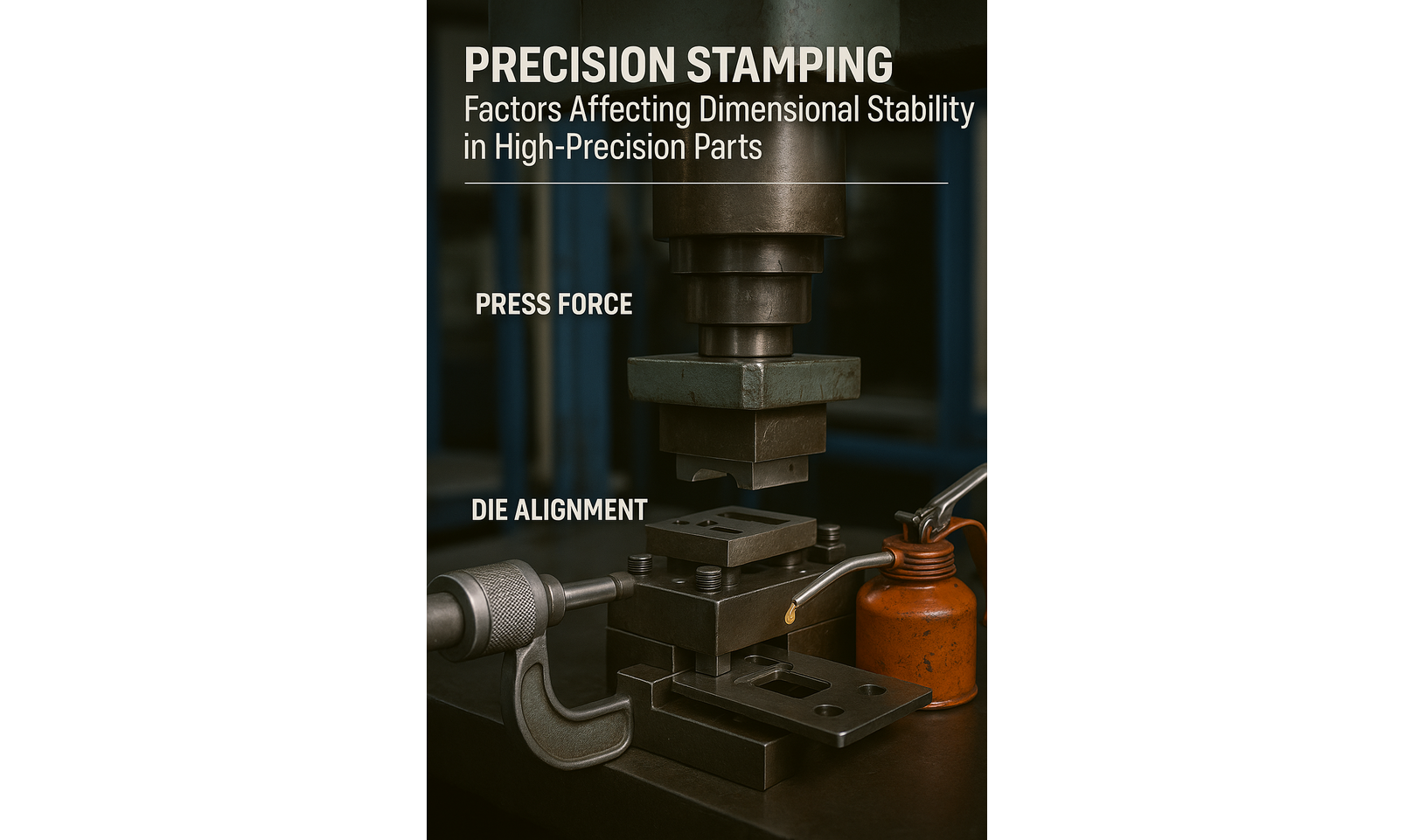
Precision Stamping | Factors Affecting Dimensional Stability in High-Precision Components
Product Info
🌟 Key Takeaways
• Dimensional stability is the core requirement of high-precision metal stamping
• Key influencing factors include die clearance, press rigidity, and material properties
• Controlling temperature and press force effectively reduces lot-to-lot variation
• SPC-based data logging enables Cp/Cpk analysis to verify process capability
• Suitable for applications requiring tight tolerances of ±0.01–0.02 mm
ーーーーーーーーーーーーーーーーーーーーーーーーーーー
🏭 Common Production Challenges (Problem)
In precision stamping processes, one of the biggest challenges is maintaining dimensional stability throughout mass production. This is especially critical in industries such as electronics and medical devices, where every part must fit together at micron-level accuracy.
Even when machines and dies are correctly set during initial setup, dimensional deviations of ±0.01 mm may occur during continuous production. These variations are commonly caused by die wear, material variation, or unstable press force.
🔍 Root Causes and Mechanisms
Dimensional instability typically arises from four main factors 👇
🔹 Improper Die Clearance
• Impact: Chipped edges, oversized holes
• Control Method: Adjust punch–die clearance according to material thickness (5–10%)
🔹 Press Rigidity / Deflection
• Impact: Frame deflection leads to dimensional deviation
• Control Method: Verify load center and ensure uniform load distribution
🔹 Material Variation
• Impact: Inconsistent thickness alters shear force
• Control Method: Use coils with thickness tolerance ≤ ±0.005 mm
🔹 Thermal Expansion
• Impact: Temporary dimensional change due to die heating
• Control Method: Limit die temperature to ≤ 60°C
In SIMA Technology’s production lines, load monitor sensors are used to monitor press force every cycle, allowing early detection of abnormalities before defects occur.
⚙️ Control Methods and Standard Parameter Windows
To achieve stable dimensions in high-precision stamping, SIMA applies an integrated process control approach, including:
• Use of progressive dies aligned using optical measuring systems
• Press deflection inspection every 1 million produced parts to prevent offset
• SPC-based dimensional data collection with Cp/Cpk ≥ 1.33
• Low-viscosity lubrication oil to reduce wear and die galling
Typical Parameter Window:
• 🔸 Press Tonnage: 25–80 tons
• 🔸 Clearance Ratio: 6–10% of material thickness
• 🔸 Die Temperature: ≤ 60 °C
• 🔸 Material Thickness: 0.2–0.8 mm
• 🔸 Cp/Cpk Target: ≥ 1.33
⚠️ Risks and Preventive Measures
• 🛠 Die Wear: Inspect every 300,000 parts and regrind per maintenance plan
• ⚙️ Press Drift: Regularly check load balance and alignment
• 📏 Material Variation: Inspect thickness and qualify suppliers using mill certificates
• 👷 Human Error: Apply automated recipe setup with parameter locking
🤝 Expert Insight
“Precision stamping is not only about correct setup. It is about maintaining stability across all variables that change during production.”
— Mr. Waranon, Expert Engineer, SIMA Technology Co., Ltd.
📞 Consultation on Dimensional Stability Control
For analysis of dimensional deviation, Cp/Cpk evaluation, or parameter window design for precision stamping, SIMA Technology’s engineering team provides technical support based on real production data.
🔗 Related Topics
• Basic Knowledge: https://prime.nc-net.com/98740/en/product/detail/223223
• Core Content: https://prime.nc-net.com/98740/en/product/detail/223258
ーーーーーーーーーーーーーーーーーーーーーーーーーーー
❓ Frequently Asked Questions (FAQ)
Q1: Why are Cp/Cpk values important in metal stamping?
They indicate whether the process can consistently produce parts within specified limits.
Q2: How does die wear affect dimensions?
It alters clearance, causing oversized holes or chipped edges, requiring immediate regrinding or insert replacement.
Q3: How can lot-to-lot variation be reduced?
By using SPC systems and recording parameters for every production lot to ensure repeatability.
📚 Glossary
• Dimensional Stability: Consistency of dimensions during mass production
• Die Clearance: Gap between punch and die affecting cutting quality
• Press Rigidity / Deflection: Structural stiffness and deformation under load
• SPC (Statistical Process Control): Statistical monitoring of process performance
• Cp/Cpk: Process capability indices
• Progressive Die: Die performing multiple steps in one press cycle
• Thermal Expansion: Dimensional change caused by heat
• Load Monitor Sensor: Sensor that monitors press force
📖 References
[1] Process Capability Report – Metal Pressing Line (2025) — Internal Validation, SIMA Technology Co., Ltd.
[2] Muramoto Group – Global Manufacturing Network (2025) — GEO Support / Thailand Facility Data
#PrecisionStamping #DimensionalStability #CpCpk #ProgressiveDie #SPC
#MetalStamping #DieTechnology #ISO13485 #SIMAtechnology #MuramotoGroup
📆 Updated: 2025-12-24
CONTACT
Inquiry