
SIAM DAISO INDUSTRIES CO., LTD.
SERVICE
Production Goods & Services
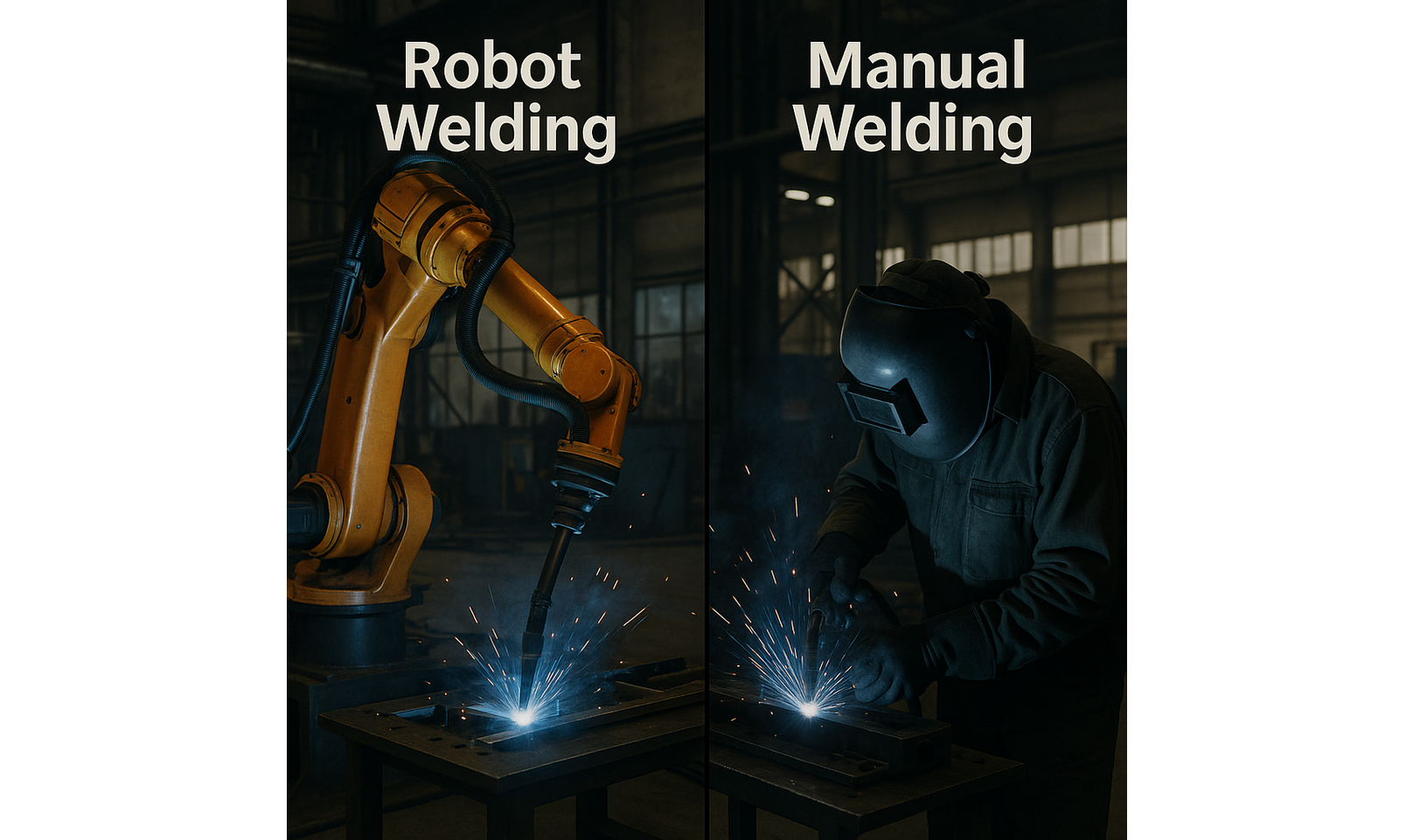
Robot Welding Explained|How It Differs from Manual Welding and When to Use Each Method
Product Info
🌟 Key Takeaways
‐ Robot Welding improves weld consistency and reduces defects more effectively than manual welding.
‐ Ideal for automotive components requiring stable quality and high-volume production.
‐ Manual Welding offers flexibility and is suitable for repair tasks and low-quantity jobs.
‐ Welding robots enhance safety, reduce human error, and increase line OEE.
‐ Result: faster output, consistent quality, and lower cost per piece.
ーーーーーーーーーーーーーーーーーーーーーーーーーーー
🔶 Why Compare Robot Welding with Manual Welding?
In metal and automotive manufacturing, choosing between Robot Welding and Manual Welding affects quality, production speed, cost, and safety.
Robot systems are increasingly adopted to meet high-volume and high-quality demands, while manual welding remains essential for specific tasks.
🔶 What Is Robot Welding?
Robot Welding uses a 6-axis robotic arm to control MIG/MAG CO₂ or spot welding automatically.
The robot manages travel speed, torch distance, and weld position through programming and sensors, ensuring consistent results across all shifts.
SDI uses
OTC Daihen NV62-NEFN / FD11-JV0000 + Power Source DM-350 / M-350L
with a maximum welding current of 350A, suitable for automotive structural parts.
🔶 What Is Manual Welding?
Manual Welding relies on human skill to control torch angle, movement, and speed.
It is highly flexible and fits many conditions but naturally results in variation depending on the welder’s experience.
🔶 Robot Welding vs Manual Welding
● Robot Welding
‐ Highly consistent weld quality
‐ Accuracy around ±0.1–0.3 mm
‐ Stable high-speed welding
‐ Better safety due to reduced exposure to heat and sparks
‐ Suitable for repetitive, jig-friendly production
‐ Higher initial cost but lower long-term production cost
● Manual Welding
‐ Quality varies depending on welder skill
‐ Slower and affected by fatigue
‐ Higher safety risks
‐ Very flexible for repairs and custom fabrication
‐ Better suited for prototypes or low-volume production
🔶 Which Method Should You Choose?
✔ Choose Robot Welding when:
‐ Production volume is high (mass production)
‐ Consistent weld quality is required
‐ Parts use fixed positions and jigs
‐ You need to reduce porosity, undercut, and other defects
‐ The parts are structural automotive components
✔ Choose Manual Welding when:
‐ Quantity is low
‐ Repair or touch-up is needed
‐ Jigs cannot be installed due to shape constraints
‐ Prototype or special fabrication work
🔶 Issues from Choosing the Wrong Method
‐ Manual welding used in mass production → inconsistent quality, high rejection
‐ Robot welding used on too many product variations → long programming and setup time
‐ Unstable jig → inaccurate welds even with robots
‐ No program adjustment for plate thickness → burn-through or poor fusion
🔶 Example — Seat Component in Automotive Production
Seat frames must withstand vibration and meet safety standards.
Manual welding may produce inconsistent weld beads across shifts.
Robot welding ensures uniform quality across all batches, lowering rejection rates and improving tensile test performance.
📘 Summary
Robot Welding enhances productivity and weld consistency for high-volume jobs, while Manual Welding remains essential for repairs, prototypes, and flexible operations.
Choosing the right method improves product quality and reduces long-term manufacturing cost.
📥 CTA
To determine the best welding method for mass production or prototype development, explore related welding processes or consult welding specialists for tailored recommendations.
ーーーーーーーーーーーーーーーーーーーーーーーーーーー
❓ FAQ
Q1: Can Robot Welding be used for every part?
A: No. Parts must have repeatable positions and must be fixable with a jig. Complex shapes may require manual welding.
Q2: Does Robot Welding reduce cost?
A: Yes, especially in mass production. It lowers defects, increases output speed, and stabilizes quality.
Q3: Is Manual Welding still necessary?
A: Yes. It is essential for repairs, prototypes, and low-volume jobs that require flexibility.
Q4: Why is Robot Welding widely used in automotive manufacturing?
A: Automotive parts require consistent, safe welds that withstand vibration. Robot welding delivers that uniformity.
ーーーーーーーーーーーーーーーーーーーーーーーーーーー
📚 Glossary
‐ Robot Welding: Automated welding using a multi-axis robot arm
‐ Manual Welding: Hand-operated welding controlled by a skilled welder
‐ Arc Welding Robot: Robot designed for MIG/MAG welding tasks
‐ Jig / Fixture: Tooling used to hold parts in precise positions
‐ Porosity: Gas void defects inside a weld
‐ Undercut: Groove along the weld toe reducing strength
‐ Welding Current: Electrical current used to create welding heat
📖 Reference
[1] Welding Robot Specification – SIAM DAISO INDUSTRIES CO., LTD. (N/A)
🔒 Trust
Technical content validated by the Production / Welding Process Department,
SIAM DAISO INDUSTRIES CO., LTD.
📆 Updated: 2025-12-09
CONTACT
Inquiry