
SIAM DAISO INDUSTRIES CO., LTD.
SERVICE
Production Goods & Services
EDP vs Powder Coating|What’s the Difference and Which One Should You Use for Metal Parts?
Product Info
🌟 Key Takeaways
- EDP is suitable for applications that require high corrosion resistance, especially automotive parts.
- Powder Coating provides a beautiful thick finish but cannot reach deep holes or inner cavities as well as EDP.
- EDP creates a thin, uniform film that covers the entire part and helps prevent internal rust.
- Powder Coating is ideal for decorative work, visible surfaces, and parts that do not face severe corrosion.
- Simple rule: EDP = durability / Powder = appearance.
ーーーーーーーーーーーーーーーーーーーーーーーーー
🔶 Why Compare EDP and Powder Coating?
Many metal part manufacturers struggle to choose between EDP (Electro-Deposition Coating) and Powder Coating. Both methods are widely used, but their performance differs greatly—especially for automotive components that must pass the Salt Spray Test (SST) under standards from Toyota, Honda, Isuzu, Mitsubishi, and Ford.
These requirements are commonly applied in real automotive production lines in Thailand.
🔶 What Is EDP and What Is Powder Coating?
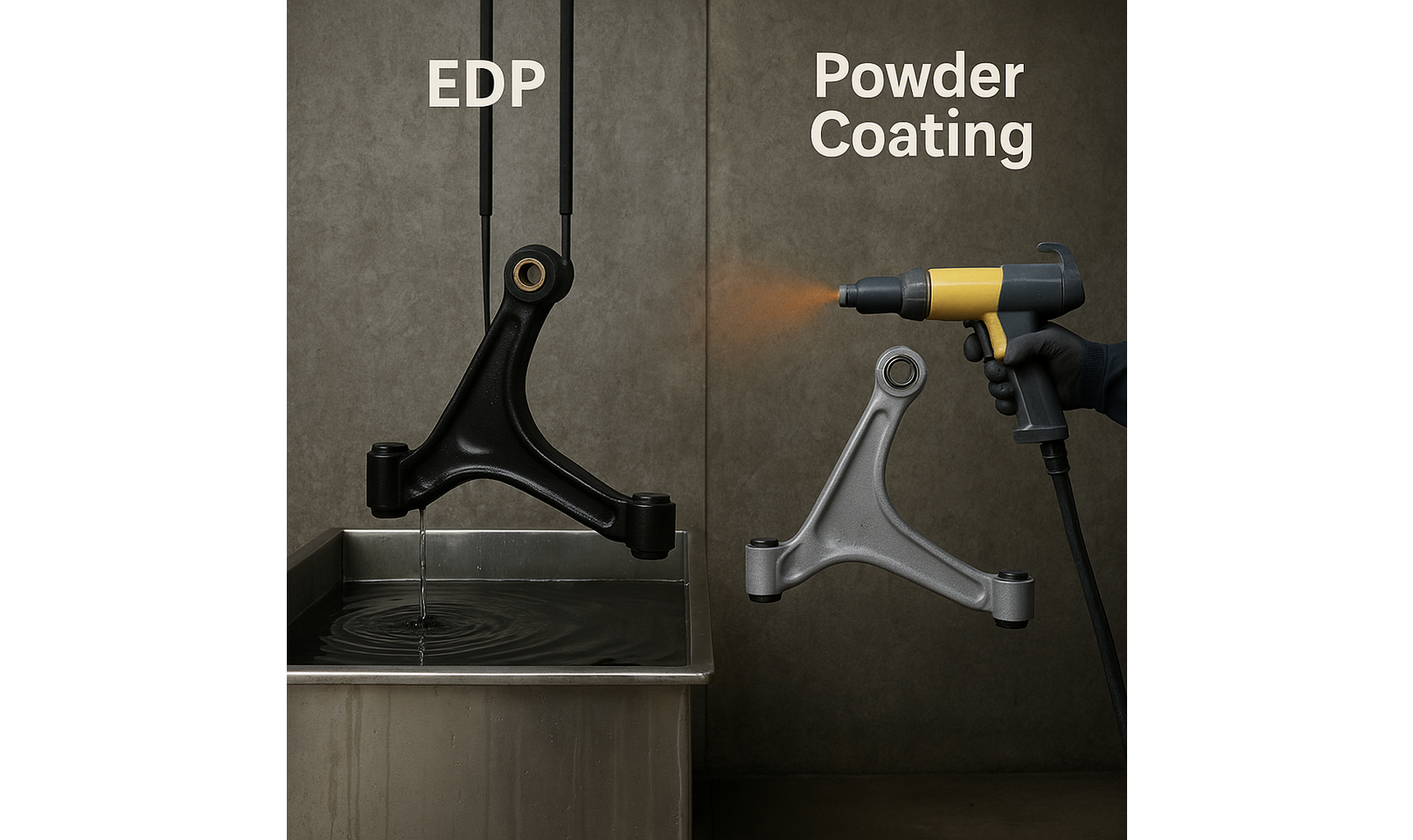
● EDP Coating – Electrical Deposition
- The part is dipped into a paint tank, and electricity pulls the paint onto the entire surface.
- Excellent penetration into narrow gaps and internal cavities.
- Ideal for complex parts like seat components, brackets, and reinforcements.
- Often uses Epoxy Black paint with fully automatic systems to achieve consistent and high corrosion resistance.
● Powder Coating – Sprayed Powder Film
- Powder paint is applied using electrostatic spray, then baked to form a solid film.
- Creates a thick, attractive finish.
- Does not reach deep cavities or hidden areas well.
- Best for decorative parts, visible surfaces, or components that do not face heavy corrosion.
🔶 Key Differences Between EDP and Powder Coating
● EDP typically provides:
- Thin and very uniform coating
- Excellent penetration into tight areas
- Higher corrosion resistance (especially with epoxy)
- Best for automotive parts, structural components, and complex shapes
● Powder Coating typically provides:
- Thick, smooth, visually appealing finish
- Limited penetration into hidden or deep areas
- Good scratch resistance
- Best for decorative parts or exterior finishes
🔶 Practical Tips – How to Choose the Right Method
✔ Choose EDP if…
- You need to pass SST for 500–1,000 hours
- Parts have complex shapes or internal cavities
- You require a thin, even coating across every surface
- The part is a structural automotive component
Note:
Industrial EDP lines often operate with Fully Automatic systems, 400 kg per bar, and a 135-minute cycle time, which helps maintain stable coating quality.
✔ Choose Powder Coating if…
- Appearance and surface finish are the priority
- The part has no deep cavities
- Suitable for indoor or decorative applications
- You need a thick and colorful finish
🔶 Common Problems When Choosing the Wrong Method
- Using Powder on complex parts → coating cannot reach inside → internal rust occurs
- Using EDP without an automatic system → uneven film → SST failure
- Misunderstanding “thicker film = better durability” → in reality, uniformity matters more
🔶 Example – Seat Component Case
Seat Tracks and Reinforcements contain multiple layers and small cavities. Powder Coating often fails to cover internal areas, leading to early rust.
EDP uses electrical attraction to pull the paint into every corner, providing better corrosion resistance, longer part life, and fewer warranty claims.
📘 Summary – The Simple Way to Decide
- EDP = high corrosion resistance / uniform coating / suitable for complex shapes
- Powder = aesthetic finish / thick film / suitable for decorative parts
📥 CTA
For a deeper understanding of selecting the right coating method for real manufacturing conditions, consider reviewing related EDP and Powder Coating materials or consulting surface-coating specialists.
ーーーーーーーーーーーーーーーーーーーーーーーーー
❓ FAQ
Q: Can EDP replace Powder Coating?
A: Yes, for corrosion protection. No, if the part requires a decorative or colorful surface.
Q: Why is EDP recommended for complex shapes?
A: Because electrical attraction allows paint to reach narrow gaps and hidden areas where spraying cannot.
Q: Is Powder Coating more durable?
A: It has good scratch resistance but lower corrosion resistance than EDP.
ーーーーーーーーーーーーーーーーーーーーーーーーー
📚 Glossary
- EDP Coating: Electrical coating process that creates a uniform film
- Powder Coating: Powder paint applied by electrostatic spray and baked
- Epoxy Black: Highly corrosion-resistant epoxy paint used in automotive parts
- Salt Spray Test (SST): Corrosion resistance test under OEM standards
- Cross Cut Test: Film adhesion test
- Fully Automatic Line: Automated coating system for consistent quality
📖 Reference
[1] EDP Line Specification – SIAM DAISO INDUSTRIES CO., LTD.
[2] Automotive SST Requirement – OEM Standard
🔒 Trust
Technical details such as line specifications, epoxy paint type, and SST conditions are validated by the Production / Coating Process team of an automotive coating facility in Thailand.
📆 Updated: 2025-12-09
CONTACT
Inquiry