
LILAMA 10 Joint Stock Company
PRODUCTS
Technology / Product Information
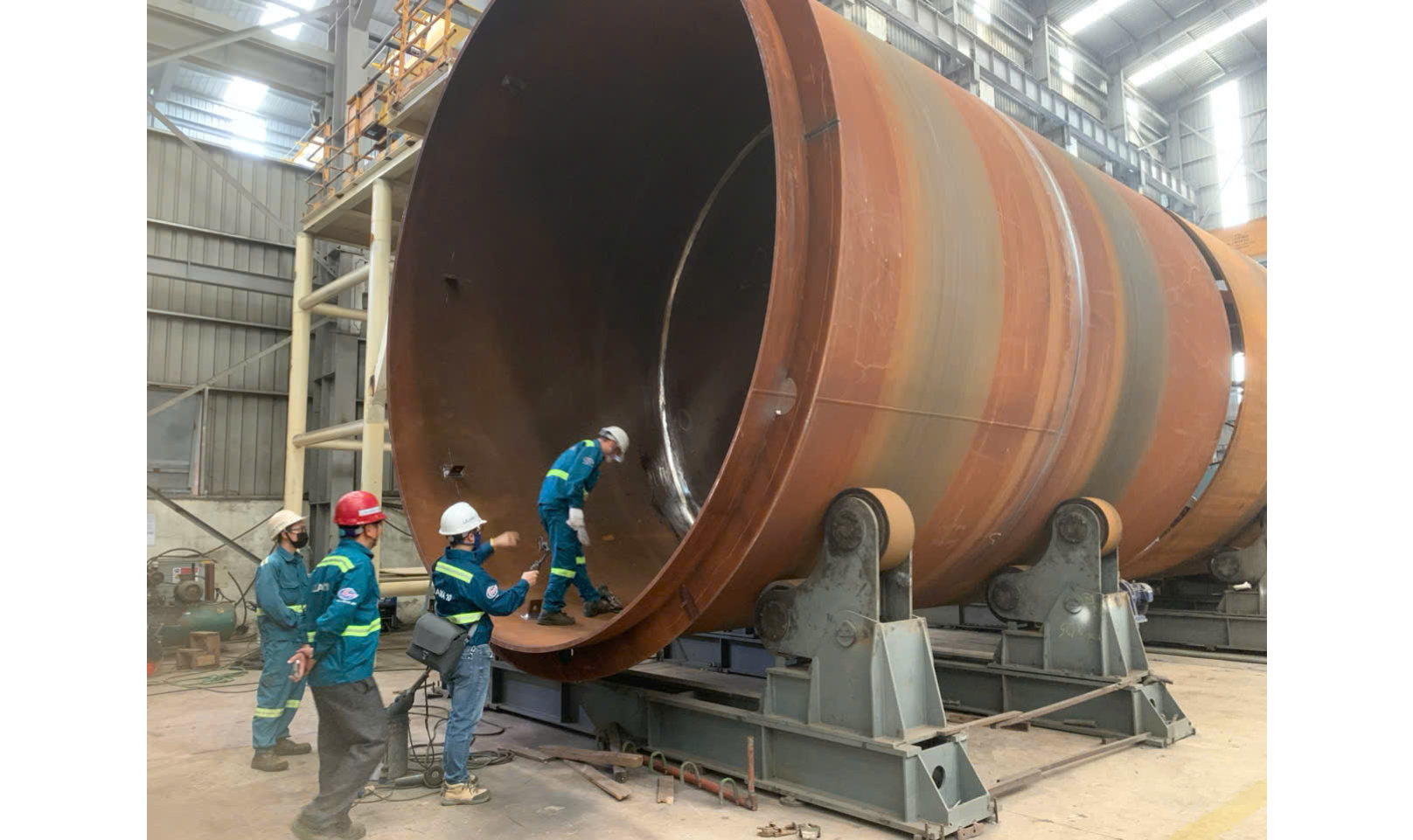
Application of Non-Destructive Welding Technology (NDT) and PWHT in Pumped Storage Hydropower Penstock Manufacturing at Lilama 10
Technology / product information
In pumped storage hydropower projects, the pressure penstock is a critical component subjected to heavy loads and continuous pressure fluctuations during operation. Therefore, stringent requirements are imposed on weld tightness, structural strength, and long-term durability.
To meet international standards for such projects, Lilama 10 implements an integrated approach combining non-destructive testing (NDT), TOFD technology, and post-weld heat treatment (PWHT), supported by long-established steel fabrication experience and modern equipment.
1. Non-Destructive Testing (NDT) – The foundation of weld quality assurance
NDT (Non-Destructive Testing) refers to inspection methods that evaluate weld quality without damaging the product, enabling detection of internal defects such as cracks, porosity, lack of fusion, and structural discontinuities.
It is a mandatory process for high-pressure structures.
In pumped storage hydropower penstock projects, Lilama 10 applies various NDT methods, with TOFD (Time of Flight Diffraction) being the most critical. TOFD is recognized as one of the most advanced NDT techniques due to:
High sensitivity to deep cracks
Full-thickness inspection capability
Excellent repeatability with low measurement uncertainty
Clear visualization of defect size and characteristics
2. Application of TOFD Level 1 – EN 15626:2018
TOFD results at Lilama 10 are evaluated according to EN 15626:2018 – Level 1, the most stringent acceptance level under this standard. Level 1 requires:
Accurate detection and classification of welding-induced defects
Assurance of the highest safety level for pressure-bearing structures
In addition, Lilama 10 applies:
ISO 11666:2018 – Ultrasonic acceptance criteria for weld defects
ISO 23279:2017 – Characterization and classification of UT/TOFD indications
3. Temperature-controlled welding process – A critical step before NDT
To ensure accurate NDT results and minimize risks of thermal or hydrogen-induced cracking, Lilama 10 implements strict thermal control during welding:
Preheating materials to a minimum of 80°C and maintaining temperature throughout welding
Interpass temperature controlled below 190°C
Post-weld heating to 350°C, maintained for 4 hours to eliminate hydrogen and prevent cold cracking in thick welds
All welding activities are supervised by Lilama 10’s welding inspectors and three technical experts appointed by the European project owners (ATB, FGJV, and SHL).
4. TOFD inspection after 72-hour hydrogen release
Lilama 10 conducts TOFD inspection only after a 72-hour hydrogen release period following welding. This allows:
Stabilization of the metal microstructure
Removal of residual hydrogen
Prevention of delayed cracking
Improved accuracy of TOFD measurements
This step ensures that NDT results accurately reflect the true weld quality before heat treatment.
5. PWHT – Residual stress relief and mechanical property stabilization
After welding and NDT, all penstock sections are placed in Lilama 10’s large-scale PWHT furnace, capable of handling structures longer than 7 meters.
The PWHT cycle lasts approximately 14 hours, including:
Controlled heating
Holding at specified temperature
Controlled cooling to avoid thermal stress
The process is fully automated to ensure precise temperature and time control.
Through close integration of advanced inspection technologies, strict supervision, and synchronized equipment, Lilama 10 steadily meets the demanding technical requirements of pumped storage hydropower penstock manufacturing.
The application of NDT, TOFD Level 1, temperature-controlled welding procedures, and large-scale PWHT systems demonstrates Lilama 10’s commitment to strict compliance with international standards in pressure penstock fabrication.
These practices form a solid foundation for ensuring product reliability in high-technical-requirement energy projects.
PICKUP
Technology / Product Information
CONTACT
Inquiry