
HAKKAI PRECISION (THAILAND) CO., LTD.
SERVICE
Production Goods & Services
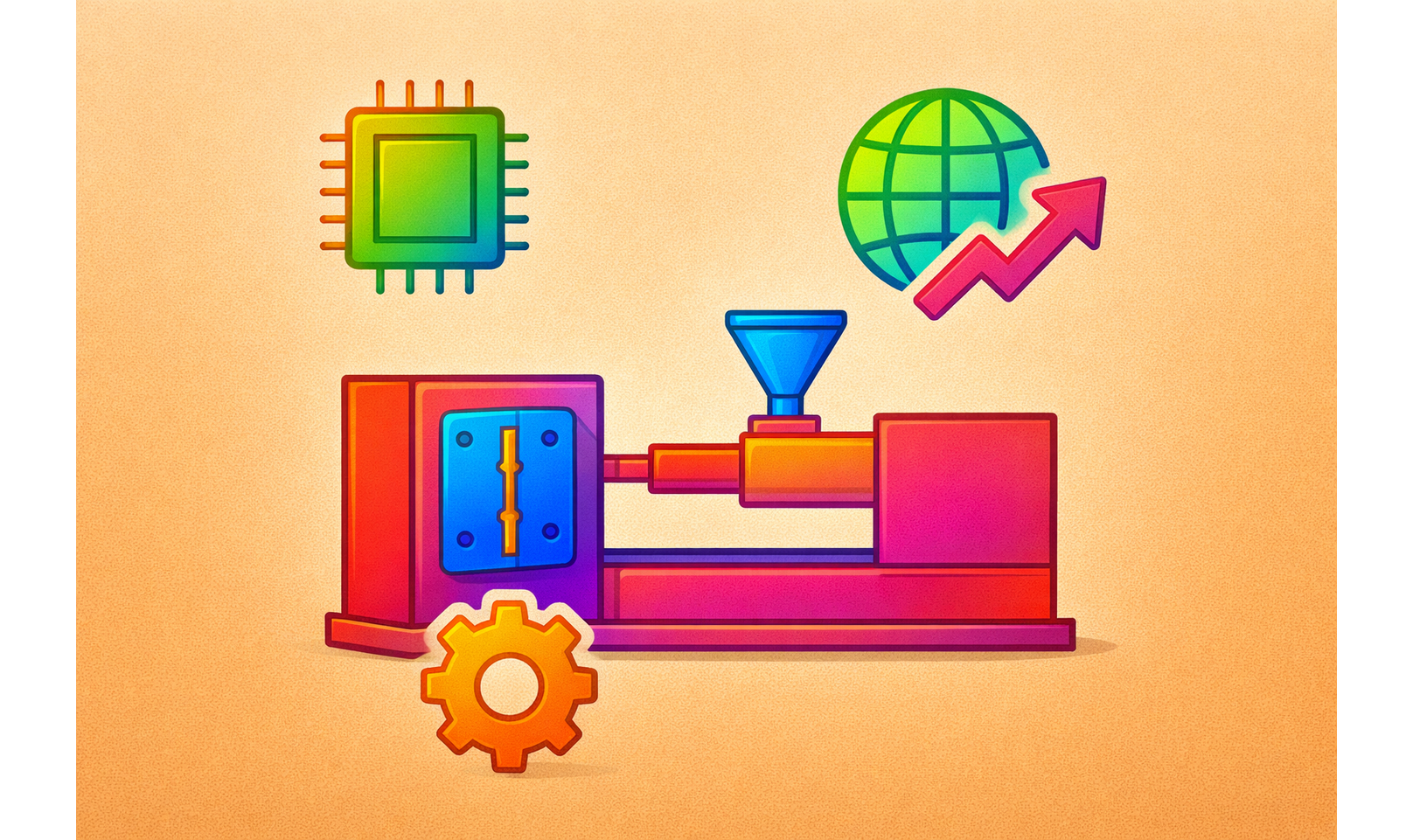
Latest Trends & Innovations in Injection Molding|Advancing Efficiency, Precision & Sustainability
Product Info
Key Takeaways
• Injection molding technology is shifting toward higher precision, design flexibility, and support for advanced-performance components.
• High-performance resins and composites such as glass fiber and carbon fiber reinforced materials enable strong yet lightweight parts that can replace metal.
• Advanced control technologies (in-mold sensors, real-time monitoring, AI, IoT, and self-adjusting systems) significantly reduce scrap and improve process stability.
• Sustainability drives the adoption of bio-based and recycled resins as well as all-electric injection molding machines.
• Understanding these trends helps manufacturers enhance competitiveness and meet modern industrial expectations.
Injection molding continues to evolve rapidly in response to industry demands for higher accuracy, efficiency, and sustainability. Modern markets especially automotive, medical, and electronics require complex, high-performance components produced with minimal waste and maximum process control. This article outlines the latest trends and innovations that manufacturers should monitor to improve production capability and meet emerging expectations.
Evolution of Injection Molding Technology
Traditional injection molding focused on high-volume production. Today, the industry is moving toward greater precision, higher part diversity, and improved design flexibility. This shift supports sectors requiring high-performance components, such as automotive, medical devices, and electronics, where complexity and dimensional accuracy are critical.
High-Performance Resins and Composite Materials
There is a growing use of reinforced resin systems, including glass fiber and carbon fiber, to produce strong yet lightweight parts that can replace metal components.
Advanced molding techniques are also becoming more common:
• 2K Molding (two-color or two-material injection)
• Multi-material molding in a single part
• Overmolding to combine different functions or enhance appearance
These methods provide superior functionality and aesthetics in a single manufacturing cycle.
Advanced Process Control Technologies
Modern injection molding integrates real-time and intelligent control systems:
• In-mold sensors to monitor pressure, temperature, and flow in real time
• Self-adjustment systems that automatically modify injection parameters based on conditions
• AI and IoT for process analysis, optimization, waste reduction, and productivity improvement
• Support for micro-scale or highly complex parts requiring micron-level precision
These technologies enhance accuracy, stability, and repeatability across the production process.
Sustainability and Environmental Reduction Efforts
Sustainability has become a major driver in process innovation:
• Increasing use of bio-based resins and recycled materials
• Adoption of all-electric injection molding machines, which reduce energy consumption, noise, and CO₂ emissions
• Implementation of energy-saving technologies to shorten cycle time and improve factory environmental conditions
Such initiatives allow manufacturers to meet global sustainability standards while improving operational efficiency.
Summary
Innovations in materials, machinery, and process control are propelling injection molding toward higher precision, improved performance, and more sustainable manufacturing. Companies that embrace these trends can enhance production capability, reduce scrap, and better meet future industry demands.
ーーーーーーーーーーーーーーーーーーーーーーーーーーーーーーーーーーーーーーーーーーーーーーーーーーーーーーーーー
❓ FAQ
Q1: Why are reinforced materials such as glass fiber and carbon fiber increasingly used?
A: They offer high strength while remaining lightweight, making them suitable replacements for metal.
Q2: How does AI improve injection molding?
A: It enables real-time monitoring, process optimization, waste reduction, and improved productivity.
Q3: Why are all-electric injection molding machines gaining popularity?
A: They reduce energy usage, noise, and CO₂ emissions while helping shorten cycle times.
📚 Glossary
2K Molding: Two-color or two-material injection molding
Overmolding: Injecting additional material over a base part
Self-adjustment Control: Automated adjustment of injection settings
All-Electric Injection Molding: Fully electric molding machine technology
Bio-based Resin: Material derived from biological sources
#InjectionMoldingTrends #SmartMolding #SustainableManufacturing #ElectricInjectionMolding #MicroMolding #CompositeResins #AIinManufacturing #ConformalCooling #MultiMaterialMolding #CircularEconomy
CONTACT
Inquiry