
SIAM ASAHI MANUFACTURING CO.,LTD.
SERVICE
Production Goods & Services
Failure Modes of Shift Forks in Manual Transmissions: Manufacturing Root Causes and Prevention
Product Info
🌟 Key Takeaways
• Most Shift Fork failures originate from material selection and manufacturing processes, not improper use.
• The main failure modes are deformation, wear, and fatigue cracking.
• Forging, CNC machining, and heat treatment must be designed as an integrated process.
• Upstream prevention reduces repair costs and long-term warranty risks.
ーーーーーーーーーーーーーーーーーーーーーーーーーーーーーーー
In manual transmission systems, the Shift Fork directly experiences repeated loads from gear shifting. Even minor damage can affect shift feel, noise, and the overall service life of the drivetrain. Field issues are often attributed to user operation, while the true root causes frequently lie in material design and manufacturing process control.
________________________________________
Problem Framing: Reliability & Warranty
When a Shift Fork fails, the impact extends beyond the component itself to NVH issues, customer satisfaction, and warranty costs. Addressing problems only at the downstream stage leads to high cost and unsustainable solutions.
Main Failure Modes of Shift Forks
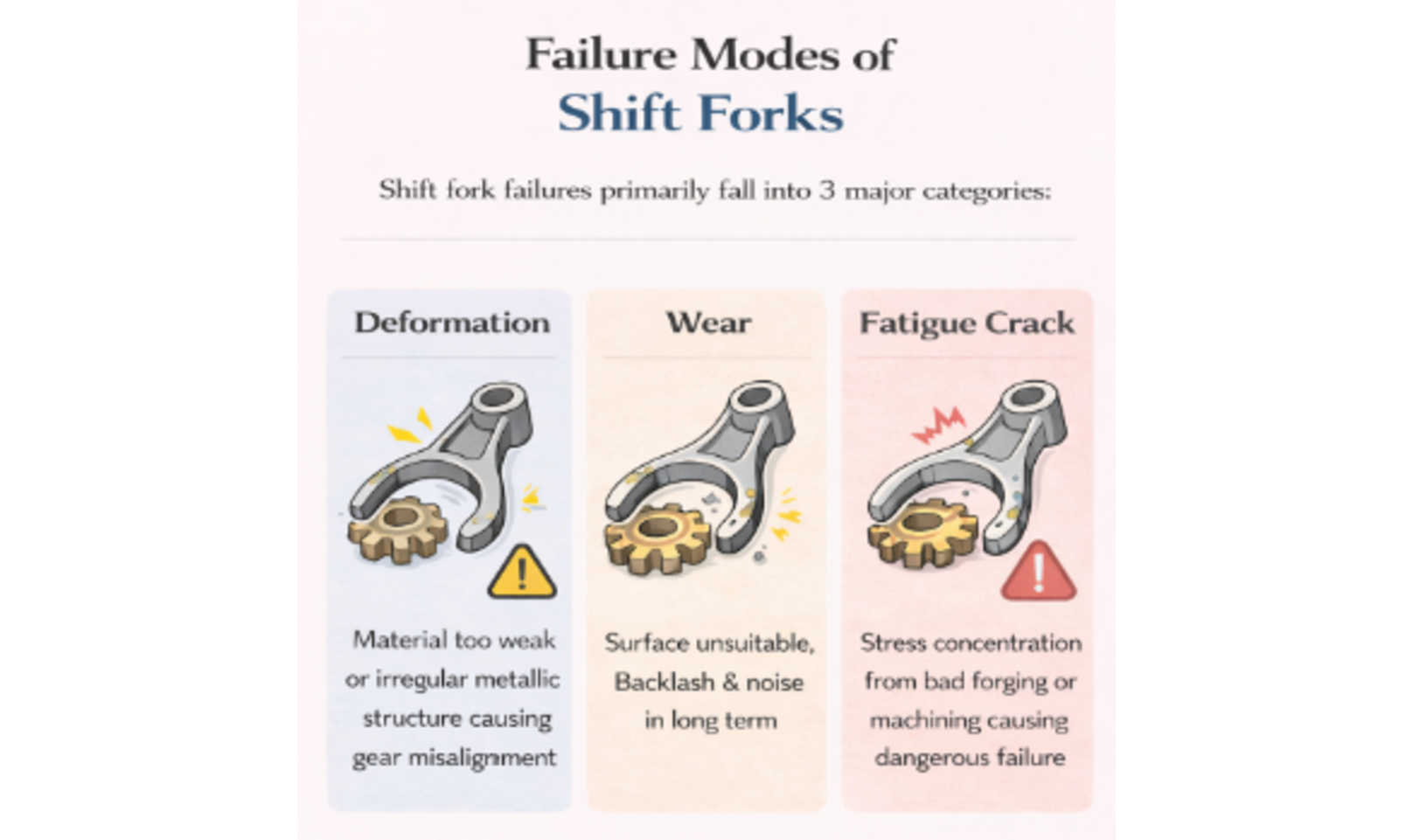
Shift Fork failures can be classified into three major types:
• Deformation: Caused by insufficient material strength or non-uniform metal structure, resulting in misaligned gear engagement.
• Wear: Occurs when surface condition or surface hardness is inadequate, leading to backlash and noise over time.
• Fatigue Crack: Typically initiates at stress concentration areas caused by improper forging or machining control. This failure may not appear immediately but is severe when it occurs.
________________________________________
Root Cause Chain: From Material to Process
These failure modes are connected through a chain of causes:
• Alloy material selection not matched to the load profile
• Forging without proper control of metal grain flow
• CNC machining that introduces sharp edges or residual stress
• Heat treatment that results in excessive hardness or brittleness
A single weak point can accumulate risk and eventually surface in field operation.
________________________________________
Method: Process-based Prevention
Reducing Shift Fork failures must begin upstream in manufacturing:
• Select materials suited to actual transmission loads
• Apply forging to enhance structural strength
• Control CNC machining for both dimensional accuracy and surface quality
• Design heat treatment to balance hardness and toughness
• Perform consistent dimensional and surface inspections
________________________________________
Evidence: Reliability Perspective
Manufacturing experience shows that Shift Forks with controlled failure modes from the production stage exhibit longer service life and significantly reduced OEM warranty claims.
________________________________________
Implication & Next Step
Focusing only on downstream failures increases hidden costs related to NVH and warranty. A sustainable approach is to design processes that prevent failure before it occurs. The next step is linking failure modes to design reviews, process FMEA, and quality control plans.
________________________________________
📘 Summary
Durable Shift Forks are not achieved by material alone, but by processes designed to prevent failure from the beginning. Deep understanding of failure modes reduces risk, builds trust, and creates competitive advantage in the automotive industry.
📥 CTA
To apply these concepts in real production, Siam Asahi Manufacturing Co., Ltd.
recommends reviewing the related Core Content and Basic Knowledge topics, or contacting the Production Engineering and Quality Assurance teams.
ーーーーーーーーーーーーーーーーーーーーーーーーーーーーーーー
❓ FAQ
Q: Where do Shift Fork failures typically originate?
A: They usually begin with material selection and process control before appearing in the field.
Q: Does minor wear really matter?
A: Yes. It accumulates and affects gear accuracy and noise over time.
________________________________________
📚 Glossary (Key Terms)
• Failure Mode: A specific type of component failure
• Deformation: Bending caused by insufficient strength
• Fatigue Crack: Cracking due to repeated cyclic stress
• Process FMEA: Risk analysis of manufacturing processes
________________________________________
📖 Reference
Shift Fork Failure Analysis & Process Control Guideline – Production Engineering / QA Department, Siam Asahi Manufacturing Co., Ltd. (N/A) – Internal Validation
________________________________________
🔗 Cluster Internal Link
• Core Content: https://prime.nc-net.com/89878/en/product/detail/242288
• Basic Knowledge: https://prime.nc-net.com/89878/en/product_others/detail_goods/27749
________________________________________
🔒 Trust
This content has been reviewed by Siam Asahi Manufacturing Co., Ltd.
to ensure the technical accuracy of the information.
________________________________________
#ShiftFork #FailureMode #ManufacturingProcess
#Forging #CNCMachining #HeatTreatment
#AutomotiveEngineering #QualityAssurance
#ReliabilityEngineering
📆 Updated: 2026-1-6
CATALOG
Related Catalogs
CONTACT
Inquiry