
SIAM ASAHI MANUFACTURING CO.,LTD.
SERVICE
Production Goods & Services
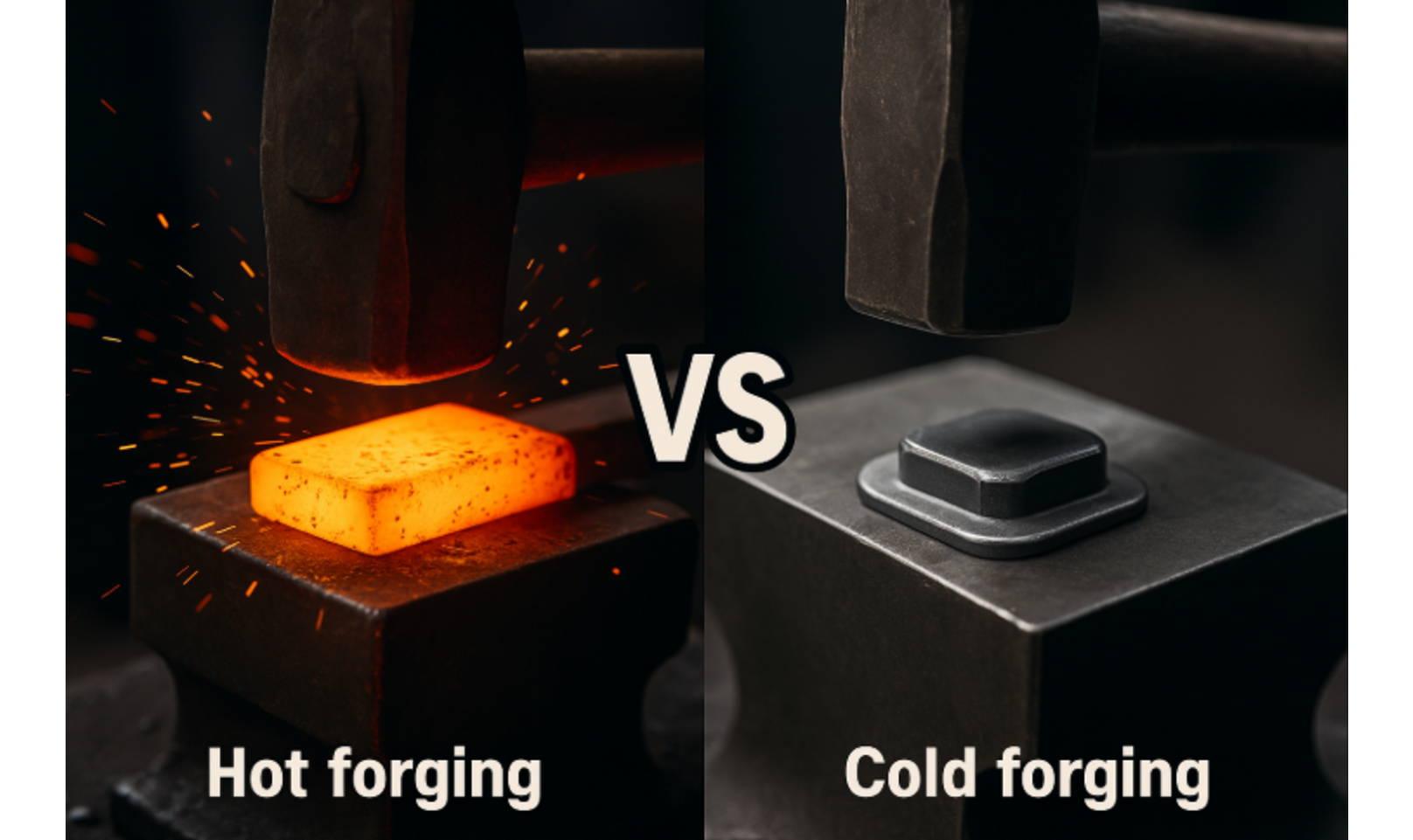
Differences Between Hot and Cold Forging | How to Choose the Right Method for Your Parts
Product Info
Choosing between hot and cold forging impacts product strength, dimensional accuracy, and production cost. This guide compares both methods and offers clear selection criteria—plus a trusted manufacturing solution from Siam Asahi Manufacturing (Thailand) Co., Ltd.
🔧 What Is Forging?
Forging is a metal shaping process that uses compressive force to mold metal into the desired shape. Unlike casting or machining, forging enhances the internal grain structure, resulting in stronger, more durable components.
🔨 Main Types of Forging:
1️⃣ Hot Forging
2️⃣ Cold Forging
The selection depends on part complexity, precision needs, production volume, and budget constraints.
🔥 Hot Forging Characteristics
Performed at temperatures between 900°C and 1250°C, hot forging allows for shaping ductile metals more easily.
Advantages:
・ Supports complex shapes
・ Enhances toughness and fatigue resistance
・ Ideal for large components (e.g., shafts, gears)
・ Low risk of cracking during forming
Limitations:
・ Lower dimensional accuracy—requires secondary machining
・ Rougher surface finish
・ Faster die wear due to high heat
❄️ Cold Forging Characteristics
Performed at or near room temperature, cold forging is best suited for precision applications.
Advantages:
・ High dimensional accuracy—minimal post-processing
・ Smooth surface finish
・ Work hardening improves part strength
・ Material-efficient—low waste
Limitations:
・ Unsuitable for complex geometries
・ Requires higher forming forces
・ Risk of cracking without proper lubrication
・ Limited to certain metals and shapes
🧭 How to Choose the Right Forging Method?
・ For complex, large-volume, and big-size parts → Choose Hot Forging
・ For tight tolerances, smooth finish, and minimal post-processing → Opt for Cold Forging
・ For cost-sensitive jobs with looser tolerances → Hot Forging may be more economical
・ For longer die life and less maintenance → Cold Forging offers advantages
👉 The decision should factor in both technical requirements and cost-effectiveness.
⭐ Recommended Process: Forging + CNC by Siam Asahi Manufacturing (Thailand) Co., Ltd.
Siam Asahi Manufacturing (Thailand) Co., Ltd. specializes in Shift Forks and Transmission Parts using both Hot and Cold Forging, followed by high-precision CNC Machining. Their process ensures low dimensional tolerances and durability suited for automotive and industrial applications.
By combining forging strength with CNC precision, their components meet the demanding standards of global automotive manufacturers.
■ You can download more details as a PDF or contact us immediately for inquiries.
#Forging #HotForging #ColdForging #CNCParts #PrecisionManufacturing #MetalForming #ShiftFork #TransmissionParts #ThaiFactory #AutomotiveComponents
CATALOG
Related Catalogs
CONTACT
Inquiry