Production Goods & Services

4hits

Narrow by category

Top Engineering Polymers for Screws|PEEK, PPS, PI and Their Key Properties

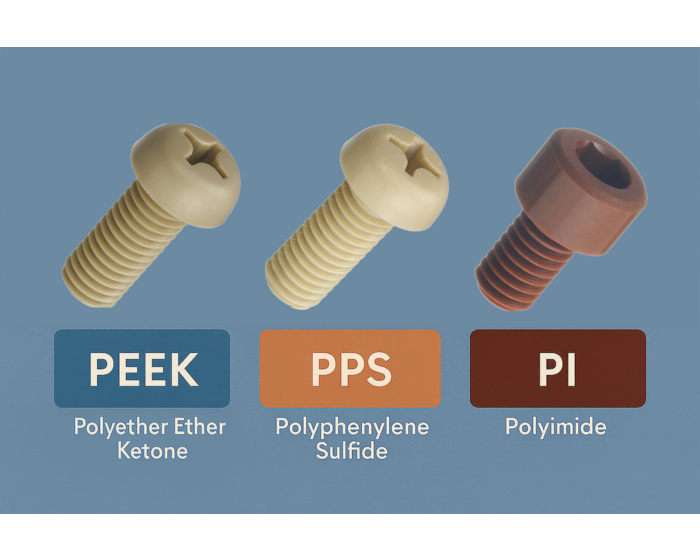
PEEK, PPS, and PI are high-performance engineering polymers used to manufacture screws that can withstand heat, chemicals, and high-stress environments. Discover their strengths and when to use each type for optimal performance. 1. Why Use Engineering Polymers for Screws? In today’s advanced manufacturing landscape, plastic screws and fasteners are increasingly replacing metal components, especially where thermal, electrical, and chemical resistance is critical. Engineering polymers offer unique advantages over metals: - Lightweight – Reduces system weight and enhances energy efficiency - Electrical insulation – Prevents short circuits in electronic assemblies - Chemical resistance – Withstands harsh environments - High thermal stability – Performs under elevated temperatures - Corrosion-proof – No rust, ideal for humid or chemical-prone settings Industries benefiting from these properties include electronics, aerospace, medical devices, chemical processing, and energy systems. 2. PEEK – A Premium Polymer for Maximum Performance Full Name: Polyether Ether Ketone Key Features: - Withstands continuous temperatures up to 250°C - Resists acids, alkalis, solvents, and sterilisation (autoclave) - Mechanical strength comparable to some metals - UV and gamma radiation resistant - Biocompatible for medical use Best Applications: - Semiconductor machinery components - Medical tools requiring sterilisation - Aerospace and satellite-grade parts - Chemical or energy industry equipment 3. PPS – High Performance with Cost Efficiency Full Name: Polyphenylene Sulfide Key Features: - Sustains 200–220°C continuous use - Chemically stable in acidic, alkaline, and oily environments - Very low water absorption, retains size accuracy - Flame retardant and electrically insulating Best Applications: - Fasteners in PCBs and electronics - Lab instruments and analysers - Appliance parts exposed to moderate heat - General machinery in corrosive environments 4. PI – For the Most Demanding Environments Full Name: Polyimide Key Features: - Endures extreme heat (up to 300°C) - Excellent chemical and electrical stability - High tensile/compressive strength - Insoluble in most solvents Best Applications: - Aerospace systems and thermal shielding - Scientific analysers and high-precision devices - Furnaces or thermal processing equipment - Systems exposed to rapid temperature shifts 5. Comparing When to Use PEEK, PPS, or PI ● Choose PEEK when: - Operating in continuous high heat - High mechanical and chemical resistance are both needed - Applications involve sterilisation or medical standards - You need long-term reliability in harsh conditions ● Choose PPS when: - Cost-efficiency is essential for medium-high heat applications - Dimensional stability and water resistance are priorities - You’re producing in volume for electronics or appliances - A flame-retardant material is needed ● Choose PI when: - Your product must withstand extreme heat >260°C - Dual resistance to chemicals and electricity is critical - Use involves aerospace or high-end scientific devices - Other materials fail under thermal cycling conditions 6. Why Choose NIPPON CHEMICAL SCREW CO., LTD. As a trusted Japanese manufacturer, NIPPON CHEMICAL SCREW CO., LTD. delivers premium plastic fasteners made from high-grade engineering polymers: - Materials include PEEK, PPS, and PI from top-tier suppliers - Fully integrated in-house production ensures quality and traceability - Custom solutions available for prototypes and technical designs - Proven expertise in demanding fields—semiconductors, medical, aerospace - Scalable production from small-batch to mass volume Looking for fasteners that combine heat resistance, chemical durability, and electrical insulation? NIPPON CHEMICAL SCREW CO., LTD. is your best-fit partner. #EngineeringPolymers #PEEKScrews #PPSFasteners #PolyimidePI #PlasticScrews #HighTemperatureMaterials #ChemicalResistantFasteners #MedicalGradePlastic #NipponChemicalScrew #OEMSolutions

What Are Plastic Fasteners?|Key Advantages and Materials of Plastic Hardware

Plastic fasteners are lightweight, non-conductive, and resistant to rust and chemicals—making them ideal for electronics, medical devices, and industrial machinery. Learn the core strengths and best-use materials in this guide. 1. What Is Plastic Hardware? Plastic hardware—commonly known as plastic fasteners—includes screws, nuts, washers, and related components made from engineering plastics rather than metal. These are used in industries such as electronics, medical devices, chemical processing, and precision equipment. Plastic fasteners offer key benefits over metal: they do not conduct electricity, resist corrosion, and weigh significantly less. These features make them essential for applications that demand insulation, non-magnetic properties, and reduced weight. 2. Key Plastic Materials and Their Properties - PPS (Polyphenylene Sulfide) Excellent chemical and heat resistance. Ideal for semiconductor systems and chemical plant machinery. - PC (Polycarbonate) Transparent and impact-resistant. Used in visible or safety-critical parts of medical and electronic equipment. - PA (Polyamide/Nylon) Strong and abrasion-resistant. Widely applied in general machinery, though it can absorb moisture, which affects precision. - PEEK (Polyether Ether Ketone) Withstands temperatures up to 250°C and harsh chemicals. Perfect for aerospace, high-end medical tools, and ultra-precision components. 3. Strengths of Plastic Fasteners - Lightweight – Lowers total system weight and boosts energy efficiency - Electrical Insulation – Safe for sensitive electronics and circuit boards - Chemical Resistance – Performs in harsh chemical environments - Non-Magnetic – Prevents magnetic interference in precision instruments - Corrosion-Free – Suitable for outdoor or humid environments 4. Important Usage Considerations - Lower tensile strength and torque vs. metal counterparts - Heat resistance depends on plastic type—critical for material selection - Some types (like Nylon) absorb moisture, affecting dimensions - Susceptible to UV degradation if not UV-stabilized for outdoor use 5. Why Choose NIPPON CHEMICAL SCREW CO., LTD. As a specialized leader in plastic fastening technology, NIPPON CHEMICAL SCREW CO., LTD. offers: - Full expertise in high-performance plastic fasteners - In-house manufacturing with flexible lead times and strict quality control - Versatile material offerings (PPS, PEEK, PC) for advanced applications - Proven track record in high-stakes sectors: semiconductors, medical, and chemical industries If you're looking for precision, reliability, and materials engineered for performance, NIPPON CHEMICAL SCREW CO., LTD. is your trusted partner. #PlasticFasteners #EngineeringPlastics #NonConductiveScrews #CorrosionResistant #PrecisionComponents #PPSFasteners #PEEKParts #MedicalDeviceHardware #OEMSolutions

What is PEEK Engineering Plastic (Polyether Ether Ketone) | Properties and Industrial Applications

PEEK (Polyether Ether Ketone) is a high-performance engineering plastic renowned for its strength, heat resistance up to 250°C, and chemical durability. It’s a top material choice for medical, electronic, aerospace, and precision industrial applications requiring long-term reliability. 1. What is PEEK? PEEK, or Polyether Ether Ketone, is a premium thermoplastic known for its mechanical strength, heat resistance, and chemical stability. It belongs to the category of high-performance engineering plastics and is widely used in harsh industrial environments. Its ability to maintain structural integrity under extreme conditions makes it ideal for medical implants, aerospace parts, automotive engines, and precision industrial machinery. 2. Key Properties That Set PEEK Apart - High Thermal Resistance: Continuous use at temperatures up to 250°C without deformation or loss of mechanical strength. - Chemical Resistance: Withstands strong acids, alkalis, solvents, and corrosive chemicals. - Mechanical Strength: Offers excellent tensile and impact strength—ideal for load-bearing components. - Radiation & UV Stability: Performs well in outdoor and sterilized environments such as clean rooms. - Electrical Insulation: Maintains strong dielectric properties in high-voltage systems. - High-Precision Machinability: Suitable for complex shapes using injection molding or CNC machining. 3. Industrial Applications of PEEK 3.1 Medical Industry PEEK is used in bone screws, spinal cages, and dental devices due to its biocompatibility and resistance to bodily reactions. 3.2 Automotive & Aerospace Ideal for parts near engines and exhaust systems, such as piston rings and seals, due to its high thermal resistance. 3.3 Electronics Used in insulation for high-voltage components, connectors, and PCBs requiring high thermal stability and non-flammability. 3.4 Chemical Processing Perfect for valves, pumps, and pipelines that transport corrosive substances with no leakage or degradation. 4. Key Considerations When Choosing PEEK - Form Type: Rod, sheet, or precision-molded part—choose based on end-use. - Performance Needs: Assess temperature range, mechanical load, and dimensional tolerance. - Cost Efficiency: PEEK is premium-priced—use where high performance justifies the cost. - Expert Manufacturing: Partner with experienced suppliers to ensure machining or molding meets industrial tolerances. 5. Why NIPPON CHEMICAL SCREW CO., LTD. for PEEK Components? NIPPON CHEMICAL SCREW CO., LTD. is a leading Japanese manufacturer specializing in precision fasteners and custom components made from high-performance plastics like PEEK. With deep expertise in chemical resistance, tight-tolerance machining, and industry certifications, their PEEK products support critical applications across medical, aerospace, and electronic sectors. Custom solutions, technical consulting, and rigorous quality control make them a trusted partner for demanding engineering challenges. Visit NIPPON CHEMICAL SCREW CO., LTD. Prime Page on EMIDAS #PEEKPlastic #EngineeringPlastic #HighPerformanceMaterials #PrecisionMachining #MedicalMaterials #AerospaceComponents #ChemicalResistance #NipponChemicalScrew #IndustrialApplications #CNCPlasticParts

How to Install Plastic Screws (PEEK/PTFE) | Tips to Prevent Deformation

Plastic screws made from high-performance materials like PEEK, PTFE, and PPS require careful installation to avoid deformation and ensure long-term structural integrity. This article offers essential industrial tips including torque control, hole dimensioning, and tool selection — especially for electronics, cleanroom, and chemical plant applications. 1. Why Do Plastic Screws Require Specialized Installation? Unlike metal fasteners, plastic screws offer chemical and heat resistance but have lower mechanical strength and elasticity. Improper installation may cause cracking, deformation, or failure — leading to reduced structural stability. Common materials include: - PEEK (Polyether Ether Ketone) - PPS (Polyphenylene Sulfide) - PTFE (Polytetrafluoroethylene) - PVDF (Polyvinylidene Fluoride) These materials excel in corrosive, cleanroom, and high-temperature environments, but require precision fastening techniques. 2. Use the Right Tools and Torque Settings Over-torqueing is one of the leading causes of plastic screw failure. Tips: - Use adjustable torque screwdrivers (manual or electronic). - Refer to the torque chart provided by the screw manufacturer. - Avoid high-RPM electric drivers unless equipped with torque limiters. 3. Maintain a Controlled Installation Environment Temperature and humidity impact plastic screw behavior. Tips: - Ideal installation temperature: 20°C–30°C - Avoid oils, chemicals, or lubricants on screw surfaces. - Store screws in a dry, temperature-stable area and inspect for warping before use. 4. Ensure Proper Pilot Hole Dimensions The pilot hole determines how the screw engages with the material. A misfit can lead to excessive stress or loosening. Tips: - Follow manufacturer’s exact pilot hole diameter. - Deburr the hole and clean it thoroughly. - For repeated assemblies, use metal inserts (threaded bushings) to preserve the integrity of the housing. 5. Avoid Over-Tightening — Apply “Just Enough” Torque Over-tightening damages the thread or head, especially in brittle or thin plastic parts. Tips: - Use a torque + angle method for consistent results in production environments. - Watch for visual cues: screw head distortion means you’ve tightened too much. - Use washers to evenly distribute clamping force. 6. Why Choose Plastic Screws from NIPPON CHEMICAL SCREW CO., LTD.? NIPPON CHEMICAL SCREW CO., LTD. is a leading Japanese manufacturer of precision plastic fasteners engineered from PEEK, PPS, PTFE, and other specialty resins. Advantages: - Engineered for reliable torque performance - Material-specific technical guides and torque charts - In-house R\&D and strict quality control - Custom designs available for specific industrial requirements Whether your application involves chemical exposure, cleanrooms, electronics, or thermal stress, NIPPON CHEMICAL SCREW delivers safe, efficient, and repeatable installation results. #PlasticScrews #PEEKScrews #PTFEScrews #TorqueControl #EngineeringFasteners #IndustrialAssembly #ScrewInstallationTips #CleanroomComponents #NipponChemicalScrew #PrecisionFastening

CONTACT

Inquiry

This is the inquiry form for NIPPON CHEMICAL SCREW CO., LTD.. Please enter your inquiry.

This service is intended to provide consultation and opinion requests for processing projects.
Please do not use this information for self-promotion or sales activities.
If we receive a complaint from a recipient about the contents of the transmission, we may take measures such as forcibly stopping the use of the service.

Inquiry Type*Required
Message*Required
Attach file

Only image (jpeg, jpg, gif, png, pdf) and compressed file (zip, lzh) extensions are valid. Maximum file size 10MB