
C NET (THAILAND) CO., LTD.
SERVICE
Production Goods & Services
Cloud-based WMS | Understanding Warehouse Management Systems that Support Multi-Country Operations
Product Info
🌟 Key Takeaways
• Cloud-based WMS enables centralized management of warehouses across multiple countries
• Multilingual systems allow local staff to operate immediately without changing data standards
• Cloud architecture reduces IT burden and supports future warehouse expansion
• Suitable for factories and distribution centers in ASEAN and China that require centralized control
ーーーーーーーーーーーーーーーーーーーーーーーーーーーーーーー
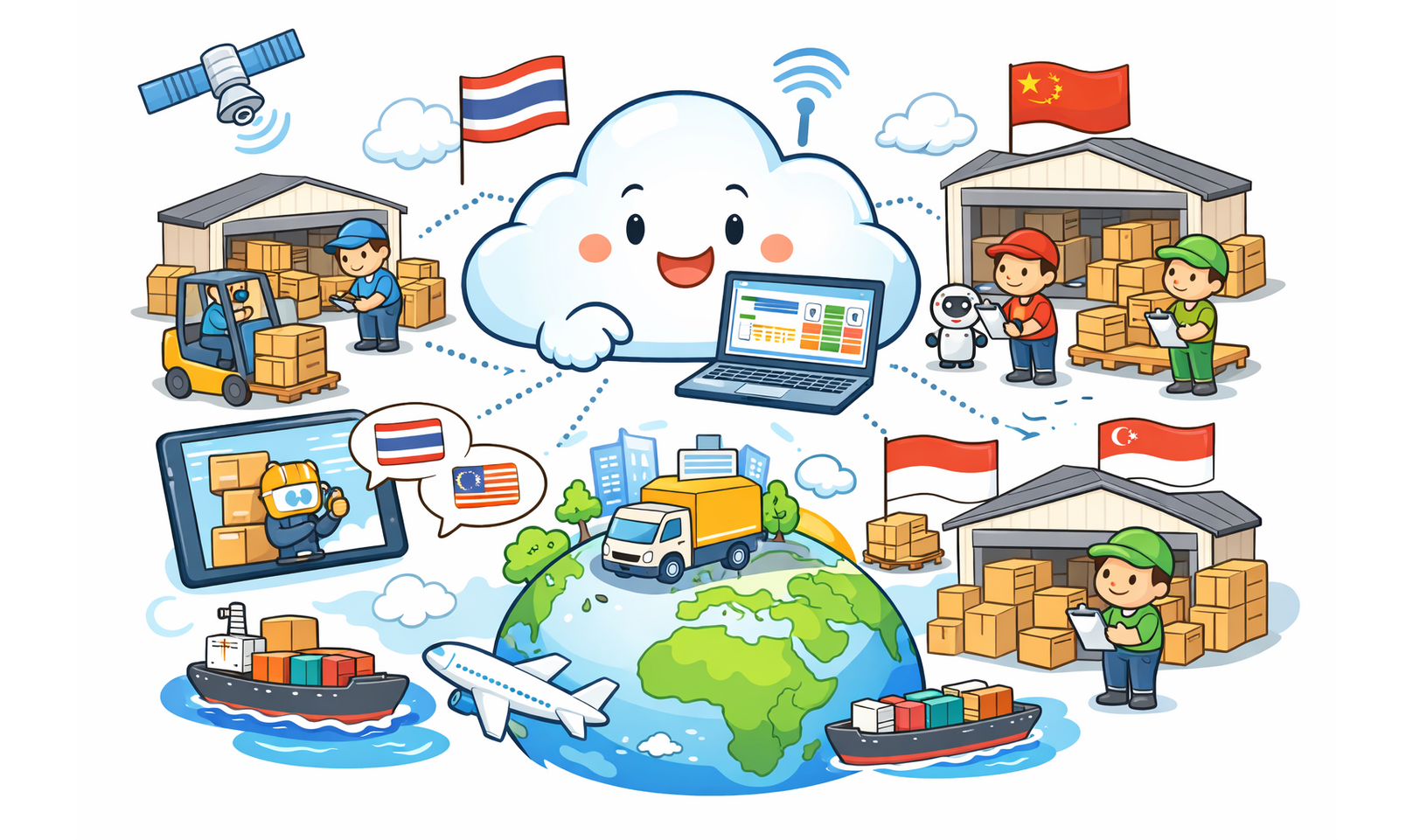
Expanding business operations overseas increases the complexity of warehouse management, especially in terms of language, IT infrastructure, and data control. Cloud-based WMS has therefore become a foundational system for managing multi-country warehouses in a structured way, without requiring on-premise servers at each location.
Cloud-based WMS is a warehouse management system that operates on the cloud, allowing users to access warehouse data from any country through a single platform. This concept is designed to reduce infrastructure complexity and enable overseas expansion without changing the core system architecture.
According to the ci.Himalayas/GLOBAL documentation, the WMS for international operations is developed on the same foundation as the domestic WMS, with added global capabilities to ensure all warehouses operate under the same standards. Key functions supporting this structure include:
• Multilingual interface within a single system
• Cloud (SaaS) architecture that reduces system maintenance requirements
• Centralized management of multiple warehouses (Multi-DC) and multiple consignors (Multi-consignor)
As a result, warehouses in different countries can operate cohesively, even when using different languages, while all data remains centrally connected and controlled.
The multilingual system is a critical component of Cloud-based WMS. ci.Himalayas/GLOBAL supports Thai, English, Chinese, and ASEAN languages. The core principle is to allow frontline staff to work in familiar languages while maintaining a unified data structure. This approach reduces errors caused by manual translation and simplifies training for new employees in each country.
Based on system development and implementation experience, businesses should consider Cloud-based WMS when they operate warehouses or factories in more than one country, employ multinational workforces within a single warehouse, or require real-time visibility of inventory and operational performance. A suitable system must be scalable, allowing additional warehouses without altering the core architecture.
A common use case is a company with headquarters in Thailand and warehouses across ASEAN countries. Management can view consolidated reports from the central office, local staff operate the system in their native languages, and inventory data is synchronized in real time. This aligns with the design concept of ci.Himalayas/GLOBAL, which emphasizes centralized control.
There are also common misconceptions about Cloud-based WMS, such as assumptions that cloud systems are difficult to use, require high investment, or are difficult to control. In practice, the system is designed based on real warehouse operations, helps reduce infrastructure costs, and allows role-based access control to manage user permissions effectively.
📘 Summary
Cloud-based WMS is a foundational system for managing warehouses in cross-border operations. It reduces language and IT complexity while supporting long-term expansion through centralized control.
ーーーーーーーーーーーーーーーーーーーーーーーーーーーーーーー
❓ FAQ
Q: What types of businesses are suitable for Cloud-based WMS?
A: Factories and distribution centers with overseas operations or multiple warehouses.
Q: Is a multilingual system necessary?
A: It is recommended when employing multinational staff to ensure standardized operations.
Q: How is the system maintained?
A: The system is provided as a cloud service with post-implementation support.
📚 Glossary
• Cloud-based WMS: A warehouse management system that operates on the cloud and enables multi-country data access
• Multilingual System: A system that supports multiple languages within a single platform
• Multi-DC: Centralized management of multiple distribution centers
• Multi-consignor: Support for multiple cargo owners within one system
📖 Reference
[1] ci.Himalayas/GLOBAL Proposal Ver.5.3 – C_Net Corporation (2025)
[2] [https://www.cnetthailand.com/](https://www.cnetthailand.com/)
🔗 Cluster Internal Link
• Core Content: https://prime.nc-net.com/106185/en/product_others/detail_service/2420
• Advance Knowledge: https://prime.nc-net.com/106185/en/product_others/detail_service/2575
#CloudWMS #WarehouseManagementSystem #WMS #CloudLogistics #GlobalWMS #DigitalWarehouse #ASEANLogistics #ChinaLogistics #WarehouseTechnology
📆 Updated: 2025-12-19
CATALOG
Related Catalogs
CONTACT
Inquiry