
SHOWA SOKKI CORPORATION
SERVICE
Production Goods & Services
5 Common Root Causes of Compressor Vibration | How to Diagnose with 1332B
Product Info
🌟 Key Takeaways
- Compressors fail faster when vibration exceeds acceptable limits.
- 1332B measures Acceleration, Velocity, and Displacement for accurate diagnostics.
- Five major vibration causes can be identified through vibration measurements.
- Velocity RMS supports health evaluation based on ISO10816 zones.
- Proper vibration checking reduces downtime and increases system safety.
ーーーーーーーーーーーーーーーーーーーーーーーーーーー
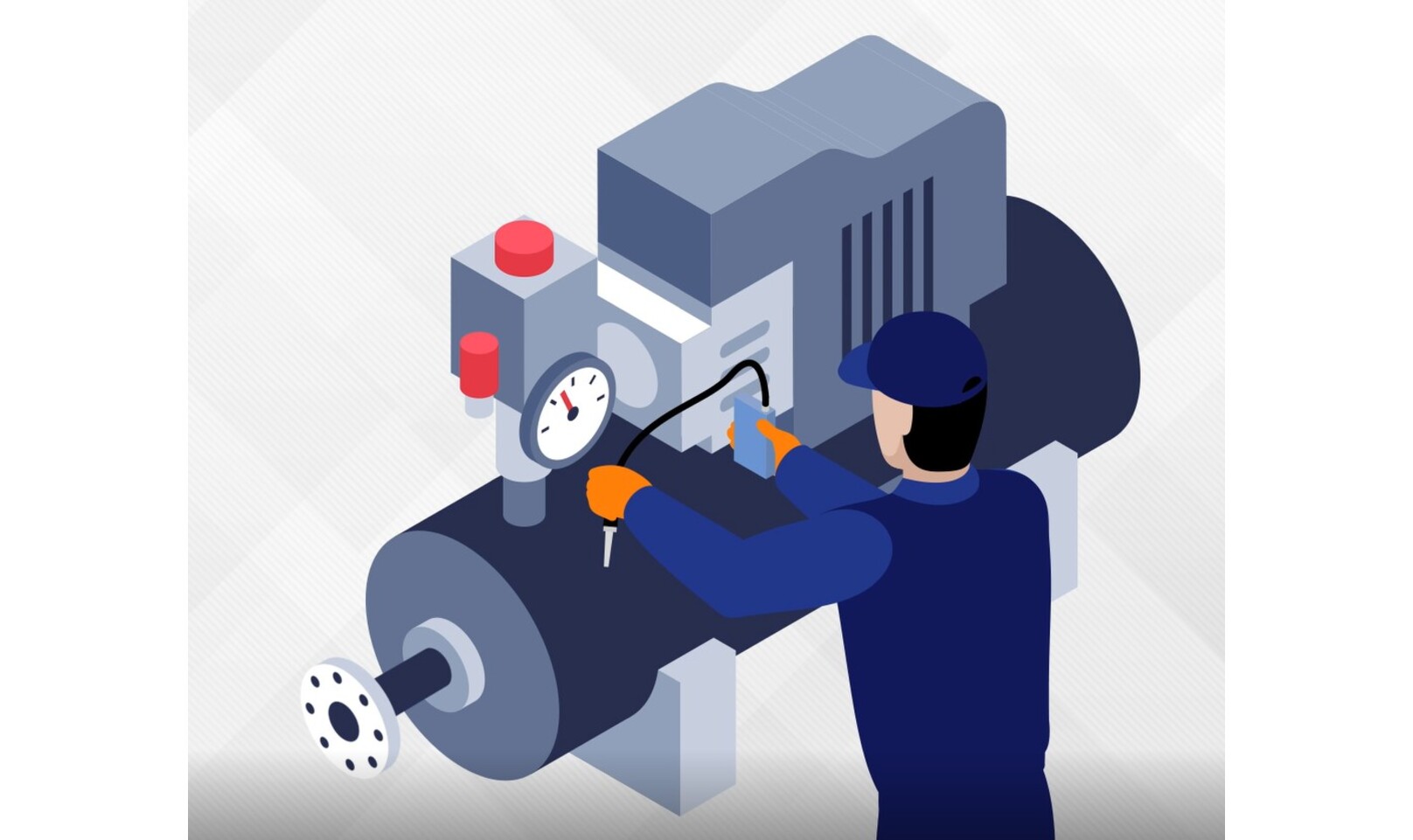
A compressor is a critical component in industrial air systems, but it is also one of the most failure-prone machines when abnormal vibration occurs. Understanding vibration sources and using appropriate diagnostic tools—such as the DIGI-VIBRO MODEL 1332B—enables early detection before failures escalate into unexpected shutdowns.
■ 1) Unbalance — Rotor or Impeller Mass Imbalance
Symptom: Velocity increases proportionally with machine speed.
How to detect:
- Set 1332B to Velocity (mm/s RMS)
- Measure on both motor and compressor sides
- A consistent increase with RPM strongly indicates unbalance
■ 2) Misalignment — Shaft Centerline Offset
Symptom: High vibration in the axial direction.
How to detect:
- Measure all 3 axes: Horizontal / Vertical / Axial
- Dominant axial vibration = clear misalignment signature
■ 3) Bearing Wear — Early Bearing Degradation or Surface Damage
Symptom: Shock-pulse-type vibration.
How to detect:
- Use Acceleration Peak mode to capture high-frequency impact signals
- Gradual increase over time = early failure or spalling progression
■ 4) Looseness — Loose Mounting or Base Structure
Symptom: Velocity values fluctuate abnormally.
How to detect:
- Measure at multiple points
- A significantly higher reading at one point often indicates structural looseness
■ 5) Resonance — Structural Natural Frequency Excitation
Symptom: Vibration peaks occur only at specific RPM ranges.
How to detect:
- Measure during ramp-up and ramp-down
- High vibration at certain speed bands suggests resonance
■ Insight Bridge
Understanding these five root causes and interpreting 1332B readings correctly allows users to build reliable routine-check standards and transition smoothly into predictive maintenance practices.
ーーーーーーーーーーーーーーーーーーーーーーーーーーーーーーー
📘 Summary
Using the 1332B for compressor vibration monitoring provides a simple, accurate method to prevent severe failures and reduce downtime.
📥 To deepen understanding of how measurement points influence diagnostic accuracy,
SHOWA SOKKI CORPORATION, expert in Vibration Measurement & Industrial Diagnostic Instruments, recommends reviewing the related Advance Knowledge article below.
🔗 Cluster Internal Link
- Core Content: https://prime.nc-net.com/105994/en/product_others/detail_goods/25249
- Advance Knowledge: https://prime.nc-net.com/105994/en/product_others/detail_goods/27621
ーーーーーーーーーーーーーーーーーー
❓ FAQ
Q: Which mode should I use for bearing inspection?
A: Use Acceleration Peak to detect high-frequency signals associated with bearing wear.
Q: What Velocity level indicates danger?
A: According to ISO10816, Zone C–D indicates risk and requires maintenance action.
ーーーーーーーーーーーーーーーーーー
📚 Glossary
- Velocity RMS: Root-mean-square vibration velocity value
- Acceleration Peak: Maximum acceleration used for high-frequency fault detection
- Unbalance: Uneven mass distribution on rotating components
- Misalignment: Shaft centerline deviation
- Resonance: Excessive vibration at a structure’s natural frequency
📖 References
1. MODEL 1332B Technical Catalogue – SHOWA SOKKI (N/A)
2. ISO10816-1 Mechanical Vibration Evaluation – External Standard (N/A)
🔒 Trust
This content has been reviewed by Mr. Satoshi Fukuda, Sales Department, SHOWA SOKKI CORPORATION, to ensure technical accuracy.
#Vibration #CompressorMaintenance #SHOWASOKKI #1332B #ISO10816
#PredictiveMaintenance #IndustrialEngineering #MachineHealth #PdM #FactoryReliability
📆 Updated: 2025-12-04
CATALOG
Related Catalogs
CONTACT
Inquiry