
SHOWA SOKKI CORPORATION
SERVICE
Production Goods & Services
Basics of Vibration Measurement and FFT Analysis
Product Info
Meta Description: Vibration measurement is essential for machine condition monitoring and structural diagnostics. This article explains how FFT analysis enables precise frequency-domain diagnostics and performance evaluation, starting from the fundamentals.
============================================
🔹 Table of Contents
1. What is Vibration Measurement?
2. Types and Characteristics of Vibration Sensors
3. The Role of FFT in Vibration Analysis
4. Steps and Precautions in FFT Analysis
5. Why Choose FFT Analyzers from Showa Sokki
============================================
1. What is Vibration Measurement?
Vibration measurement refers to the process of monitoring how an object moves over time. It is a critical technology for preventive maintenance, troubleshooting, and structural diagnostics across a wide range of equipment—such as motors, pumps, engines, and steel frameworks.
Detecting anomalies such as wear, imbalance, or deformation is possible by analyzing vibrations. Beyond just measuring the amplitude, identifying which frequencies are involved is crucial, as specific frequency patterns often indicate particular mechanical issues.
----------------------------------------------------------
2. Types and Characteristics of Vibration Sensors
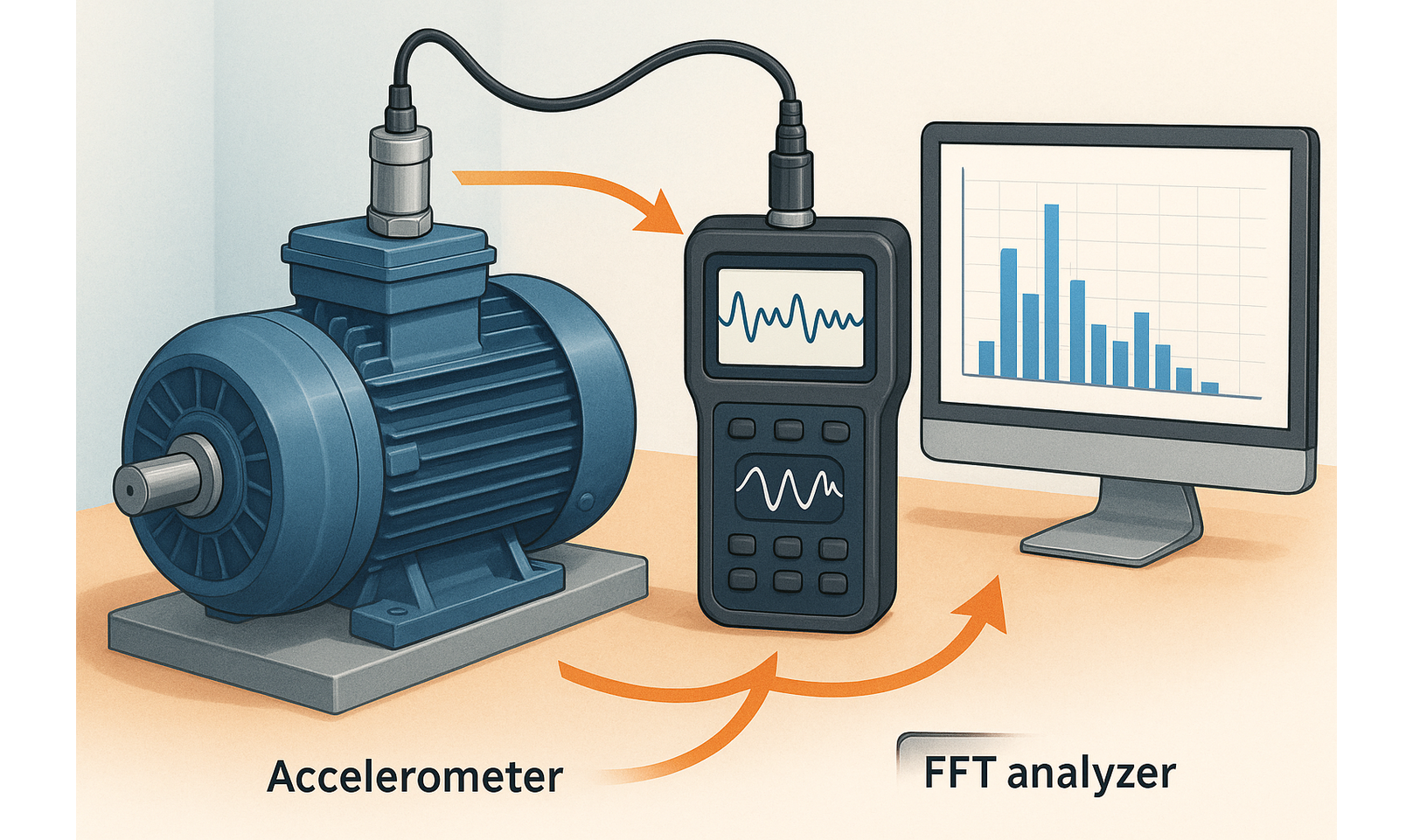
The core component of vibration measurement systems is the accelerometer, which converts mechanical motion into electrical signals for analysis. There are several types of accelerometers, each suited for different applications:
- Piezoelectric Accelerometers: Offer wide frequency response and high durability; ideal for industrial machinery.
- Capacitive Accelerometers: Suitable for detecting low-frequency and micro-vibrations.
- Servo Accelerometers: High precision for slow, long-period vibration detection.
Choosing the appropriate sensor type for the application is vital to ensuring accurate data acquisition.
----------------------------------------------------------
3. The Role of FFT in Vibration Analysis
While vibration signals are initially captured in the time domain, most fault signatures become clearer in the frequency domain. This is where FFT (Fast Fourier Transform) plays a crucial role—it transforms time-based data into frequency components.
For example:
- Imbalance in a rotating shaft shows up at the same frequency as the shaft’s RPM.
- Gear defects often manifest as harmonics.
- Bearing damage can appear at specific fault frequencies.
FFT analysis enables engineers to identify the source of the problem, not just its symptoms.
----------------------------------------------------------
4. Steps and Precautions in FFT Analysis
To perform FFT analysis effectively, consider the following steps and best practices:
1. Secure Sensor Mounting: Loose attachments introduce noise and reduce signal accuracy.
2. Proper Sampling Rate: Ensure the Nyquist frequency is high enough to cover the target frequency range.
3. Window Function Selection: Use functions like Hanning or Hamming to reduce spectral leakage.
4. Adequate Data Collection Time: Longer duration provides higher resolution in frequency analysis.
5. Apply Filtering and Averaging: Helps eliminate external noise and smooth the data.
Small oversights in these steps can significantly impact the quality of your FFT results.
----------------------------------------------------------
5. Why Choose FFT Analyzers from Showa Sokki
Showa Sokki Corporation is a trusted name in vibration measurement technology in Japan. Their FFT analyzers are designed with field usability and engineering precision in mind. Key features include:
- Compact, portable hardware for field use
- High compatibility with various sensor types
- Real-time FFT processing with precise output
- Intuitive software and GUI for ease of use
- Applicable across maintenance, diagnostics, and R&D
For anyone seeking a reliable, high-precision vibration analysis solution, Showa Sokki's FFT Analyzers offer a professional-grade option with proven performance.
For more details, please download the PDF or feel free to contact us directly.
CATALOG
Related Catalogs
CONTACT
Inquiry