
KEM (THAILAND) CO.,LTD.
SERVICE
Production Goods & Services
Selecting the Right Damper for OEM Applications | From Impact Control to Long-Term Stability
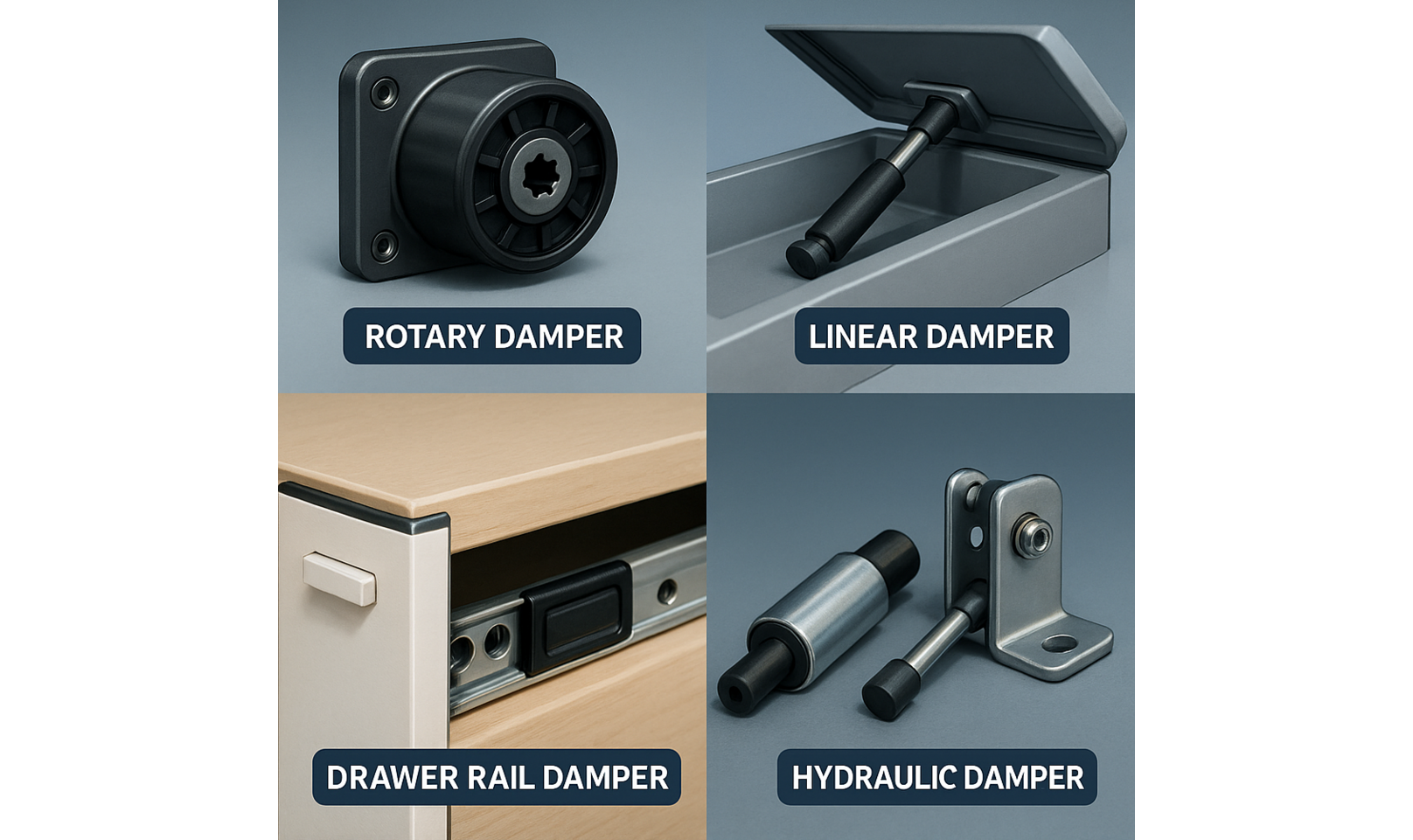
Product Info
🌟 Key Takeaways
• Damper selection is not just about “having one or not,” but about defining long-term product stability
• Improper damping force directly affects noise, user feel, and product lifespan
• A suitable damper must match real operating Load, Speed, and Cycle conditions
• Incorrect damper selection is a hidden cause of QA issues and warranty claims in OEM projects
ーーーーーーーーーーーーーーーーーーーーーーーーーーーーーーー
In many OEM projects, issues such as abnormal noise, drawer rebound, or hard lid closing often do not appear during the prototype phase. Instead, they become evident after a period of real-world use.
These problems are often misunderstood as component failure, but in reality, the root cause is usually damper selection that does not match actual operating conditions.
________________________________________
🔶 Common Problems Faced by OEMs
Under real usage conditions, user behavior often differs from laboratory assumptions. Differences in applied load, opening and closing speed, and usage frequency cause dampers that seemed suitable at the beginning to lose effectiveness over time.
________________________________________
🔶 From Impact to Long-Term Degradation
A typical problem chain in OEM applications is:
Component load → Motion speed → Improper damping force → Noise and wear
If the damping force is too low, motion ends with impact.
If the damping force is too high, users must apply excessive force, creating a stiff feel and increasing structural stress over time.
________________________________________
🔶 Key Principles for Damper Selection
Selecting a damper for OEM applications requires considering at least four core parameters together:
• Load (moving component weight)
Load directly determines the amount of energy that must be dissipated.
• Speed (opening and closing speed)
Real user behavior is often faster than controlled test conditions.
• Stroke / Angle (linear travel or rotational angle)
These affect the timing and effectiveness of end-of-motion damping.
• Cycle Life (number of operating cycles)
The damper must maintain stable damping force throughout its service life.
________________________________________
🔶 Trade-offs That Must Be Balanced
Damper selection is essentially a balance between:
• Smooth user feel
• Acoustic performance (noise reduction)
• Reliability and durability
Overemphasizing one aspect can unintentionally create problems in another.
For OEM applications, a suitable damper should be evaluated using real data, such as:
• Repeated open/close cycle testing over tens of thousands of cycles
• Damping force stability under actual operating temperatures
• Noise and impact evaluation under real usage conditions
These metrics reflect long-term stability more accurately than specification values alone [1][2].
________________________________________
📘 Summary
A properly selected damper does more than reduce impact today—it defines long-term stability, acoustic performance, and product lifespan.
System-level damper selection is a fundamental requirement for sustainable OEM design.
📥 CTA
For practical application, KEM (THAILAND) CO., LTD., with expertise in motion control, recommends reviewing the related Core Content or contacting the Regional Sales & Technical Support team to connect damper selection with system-level design.
🔗 Cluster Internal Link
• Core Content: https://prime.nc-net.com/96012/en/product/detail/262701
• Basic Knowledge: https://prime.nc-net.com/96012/en/product_others/detail_goods/27654
ーーーーーーーーーーーーーーーーーーーーーーーーーーーーーーー
❓ FAQ
• Q: Is selecting a damper based only on damping force sufficient?
A: No. Load, speed, and real user behavior must also be considered.
• Q: Is the softest damper always the best choice?
A: Not necessarily. A good damper balances user feel with long-term durability.
ーーーーーーーーーーーーーーーーーーーーーーーーーーーーーーー
📚 Glossary (Key Terms)
• Load: The weight of the component controlled by the damper
• Cycle Life: The number of cycles a damper must maintain stable damping performance
• Acoustic Performance: Noise behavior during operation
• Motion Control: Regulation of mechanical movement within a system
📖 Reference
• [1] QA Standard for Motion Control Components – Katoh Electrical Machinery Co., Ltd. (Japan) — Internal Validation
• [2] Engineering Test Report: Damper Selection & Reliability – KEM (THAILAND) CO., LTD. (2025) — Internal Validation
🔒 Trust
This content has been reviewed by the Sales / Engineering Coordination Team
from the Regional Sales & Technical Support Department,
KEM (THAILAND) CO., LTD., to ensure technical accuracy.
#DamperSelection #OEMDesign #MotionControl #SoftMotion
#QAEngineering #RotaryDamper #IndustrialDesign #Reliability
📆 Updated: 2025-12-12
CATALOG
Related Catalogs

CONTACT
Inquiry