
Bangkok Sanyo Spring Co., Ltd.
SERVICE
Production Goods & Services
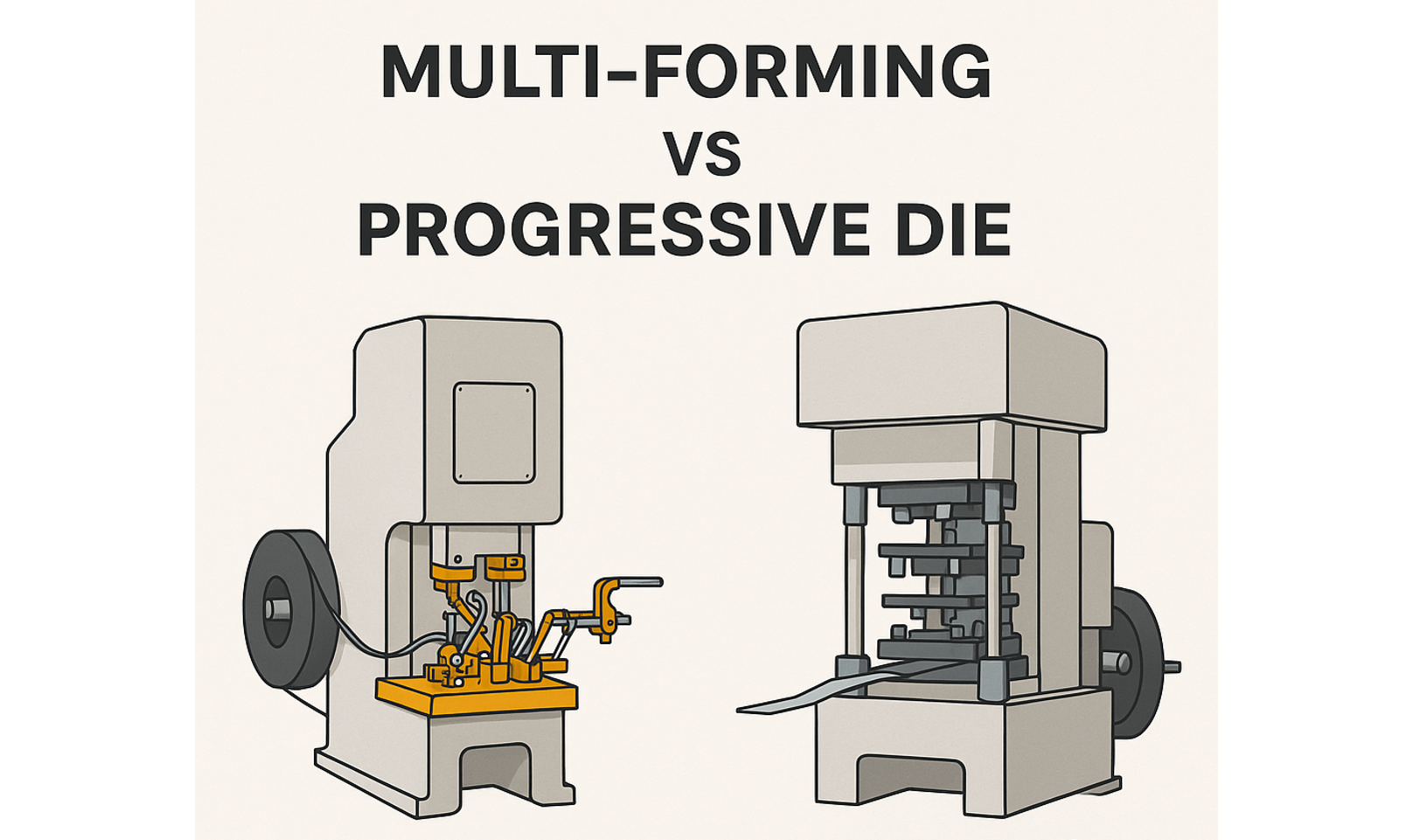
Multi-Forming vs. Progressive Die|Which Metal Forming Technology Is Right for Your Production?
Product Info
Choosing the right forming technology—Multi-Forming or Progressive Die—can significantly impact production cost, quality, and flexibility. Here’s how to make the best decision based on your part complexity, volume, and manufacturing goals.
1. Why Technology Choice Matters in Metal Forming
In metal component manufacturing, the chosen forming method affects not only cost but also production lead time, tooling flexibility, and quality. With evolving market demands, selecting the right technology can give your factory a critical edge.
2. Progressive Die: Best for High-Volume Runs
Progressive Die presses feed metal strips through sequential die stations for fast, repetitive production.
Advantages:
- Ideal for high-volume, repeatable production
- Low per-piece cost once tooling is set
- High-speed, consistent output
Limitations:
- High initial investment in die and press
- Requires significant floor space
- Low flexibility for design or product changes
3. Multi-Forming: Flexible and Precision-Friendly
Multi-Forming integrates multiple forming steps—cutting, bending, punching—in a single machine. It’s ideal for parts requiring high precision or shape complexity.
Advantages:
- Suitable for low to medium volumes
- Quick setup and easy product changes
- Less material waste
- Handles diverse materials: stainless steel, aluminum, copper, steel
Limitations:
- Slower than Progressive Dies for mass runs
- Not ideal for hundreds of thousands to millions of units per month
4. How to Choose the Right Technology
4.1 Production Volume
- Large, stable volumes: Progressive Die offers lowest cost per part
- Low to medium volumes or frequent design shifts: Multi-Forming provides better agility
4.2 Part Complexity
- Simple, flat parts: Progressive Die
- Complex bends or 3D shapes: Multi-Forming
4.3 Design Flexibility
- Multi-Forming excels in dynamic environments with high mix and fast design iterations
- Progressive Die suits long-term, single-design production
4.4 Investment and Budget
- Progressive Die requires significant upfront capital
- Multi-Forming allows phased investment and trial production
5. Which One Fits You Best?
- Choose Progressive Die if your part design is stable, volumes are high, and ROI justifies large tooling costs.
- Choose Multi-Forming if you need precision forming, work with various parts, and prioritize setup speed and cost control.
Modern manufacturers facing volatile demand and shorter product life cycles are increasingly turning to Multi-Forming as a flexible, future-ready solution.
6. Why Choose Multi-Forming from Bangkok Sanyo Spring?
- Supports 0.5–1.5 mm thick materials: steel, stainless, aluminum, copper
- In-house tooling reduces lead time and ensures consistent quality
- Perfect for complex parts like collars, spring plates, busbars
- Expert engineering team offers customized production consultation
Multi-Forming is more than a machine—it's a manufacturing strategy.
Learn more or download technical specs at
Bangkok Sanyo Spring Co., Ltd.
#MetalForming #ProgressiveDie #MultiFormingTechnology #PrecisionParts #ManufacturingStrategy #IndustrialAutomation #BangkokSanyoSpring #CostEffectiveProduction #FlexibleManufacturing
CONTACT
Inquiry