
HAKKAI PRECISION (THAILAND) CO., LTD.
SERVICE
Production Goods & Services
Differences and Appropriate Use of POM and PBT|Choosing the Best Material for Automotive Parts
Product Info
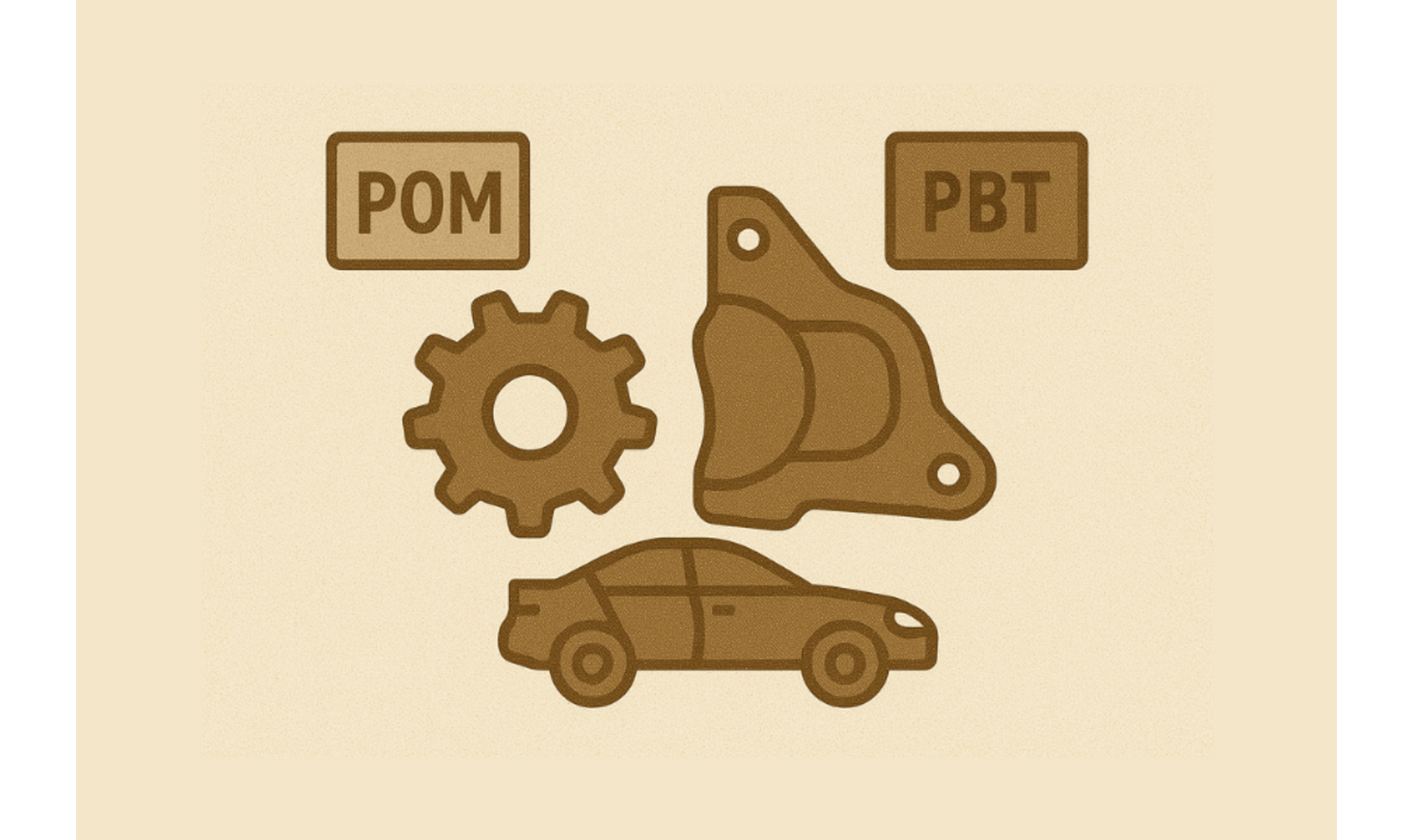
POM and PBT are both essential engineering plastics for automotive parts, each excelling in different areas—POM for wear-resistant, moving components, and PBT for heat-resistant electrical parts. Understanding their differences ensures optimal material selection for specific automotive applications.
1. Engineering Plastics for Automotive Applications
Automotive parts demand high heat resistance, dimensional stability, and mechanical strength. Two of the most common materials used are POM (Polyacetal, โพลีอะซีทัล) and PBT (Polybutylene Terephthalate, โพลีบิวทิลีนเทเรฟทาเลต).
POM offers high mechanical strength and low friction, making it ideal for sliding parts such as gears and actuators.
PBT, known for its electrical insulation and heat resistance, is frequently used in electrical components like sensor housings and wire connectors.
2. Mechanical Performance and Application Suitability
POM stands out for tensile strength and fatigue resistance—ideal for components under continuous motion. Its low friction coefficient contributes to silent, smooth operation, a key benefit in interior parts and mechanical linkages.
PBT delivers superior dimensional stability, even under high heat or humidity. It retains shape even with thin walls and complex molds, which makes it excellent for parts requiring precision and rigidity.
Key Selection Tip:
- Use POM when wear resistance and friction reduction are critical.
- Use PBT when thermal stability and structural rigidity are essential.
3. Heat, Chemical, and Electrical Performance Comparison
POM resists oils and alkalis, making it a strong choice for fuel system components. However, it may deform under high thermal conditions.
PBT handles sustained temperatures of 120–150°C and comes in flame-retardant variants certified under UL94 standards, which is crucial for vehicle safety compliance.
Thanks to its excellent insulation, PBT is advantageous for noise suppression and creepage resistance in ECUs and sensor modules.
4. Automotive Use Cases and Industry Trends
POM is often selected for:
- Power window gears
- Seat recliner systems
- Throttle valve mechanisms
PBT is prevalent in:
- Engine bay connectors
- Sensor casings
- Headlamp adjustment modules
EV Market Trend:
With the shift toward electric vehicles (EVs), PBT’s flame resistance and electrical properties are gaining prominence. Meanwhile, POM remains essential for high-strength and lightweight drivetrain elements.
#EngineeringPlastics #POM #PBT #AutomotiveParts #EVComponents #HeatResistantPlastics #PrecisionMolding #ElectricalInsulation #ThailandIndustry #OEM
CONTACT
Inquiry