
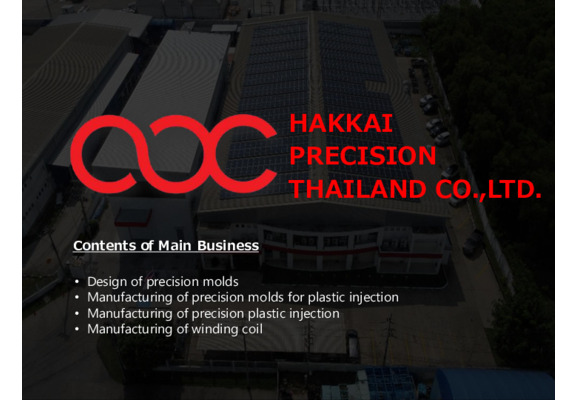
HAKKAI PRECISION (THAILAND) CO., LTD.
SERVICE
Production Goods & Services
Material Selection & Performance Optimization in Injection Molding|Engineering Best Practices

Product Info
Selecting the right resin and optimizing molding conditions are essential for consistent quality, performance, and cost-efficiency. This guide provides engineers with practical insights into resin properties, material modifications, and process control methods.
1. Importance of Material Choice
Injection molding relies on melting and injecting resin to create complex parts quickly. However, product durability, dimensional accuracy, and reliability heavily depend on resin properties. Choosing the appropriate material aligned with usage conditions ensures stable outputs, fewer defects, and better cost control.
2. Core Selection Criteria for Resins
Most injection molding applications use thermoplastics such as PP, PC, and ABS. Key properties to evaluate include:
- Mechanical strength (impact, tensile)
- Heat resistance (resistance to deformation and degradation)
- Dimensional stability (shrinkage, warpage control)
- Chemical resistance (solvents, oils)
- Appearance (transparency, gloss, dyeing)
For instance, automotive parts emphasize strength and heat resistance, while medical components demand chemical resistance and biocompatibility.
3. Additives and Resin Modification for Enhanced Performance
To enhance material performance, additives like glass or carbon fibers are used to increase rigidity, while flame retardants and UV stabilizers improve specific environmental resistance. Emerging resin formulations now offer tailored solutions—not just strength but also lightweight, functionality, and cost targets.
4. Matching Material Properties with Processing Conditions
Even after selecting optimal resin, improper processing settings can undermine performance. Mold parameters such as melt temperature, mold temperature, injection pressure, and hold time must be fine-tuned based on material characteristics.
Crystalline resins require controlled cooling as solidification speed influences dimensional accuracy. Advanced techniques like Bayesian adaptive DoE and deep reinforcement learning (DRL) now enable real-time process optimization by balancing quality and profit objectives. These technologies allow dynamic adjustment of settings to maintain consistent part quality across varying production conditions.
5. Best Practices Summary
Proper material selection and optimized processing reduce rejects, improve consistency, and extend part service life. Modern AI/ML‐driven optimization delivers both quality and profitability.
#InjectionMolding #MaterialSelection #ResinOptimization #SmartManufacturing #AIforMolding #InjectionControl #PartQuality #EngineeringPlastics #AdvancedResins #ProcessOptimization
CONTACT
Inquiry